
The most common orforglipron side effects in the phase 3 trials were digestive: nausea, vomiting, diarrhea, constipation and indigestion. The papers describe them as mostly mild to moderate and mainly occurring while the dose was being raised. In the four trials below, roughly 4% to 10% of people on orforglipron stopped treatment because of an adverse event, depending on the trial and dose, more than on placebo or oral semaglutide.
Mingo is a GLP-1 tracker app; this guide summarizes the prescribing information and published trials and is not medical advice.
Orforglipron is the active ingredient in Foundayo, Eli Lilly’s once-daily GLP-1 tablet. The FDA approved it on April 1, 2026, for weight reduction in adults with obesity, or with overweight and at least one weight-related condition (FDA news release). This page is the research view: what each published trial found, dose by dose, with the paper linked. For everyday questions, the label’s own side-effect table and what to do about nausea or constipation, see our Foundayo side effects guide.
How to read the doses in these trials
The trials gave orforglipron as an investigational capsule at 3, 6, 12 or 36 mg. Foundayo is a tablet with different strengths. A pharmacokinetic study found each capsule dose bioequivalent to a tablet dose: 3 mg to 2.5 mg, 6 mg to 5.5 mg, 12 mg to 9 mg and 36 mg to 17.2 mg (Ma et al., Diabetes, Obesity and Metabolism, 2026). The Foundayo label reports ATTAIN-1 and ATTAIN-2 the same way, as equivalent tablet doses (Foundayo prescribing information on DailyMed, section 6.1, Revised: 7/2026). Below, each dose appears as the papers report it, with the matching tablet in parentheses.
The orforglipron trial program at a glance
| Trial | Who took part | Orforglipron doses (tablet match) | Compared with | Length | Paper |
|---|---|---|---|---|---|
| ATTAIN-1 | 3,127 adults with obesity, or overweight plus a weight-related condition, without diabetes | 6, 12, 36 mg (5.5, 9, 17.2 mg) | Placebo | 72 weeks | NEJM, 2025 |
| ATTAIN-2 | 1,613 adults with a BMI of 27 or more and type 2 diabetes | 6, 12, 36 mg (5.5, 9, 17.2 mg) | Placebo | 72 weeks | Lancet, 2025 |
| ACHIEVE-1 | 559 adults with type 2 diabetes treated with diet and exercise only | 3, 12, 36 mg (2.5, 9, 17.2 mg) | Placebo | 40 weeks | NEJM, 2025 |
| ACHIEVE-3 | 1,698 adults with type 2 diabetes not controlled on metformin | 12, 36 mg (9, 17.2 mg) | Oral semaglutide 7 or 14 mg | 52 weeks | Lancet, 2026 |
Sources: the four papers linked in the table; ATTAIN-1 entry criteria from the Foundayo label, section 14.
In ATTAIN-1 and ACHIEVE-1, everyone on orforglipron started at 1 mg and stepped up every four weeks until they reached their assigned dose (Lilly, September 16, 2025; Lilly, June 21, 2025). ATTAIN-2 used the same four-week steps (Lilly Medical Information on ATTAIN-2).
Other published phase 3 trials include ACHIEVE-2 (against dapagliflozin), ACHIEVE-4 (cardiovascular safety against insulin glargine), ACHIEVE-5 (added to insulin glargine) and ATTAIN-MAINTAIN (keeping weight off after injectable treatment).
How common are orforglipron side effects in the trials?
The symptom percentages below are the results Lilly posted for each trial on ClinicalTrials.gov: everyone who took at least one dose, through the end of follow-up, events reported by at least 5% of a group (ACHIEVE-1 lists every event). Rates for stopping treatment come from the paper summaries, plus Lilly’s per-dose figures where a summary gives only a range. Lilly’s press releases sometimes show slightly different figures. Each trial had its own population, doses and length, so compare doses within a table, not across tables.
ATTAIN-1: adults with obesity, without diabetes
| Side effect | 6 mg (5.5 mg) | 12 mg (9 mg) | 36 mg (17.2 mg) | Placebo |
|---|---|---|---|---|
| Nausea | 28.9% | 35.9% | 33.7% | 10.4% |
| Constipation | 21.6% | 29.8% | 25.4% | 9.3% |
| Diarrhea | 21.0% | 22.8% | 23.1% | 9.6% |
| Vomiting | 13.0% | 21.4% | 24.0% | 3.5% |
| Indigestion | 13.1% | 16.2% | 14.1% | 5.0% |
| People in the group | 723 | 724 | 728 | 948 |
Source: ClinicalTrials.gov results, NCT05869903, adverse events up to week 74.
The paper reports that gastrointestinal effects were the most common adverse events with orforglipron and were mostly mild to moderate (Wharton et al., N Engl J Med, 2025). Stopping treatment because of an adverse event rose with dose: 5.3% on 6 mg, 7.9% on 12 mg and 10.3% on 36 mg, against 2.7% on placebo (Lilly’s release published with the paper; the paper’s summary gives the same range).
ATTAIN-2: adults with obesity and type 2 diabetes
| Side effect | 6 mg (5.5 mg) | 12 mg (9 mg) | 36 mg (17.2 mg) | Placebo |
|---|---|---|---|---|
| Nausea | 20.1% | 31.1% | 36.4% | 8.4% |
| Diarrhea | 21.3% | 24.8% | 27.4% | 15.0% |
| Constipation | 17.7% | 21.1% | 22.4% | 7.8% |
| Vomiting | 12.8% | 20.2% | 23.1% | 3.8% |
| Indigestion | 9.1% | 15.4% | 10.9% | 3.5% |
| Decreased appetite | 8.2% | 9.1% | 15.3% | 2.9% |
| People in the group | 328 | 331 | 321 | 628 |
Source: ClinicalTrials.gov results, NCT05872620, adverse events up to week 74.
The paper says the most common adverse events were mild-to-moderate gastrointestinal events, mainly during dose escalation. It reports that 6.1% to 9.9% of people on orforglipron stopped treatment because of adverse events, mostly gastrointestinal, against 4.1% on placebo (Horn et al., Lancet, 2025). Lilly’s medical information page, counting differently, lists 6.1% on 6 mg and 10.6% on both 12 mg and 36 mg, against 4.6% on placebo. Ten deaths were reported, six with orforglipron and four with placebo; the paper gives the investigators’ assessment of each.
ACHIEVE-1: early type 2 diabetes
| Side effect | 3 mg (2.5 mg) | 12 mg (9 mg) | 36 mg (17.2 mg) | Placebo |
|---|---|---|---|---|
| Diarrhea | 18.9% | 21.2% | 25.5% | 9.4% |
| Nausea | 12.6% | 19.0% | 17.0% | 2.2% |
| Indigestion | 11.9% | 21.2% | 15.6% | 7.2% |
| Constipation | 8.4% | 16.8% | 14.2% | 3.6% |
| Vomiting | 4.9% | 6.6% | 14.2% | 1.4% |
| People in the group | 143 | 137 | 141 | 138 |
Source: ClinicalTrials.gov results, NCT05971940, adverse events up to the end of safety follow-up (up to 42 weeks).
In the paper, the most common adverse events were mild-to-moderate gastrointestinal events, most of them during dose escalation, and no episodes of severe low blood sugar were reported. Between 4.4% and 7.8% of people on orforglipron stopped permanently because of adverse events, against 1.4% on placebo (Rosenstock et al., N Engl J Med, 2025). Lilly’s release with the paper rounded the split to 6% on 3 mg, 4% on 12 mg and 8% on 36 mg, so stopping rates did not rise neatly with dose in this trial.
What the trials have in common
- Every orforglipron dose had more nausea, vomiting, diarrhea and constipation than placebo.
- The papers describe the stomach side effects as mostly mild to moderate.
- Higher doses usually brought more, but for some symptoms the middle dose was higher than the top dose.
- The authors call the profile consistent with other GLP-1 receptor agonists (ATTAIN-1, ATTAIN-2).
When do orforglipron side effects start, and how long do they last?
The ATTAIN-2 and ACHIEVE-1 papers both place most stomach side effects in the dose-escalation period, while the dose is being stepped up. The Foundayo label says the same for the two obesity trials: nausea, vomiting and diarrhea were more common during dose escalation and decreased over time (section 6.1). The label also says the drug’s slowing of stomach emptying is largest after the first dose and diminishes over time (section 12.2).
Neither the paper summaries nor the label report how long an individual episode lasted, or how many weeks it took to settle after each step. The label ties stomach side effects to dosing in one more way: if 7 or more doses in a row are missed, it says to restart the escalation at a lower dose to reduce the risk of gastrointestinal side effects (section 2.3). Your prescriber decides how to restart.
Averages can’t show your own pattern, but a log can: rating symptoms daily and marking each dose change shows whether they cluster after a step up and how quickly they fade for you.
Is orforglipron better tolerated than oral semaglutide?
Not in the one head-to-head trial so far. ACHIEVE-3 randomized 1,698 adults with type 2 diabetes on metformin, at 131 sites in Argentina, China, Japan, Mexico and the US, to orforglipron or oral semaglutide for 52 weeks (Rosenstock et al., Lancet, 2026). Lilly described it in June 2026 as the first and only head-to-head phase 3 trial of two oral GLP-1 medicines in type 2 diabetes (Lilly, June 8, 2026).
| Orforglipron 12 mg (9 mg) | Orforglipron 36 mg (17.2 mg) | Oral semaglutide 7 mg | Oral semaglutide 14 mg | |
|---|---|---|---|---|
| Any gastrointestinal event | 59% | 58% | 37% | 45% |
| Nausea | 26.4% | 27.4% | 13.1% | 21.2% |
| Diarrhea | 21.7% | 23.4% | 13.1% | 18.1% |
| Vomiting | 17.0% | 16.5% | 7.7% | 10.4% |
| Constipation | 13.2% | 13.0% | 7.7% | 8.9% |
| Stopped because of an adverse event | 8.7% | 9.7% | 4.5% | 4.9% |
| Average rise in pulse | 3.7 bpm | 4.7 bpm | 1.0 bpm | 1.5 bpm |
| People in the group | 424 | 423 | 426 | 425 |
Sources: any gastrointestinal event, stopping and pulse from the Lancet paper; individual symptoms from ClinicalTrials.gov results, NCT06045221.
On the trial’s main goal, blood sugar, orforglipron did better: from a starting average of 8.3%, HbA1c fell by 1.71 and 1.91 points on orforglipron 12 and 36 mg, against 1.23 and 1.47 points on semaglutide 7 and 14 mg. Four people died during the study: one in each orforglipron group and two on semaglutide 7 mg. The authors conclude that gastrointestinal events, stopping for adverse events and the rise in pulse were all higher with orforglipron than with oral semaglutide.
Three caveats. The trial was open-label, so participants and investigators knew which drug was given. The semaglutide doses, 7 and 14 mg, are Rybelsus doses for type 2 diabetes (Rybelsus label, section 3, Revised: 1/2026), not the 25 mg Wegovy pill for weight management (Wegovy label, section 3, Revised: 06/2026). And everyone had type 2 diabetes, so the results may not carry over to people taking orforglipron for weight alone.
Comparisons with the Wegovy pill so far are indirect, combining separate trials, and each was sponsored by one of the two makers. A Novo Nordisk analysis estimated more stopping for adverse events with orforglipron 36 mg (Michalak et al., 2026); Lilly announced one favoring Foundayo on weight and HbA1c in type 2 diabetes (Lilly, September 29, 2026). Neither replaces a head-to-head trial. Our oral Wegovy side effects guide covers that pill’s label.
What a non-peptide GLP-1 pill means
Semaglutide is a peptide (Rybelsus label, section 11). Its tablets contain SNAC to help absorption, which happens mainly in the stomach (section 12.3), and are taken on an empty stomach with up to 4 ounces of water, at least 30 minutes before eating (section 2.1).
Orforglipron is a small, non-peptide molecule that activates the same GLP-1 receptor (ATTAIN-1 paper). That changes a few practical things, according to the Foundayo label (Revised: 7/2026):
- Food. It can be taken with or without food (section 2.1), and no clinically relevant food effect was seen (section 12.3).
- Half-life. Its elimination half-life is about 29 to 49 hours, and steady drug levels are reached after about a week of daily doses (section 12.3). Semaglutide’s half-life is about one week (Rybelsus label, section 10).
- Drug interactions. It is broken down mainly by the liver enzyme CYP3A4 (section 12.3). Strong CYP3A4 blockers raise orforglipron levels, which may increase side effects, so the label caps the dose at 9 mg with them and says to avoid those that also block OATP1B, such as ritonavir (sections 2.2 and 7.1). Tell your prescriber about every medicine and supplement you take.
- The thyroid warning. GLP-1 medicines that are active in rats and mice have caused thyroid C-cell tumors in them. Orforglipron is not active in rodents and did not produce tumors in them. The label still carries the boxed warning, says the human relevance of the rodent findings has not been determined, and rules the drug out for anyone with a personal or family history of medullary thyroid carcinoma or with MEN 2.
What doesn’t change is the side-effect pattern, led by stomach effects as with other GLP-1 medicines.
Does orforglipron affect the liver?
A pooled analysis of seven phase 3 trials, covering 11,220 participants followed for up to 104 weeks, found no case of drug-induced liver injury with orforglipron. Liver enzymes (ALT and AST) fell on average, and liver-related adverse events were balanced between orforglipron and the comparison groups (Wharton et al., Diabetes, Obesity and Metabolism, 2026). Lilly sponsored the trials, and several authors are Lilly employees.
The Foundayo label has no liver warning in section 5. It does not recommend the drug for people with severe liver impairment (section 8.6), and the Medication Guide asks you to tell your healthcare provider if you have severe liver problems.
Serious side effects and when to get help
The Foundayo label (Revised: 7/2026) has a boxed warning about thyroid C-cell tumors, and its section 5 warns about acute pancreatitis, severe gastrointestinal reactions, kidney injury from dehydration, low blood sugar (especially with insulin or a sulfonylurea), serious allergic reactions, worsening diabetic eye disease in people with type 2 diabetes, gallbladder disease, and food entering the lungs during anesthesia or deep sedation. The Foundayo guide explains each one.
From the Foundayo Medication Guide:
- Stop taking it and call your healthcare provider right away if you have severe pain in your stomach area that won’t go away, with or without nausea or vomiting, sometimes reaching your back. This can be pancreatitis.
- Stop taking it and get medical help right away for signs of a serious allergic reaction: swelling of your face, lips, tongue or throat, problems breathing or swallowing, severe rash or itching, fainting or feeling dizzy, or a very rapid heartbeat.
- Tell your healthcare provider right away about nausea, vomiting or diarrhea that won’t go away, which can lead to dehydration and kidney problems, and about pain in your upper stomach, fever, yellowing of your skin or eyes, or clay-colored stools, which can be gallbladder problems.
- Tell your healthcare provider about a lump or swelling in your neck, hoarseness, trouble swallowing or shortness of breath, and, if you have type 2 diabetes, any change in your vision.
- If you take too much, call your healthcare provider or Poison Help at 1-800-222-1222, or go to the nearest emergency room.
Where is orforglipron approved?
- United States. The FDA approved Foundayo on April 1, 2026, for weight reduction and long-term maintenance, 50 days after filing, under its National Priority Voucher pilot program (FDA). The label revised in July 2026 lists weight management only. Lilly said on June 8, 2026, that it planned to submit Foundayo for type 2 diabetes to the FDA by the end of the second quarter.
- United Kingdom. The MHRA authorized Foundayo on August 10, 2026, for weight management and type 2 diabetes. It said the tablet was not yet available on the NHS and that decisions on NHS use would follow a NICE evaluation (MHRA).
- European Union. The EMA’s committee for human medicines (CHMP) gave a positive opinion on October 15, 2026, for weight management and type 2 diabetes. The European Commission makes the final decision, and the EMA page did not show one when we checked on October 31, 2026.
- Japan and Canada. A July 2026 review reported submissions in Japan for weight management and in Canada for type 2 diabetes (Shirley, Drugs, 2026).
If you are taking Foundayo now
If you have a prescription, the Foundayo side effects guide covers the label’s own numbers, handling nausea, constipation and reflux, birth control pills and surgery. For pills versus injections, see weight loss pills and GLP-1 injections; for the whole class, our GLP-1 side effects guide.
Keeping a side-effect log in Mingo
The trials can’t show how long side effects last for you. Mingo, our app, can. You log each Foundayo tablet with its dose and notes, and get a reminder when a dose is due, an optional heads-up before, and a nudge 2 hours later if it isn’t logged. You can rate 18 built-in symptoms on a 0 to 10 slider, including nausea, constipation, diarrhea, stomach pain, bloating, heartburn and sulfur burps, and add your own, such as vomiting.
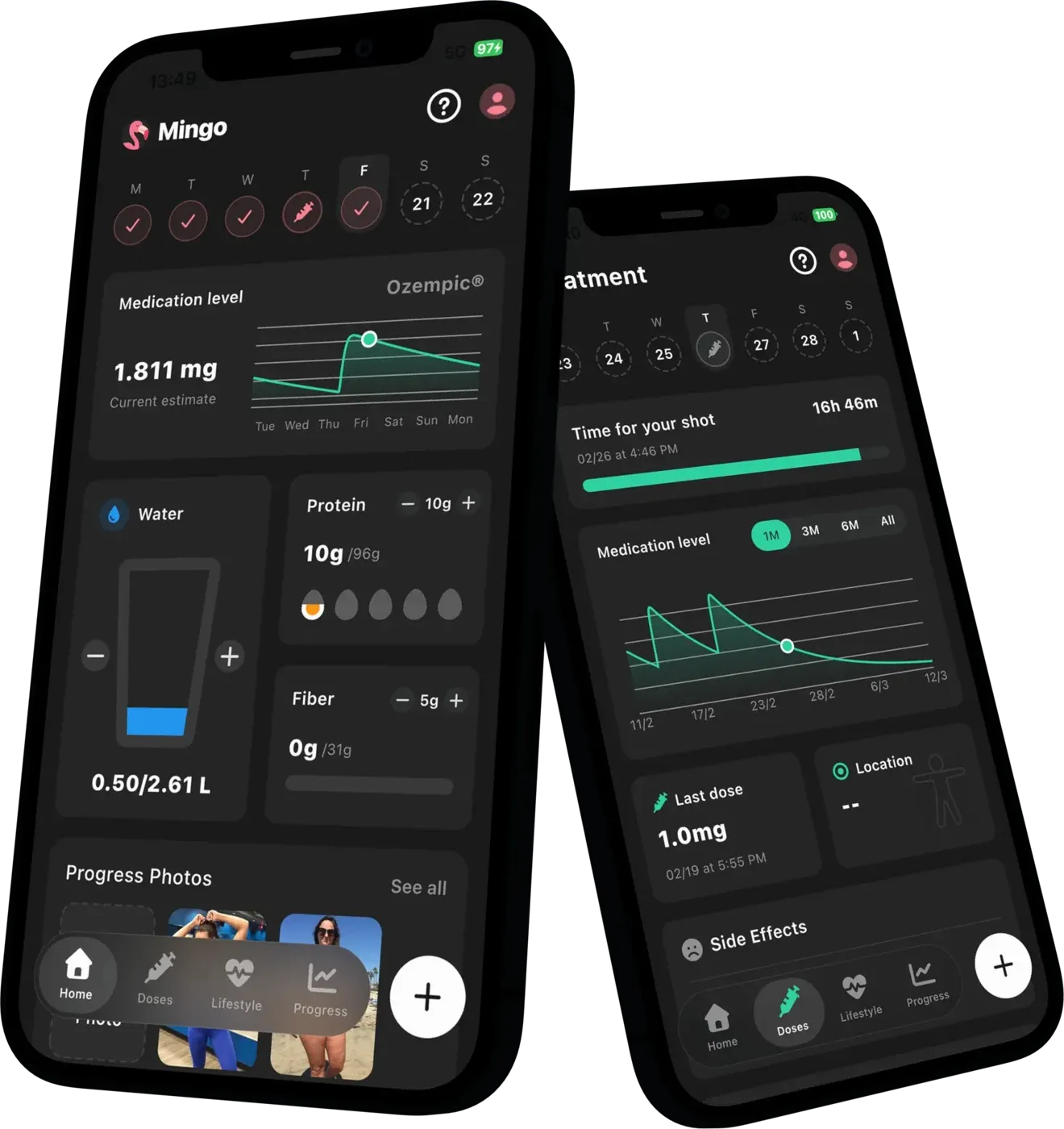
Your weight chart is colored by the dose you were on, with a marker at each new dose. You can also log meals by photo, voice, text or barcode, with daily protein, fiber and water targets. Meal photos, voice notes and descriptions are sent to Mingo’s server to estimate nutrients; the log itself stays on your phone, with no account.
For appointments, Mingo makes a PDF report of your doses, weight, food and side effects for any period. Mingo Pro is needed to keep logging new entries after the first ones; reminders and the PDF report stay free.
Sources
- Foundayo prescribing information and Medication Guide, Eli Lilly, Revised: 7/2026 (DailyMed).
- ATTAIN-1: Wharton S, et al. N Engl J Med. 2025;393(18):1796-1806 (PubMed).
- ATTAIN-2: Horn DB, et al. Lancet. 2025;406(10522):2927-2944 (PubMed).
- ACHIEVE-1: Rosenstock J, et al. N Engl J Med. 2025;393(11):1065-1076 (PubMed).
- ACHIEVE-3: Rosenstock J, et al. Lancet. 2026;407(10534):1147-1160 (PubMed).
- Results on ClinicalTrials.gov: NCT05869903, NCT05872620, NCT05971940, NCT06045221.
- Tablet and capsule bioequivalence: Ma X, et al. Diabetes Obes Metab. 2026;28(7):5803-5809 (PubMed).
- Liver safety: Wharton S, et al. Diabetes Obes Metab. 2026;28(9):8347-8358 (PubMed).
- Indirect comparison: Michalak W, et al. Diabetes Obes Metab. 2026;28(8):7247-7256 (PubMed).
- Approval review: Shirley M. Drugs. 2026;86(10):1735-1745 (PubMed).
- Eli Lilly releases of June 21, 2025, September 16, 2025, June 8, 2026 and September 29, 2026; Lilly Medical Information on ATTAIN-2.
- Regulators: FDA, April 1, 2026; MHRA, August 10, 2026; EMA, October 15, 2026.
- Rybelsus (Revised: 1/2026) and Wegovy (Revised: 06/2026) prescribing information.
Frequently asked questions
Is orforglipron the same drug as Foundayo?
Yes. Foundayo is Eli Lilly's brand name for orforglipron tablets, and the UK and EU regulators use the same name. The phase 3 trials gave orforglipron as an investigational capsule, and the US label reports those results as the matching Foundayo tablet doses.
Why are the trial doses different from Foundayo's doses?
Because the trials used a capsule and Foundayo is a tablet. A study in people with overweight or obesity matched each capsule dose to a tablet strength that produces equivalent drug levels, so the highest trial dose corresponds to Foundayo's maximum dose. The full pairing is listed near the top of this guide.
Are orforglipron side effects worse at higher doses?
Usually, but not neatly. In the two obesity trials, the lowest dose had fewer stomach side effects than the two higher doses, while the middle and highest doses were often close, and for some symptoms the middle dose was higher. The label's slow step-up schedule is there to reduce stomach side effects, so ask your prescriber before changing how you take it.
Does orforglipron cause low blood sugar?
It can. No severe episodes were reported in ACHIEVE-1, a trial of people with early type 2 diabetes treated with diet and exercise only. The Foundayo label says the risk is higher when it is combined with insulin or a sulfonylurea, and that low blood sugar has also been seen in adults without type 2 diabetes. Warning signs include shakiness, sweating, dizziness, confusion, hunger and a fast heartbeat.
Has orforglipron been tested against the Wegovy pill?
Not head to head, as far as we could find by October 31, 2026. The one head-to-head trial, ACHIEVE-3, used oral semaglutide at type 2 diabetes doses. Comparisons with the Wegovy pill's weight-management dose so far are indirect analyses that combine separate trials, so they can't settle which pill is better tolerated.


