
The most common tirzepatide side effects are digestive: nausea, diarrhea, vomiting, constipation, indigestion and stomach pain. Both prescribing labels say most nausea, vomiting and diarrhea happened while the dose was being raised and decreased over time. Rates were higher in Zepbound’s obesity trials than in Mounjaro’s diabetes trials, so the numbers you see depend on which label you read.
Mingo is a GLP-1 tracker app; this guide summarizes the prescribing information and published trials and is not medical advice.
Tirzepatide is one molecule sold by Lilly under two brand names. Mounjaro is approved for type 2 diabetes in adults and in children 10 and older, and to lower the risk of heart attack, stroke or cardiovascular death in adults with type 2 diabetes at high risk of those events. Zepbound is approved, with a reduced-calorie diet and more physical activity, to reduce excess weight and keep it off in adults with obesity, or overweight plus a weight-related condition, and to treat moderate to severe obstructive sleep apnea in adults with obesity. It activates two hormone receptors, GIP and GLP-1. For how the weekly shot works, see our tirzepatide weekly injection guide.
What are the most common tirzepatide side effects?
Each label reports side effects from two placebo-controlled trials at doses of 5, 10 and 15 mg. The Mounjaro prescribing information uses SURPASS-1 and SURPASS-5, two trials in adults with type 2 diabetes. The Zepbound prescribing information uses two 72-week weight-reduction trials in adults with obesity or overweight, which the label calls Study 1 and Study 2 and which were run as SURMOUNT-1 and SURMOUNT-2.
The table shows the percent of people who reported each side effect at least once. Mounjaro: Table 1 and section 6.1 of the label revised 8/2026 (placebo 235 people, 5 mg 237, 10 mg 240, 15 mg 241). Zepbound: Table 1 of the label revised 8/2026 (placebo 958 people, 5 mg 630, 10 mg 948, 15 mg 941).
| Side effect | Mounjaro placebo | Mounjaro 5 mg | Mounjaro 10 mg | Mounjaro 15 mg | Zepbound placebo | Zepbound 5 mg | Zepbound 10 mg | Zepbound 15 mg |
|---|---|---|---|---|---|---|---|---|
| Nausea | 4% | 12% | 15% | 18% | 8% | 25% | 29% | 28% |
| Diarrhea | 9% | 12% | 13% | 17% | 8% | 19% | 21% | 23% |
| Vomiting | 2% | 5% | 5% | 9% | 2% | 8% | 11% | 13% |
| Constipation | 1% | 6% | 6% | 7% | 5% | 17% | 14% | 11% |
| Indigestion (dyspepsia) | 3% | 8% | 8% | 5% | 4% | 9% | 9% | 10% |
| Abdominal pain | 4% | 6% | 5% | 5% | 5% | 9% | 9% | 10% |
| Decreased appetite | 1% | 5% | 10% | 11% | n/a | n/a | n/a | n/a |
| Belching (eructation) | 0.4%* | 3.0%* | 2.5%* | 3.3%* | 1% | 4% | 5% | 5% |
| Reflux (GERD) | 0.4%* | 1.7%* | 2.5%* | 1.7%* | 2% | 4% | 4% | 5% |
| Gas (flatulence) | 0%* | 1.3%* | 2.5%* | 2.9%* | 2% | 3% | 3% | 4% |
| Bloating (abdominal distension) | 0.4%* | 0.4%* | 2.9%* | 0.8%* | 2% | 3% | 3% | 4% |
| Injection-site reactions | n/a | n/a | n/a | n/a | 2% | 6% | 8% | 8% |
| Fatigue | n/a | n/a | n/a | n/a | 3% | 5% | 6% | 7% |
| Allergic (hypersensitivity) reactions | n/a | n/a | n/a | n/a | 3% | 5% | 5% | 5% |
| Hair loss | n/a | n/a | n/a | n/a | 1% | 5% | 4% | 5% |
| Dizziness | n/a | n/a | n/a | n/a | 2% | 4% | 5% | 4% |
| Low blood pressure (hypotension) | n/a | n/a | n/a | n/a | 0% | 1% | 1% | 2% |
How to read it:
- n/a: the label gives no by-dose figure. Each Table 1 lists side effects more common than on placebo, starting at 5% of people on the drug for Mounjaro (low blood sugar excluded) and 2% for Zepbound.
- * These Mounjaro figures come from the digestive side-effects paragraph in section 6.1, not from its Table 1.
- Several Zepbound rows group related terms. Diarrhea includes frequent bowel movements, abdominal pain combines five terms, fatigue includes weakness, lethargy and malaise, and injection-site reactions include bruising, redness, itching, pain and rash at the site.
- Mounjaro’s label gives two more figures for all doses together: injection-site reactions in 3.2% of people on Mounjaro versus 0.4% on placebo, and hypersensitivity reactions (for example hives and eczema) in 3.2% versus 1.7%. Zepbound’s label says most allergic reactions in its trials were skin reactions such as rash and itching.
Why does Zepbound show more side effects than Mounjaro?
Same molecule, same doses, yet most rows are higher in Zepbound’s columns. Neither label explains the gap, and both warn that trials run under widely varying conditions, so their rates can’t be directly compared and may not match real-world use. The labels do show how the two sets of trials differ:
- Different people. In Mounjaro’s pool, everyone had type 2 diabetes (for 9.1 years on average); the mean age was 58 and 54% were men. In Zepbound’s pool, the mean age was 47, 37% were men, the average BMI was 37.4 and 25% had type 2 diabetes.
- Different lengths. Mounjaro’s pool had a mean of 36.6 weeks on the drug. Zepbound’s trials treated people for up to 72 weeks. A longer trial leaves more time for a first report.
- Different table rules. Mounjaro’s table starts at 5%, Zepbound’s at 2%, and Zepbound’s groups related terms.
- Different placebo groups. Digestive side effects of any kind were reported by 20.4% of the placebo group in Mounjaro’s pool, against 37.1%, 39.6% and 43.6% at 5, 10 and 15 mg. In Zepbound’s pool they were reported by 30% on placebo and by 56% at each dose. Even without the drug, people in the obesity trials reported more digestive symptoms, which points to differences between the trials and the people in them, not only to the medicine.
Mounjaro’s own label shows how much the setting matters. In SURPASS-CVOT, which compared Mounjaro with dulaglutide (another GLP-1 medicine) in adults with type 2 diabetes and heart or blood-vessel disease over a median of 210.1 weeks, the 6,647 people exposed to Mounjaro had side effects similar to the pooled trials, except for decreased appetite (17%), constipation (13%), vomiting (12%), abdominal pain (10%), fatigue (10%) and dysesthesia, an abnormal skin sensation (0.7%).
So the column whose trial looks most like you is the better guide, and your own pattern matters most.
How long do tirzepatide side effects last?
The labels describe timing in general terms only:
- Both labels say the majority of nausea, vomiting and diarrhea reports happened during dose escalation and decreased over time.
- Zepbound’s label says most people who stopped the drug because of side effects did so during the first few months, because of digestive side effects.
- Stopping because of digestive side effects was uncommon. In Mounjaro’s pool it happened to 3.0%, 5.4% and 6.6% of people at 5, 10 and 15 mg, versus 0.4% on placebo. In Zepbound’s pool it happened to 1.9%, 3.3% and 4.3%, versus 0.5% on placebo.
Neither label reports how many days or weeks a side effect lasts for one person. To see your own pattern, log how you feel after each shot and dose change, and bring that record to your appointments. Both Medication Guides ask you to talk to your healthcare provider about any side effect that bothers you or does not go away.
Does tirzepatide cause more side effects than semaglutide?
Comparing labels can’t answer this, because the trials differ. One trial can: SURMOUNT-5 (Aronne and colleagues, New England Journal of Medicine, 2025) gave the two drugs head to head. It was an open-label phase 3b trial in 751 adults with obesity but without type 2 diabetes, randomized to the maximum tolerated weekly dose of tirzepatide (10 or 15 mg) or semaglutide (1.7 or 2.4 mg) for 72 weeks. It was funded by Lilly, which makes tirzepatide.
The table shows the percent of participants with each adverse event over 72 weeks, among the 374 people who received tirzepatide and the 376 who received semaglutide. The numbers come from the results Lilly posted on ClinicalTrials.gov: adverse events reported by at least 5% of either group, plus serious adverse events, with percentages calculated from the posted counts. We could not access the full paper, so they are not taken from its tables; the paper’s abstract gives no adverse-event rates.
| Adverse event | Tirzepatide | Semaglutide |
|---|---|---|
| Nausea | 43.6% | 44.4% |
| Constipation | 27.0% | 28.5% |
| Diarrhea | 23.5% | 23.4% |
| Vomiting | 15.0% | 21.3% |
| Fatigue | 10.4% | 12.2% |
| Belching | 9.9% | 7.7% |
| Injection-site reaction | 8.6% | 0.3% |
| Hair loss (alopecia) | 8.3% | 6.1% |
| Bloating (abdominal distension) | 7.2% | 6.4% |
| Abdominal pain | 6.4% | 6.9% |
| Reflux (GERD) | 6.1% | 10.6% |
| Indigestion (dyspepsia) | 5.9% | 7.4% |
| Any serious adverse event | 4.8% | 3.5% |
What it shows:
- Nausea, constipation and diarrhea were about as common with either drug.
- Vomiting and reflux were less common with tirzepatide. Injection-site reactions, belching and hair loss were more common.
- The paper’s abstract reports that the most common adverse events in both groups were digestive, mostly mild to moderate, and happened mainly during dose escalation.
Read it with its limits. The trial was open-label, so participants knew which drug they were taking. It counted adverse events of any cause and had no placebo group, so these rates are not comparable with the label tables above. It enrolled people without diabetes, at the highest dose each person tolerated. And its primary end point was weight, not side effects: weight changed by -20.2% with tirzepatide and -13.7% with semaglutide at week 72. For semaglutide’s own labels, see our semaglutide side effects guide.
Is compounded tirzepatide FDA-approved?
No. The FDA says compounded drugs are not FDA-approved, which means the agency does not review them for safety, effectiveness or quality before they are marketed (page updated 10/1/2026). The side-effect rates in this guide come from trials of the approved products.
What changed in December 2024, per the FDA’s compounding policy page (updated 4/1/2026):
- Tirzepatide injection had been in shortage since 2022 because of increased demand. The FDA declared the shortage resolved on October 2, 2024; during a lawsuit that decision went back to the agency for reevaluation.
- On December 19, 2024, the FDA issued a new decision that the shortage is resolved.
- When a shortage ends, the FDA generally considers the drug commercially available, and federal law restricts compounding copies of commercially available or FDA-approved drugs.
- The FDA gave compounders time to wind down: until February 18, 2025 for state-licensed pharmacies (section 503A) and March 19, 2025 for outsourcing facilities (section 503B). After a court ruling on March 5, 2025, the FDA said the pharmacy period had ended.
- As of the page’s latest update, tirzepatide is not on the FDA’s drug shortage list.
On safety, the FDA says that as of May 31, 2026 it had received more than 730 reports of adverse events associated with compounded tirzepatide, likely an undercount because state-licensed pharmacies are not required to report them. It can’t always tell whether the drug caused an event, and many look like those of the approved versions. Some reports may be related to compounded doses beyond the approved label (more per dose, more often or faster increases); some were serious, with nausea, vomiting, diarrhea, abdominal pain and constipation. The FDA encourages patients to ask their healthcare provider or compounder how to measure and give the intended dose.
Serious side effects and when to get help
Both labels carry a boxed warning: tirzepatide caused thyroid C-cell tumors in rats, and it is unknown whether it causes them, including medullary thyroid carcinoma (MTC), in people. It must not be used by anyone with a personal or family history of MTC or with Multiple Endocrine Neoplasia syndrome type 2 (MEN 2).
The Warnings and Precautions (section 5) of both labels also cover:
- Severe digestive reactions. In the placebo-controlled trials: Mounjaro 1.3%, 0.4% and 1.2% at 5, 10 and 15 mg versus 0.9% on placebo; Zepbound 1.7%, 2.5% and 3.1% versus 1%. Neither drug is recommended for people with severe gastroparesis. Reports after approval include ileus, intestinal obstruction and severe constipation, including fecal impaction.
- Kidney injury from dehydration, sometimes needing dialysis, mostly after fluid loss from nausea, vomiting or diarrhea.
- Gallbladder disease. In Mounjaro’s placebo-controlled trials, 0.6% of people on the drug and 0% on placebo. In Zepbound’s pool, inflammation of the gallbladder (cholecystitis) affected 0.7% versus 0.2%; the label links gallbladder events to weight reduction.
- Pancreatitis. Acute pancreatitis, including fatal cases, has been seen with tirzepatide and GLP-1 medicines.
- Serious allergic reactions, including anaphylaxis and angioedema.
- Low blood sugar, more likely with insulin or a sulfonylurea.
- Diabetic eye disease. Temporary worsening has been reported with rapid improvement in blood sugar; people with a history of diabetic retinopathy should be monitored.
- Food or liquid getting into the lungs during anesthesia or deep sedation, because tirzepatide slows stomach emptying. Tell every provider you take it before any procedure.
- Never share a KwikPen, even with a new needle.
From the Medication Guides, stop the medicine and get medical help right away if you have signs of a serious allergic reaction: swelling of your face, lips, tongue or throat; problems breathing or swallowing; severe rash or itching; fainting or feeling dizzy; or a very rapid heartbeat.
Stop and call your healthcare provider right away if you have severe pain in your stomach area that will not go away, with or without nausea or vomiting. You may feel the pain from your abdomen to your back.
Tell your healthcare provider right away about pain in your upper stomach, fever, yellow skin or eyes, or clay-colored stools (possible gallbladder problems), and about nausea, vomiting or diarrhea that does not go away.
Tell your healthcare provider about a lump or swelling in your neck, hoarseness, trouble swallowing or shortness of breath; changes in vision; and stomach problems that are severe or will not go away.
If you take too much, call your healthcare provider or Poison Help at 1-800-222-1222, or go to the nearest emergency room. You can report side effects to the FDA at 1-800-FDA-1088.
Easing the common side effects
These tips come from the Medication Guides and a Cleveland Clinic article on managing GLP-1 side effects (September 2026). Any medicine for symptoms is your prescriber’s call.
- Drink fluids. The Medication Guides say drinking fluids helps reduce the chance of dehydration from diarrhea, nausea or vomiting. Cleveland Clinic suggests sipping water through the day.
- Eat smaller meals, slowly. Cleveland Clinic advises smaller meals than before, slowing down (your brain can take up to 30 minutes to register fullness) and limiting high-fat foods like pizza and fried chicken.
- For nausea, Cleveland Clinic suggests ginger or peppermint tea, staying upright for 30 minutes after eating, and asking your provider about anti-nausea medicine to keep on hand.
- For diarrhea, it suggests fluids with electrolytes, soft and bland foods, and limiting caffeine, alcohol and dairy drinks.
- For constipation, it suggests drinking water, walking, and asking your provider about over-the-counter options.
- Rotate injection sites every week, as the Medication Guides instruct.
Side-effect guides by brand
Mounjaro. Its numbers come from diabetes trials, and its label adds points that matter with diabetes: low blood sugar when combined with insulin or a sulfonylurea, diabetic eye disease, and a trial in children 10 and older that had more vomiting, abdominal pain and low blood sugar than the adult trials. Read the full Mounjaro side effects guide, or see how Mingo tracks it on the Mounjaro tracker page.
Zepbound. Its numbers come from obesity trials, and its label lists side effects Mounjaro’s table doesn’t. Hair loss was linked to weight reduction and was reported by 7.1% of women versus 0.5% of men on the drug. Low blood pressure affected 1.6% of people on Zepbound versus 0.1% on placebo, and among people on Zepbound it was more frequent in those also taking blood-pressure medicine (2.2%) than in those who weren’t (1.2%). In two sleep apnea trials (SURMOUNT-OSA, 467 adults), side effects at 10 or 15 mg were similar to the weight-reduction trials. Read the full Zepbound side effects guide, or see the Zepbound tracker page.
For every GLP-1 medicine side by side, see the GLP-1 side effects hub.
Keeping a side-effect log in Mingo
Mingo is our app, a GLP-1 tracker that works with Mounjaro, Zepbound and compounded tirzepatide, as well as semaglutide medicines, Foundayo and retatrutide (for trial participants). Since neither label says how long a side effect lasts for any one person, a daily log is how you see your own pattern. More on how it handles tirzepatide is on the tirzepatide tracker page.
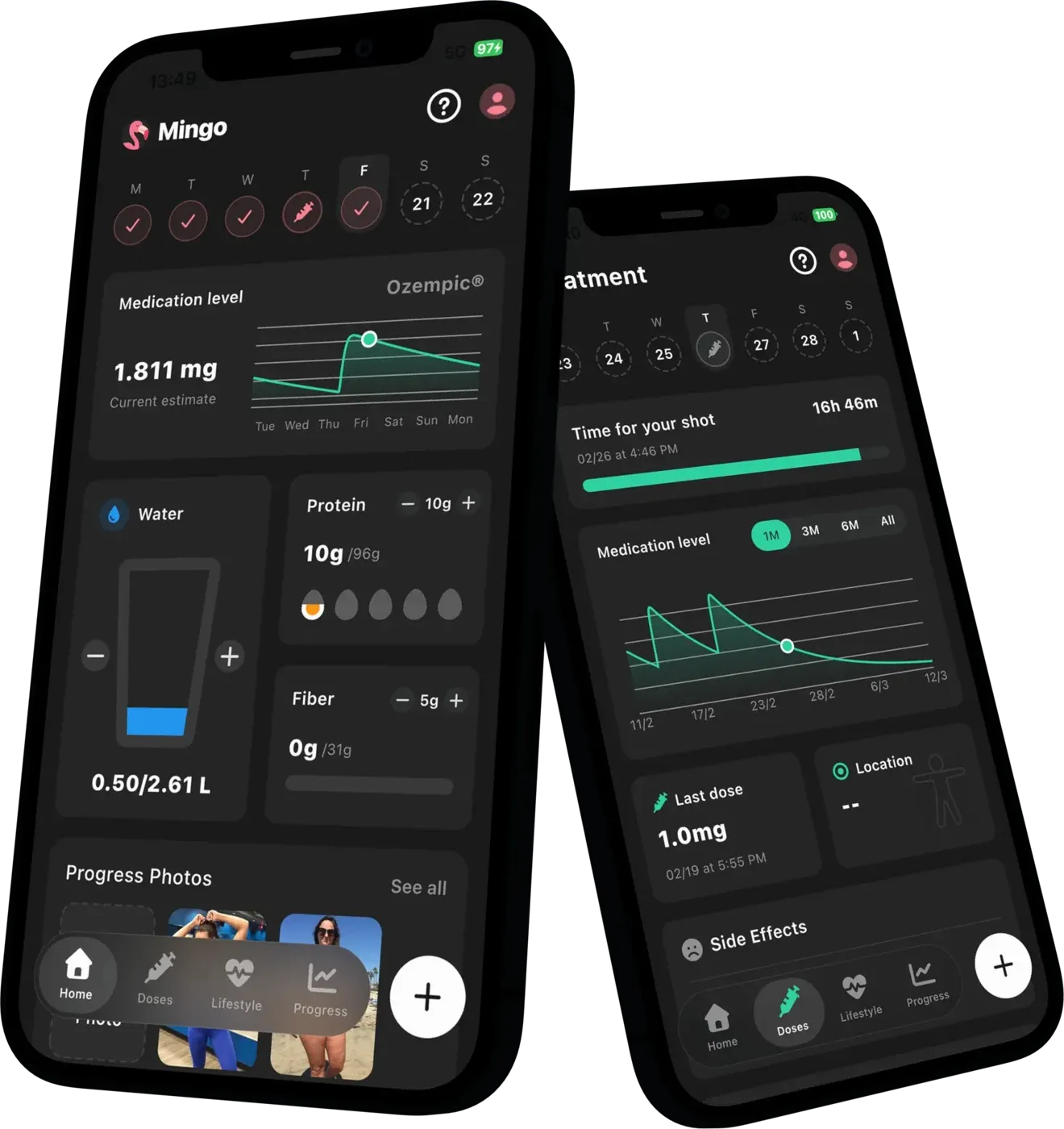
- Rate symptoms from 0 to 10. Mingo has 18 built-in symptoms, including nausea, constipation, diarrhea, stomach pain, bloating, heartburn, sulfur burps, fatigue, hair loss and injection-site reaction. Vomiting isn’t built in: add vomiting as your own symptom.
- See symptoms against your medication level. Each symptom can be charted against an estimated medication level, calculated from the doses you log and a half-life model. It’s an estimate, not a blood test.
- Log every shot. Record the dose, the injection site on a 12-site body map (with optional left/right alternation) and notes. Reminders come on dose day, with an optional heads-up before and a nudge 2 hours later if the dose isn’t logged.
- Spot dose changes. The weight chart is colored by the dose you were on, with a marker at each new dose.
- Log meals by photo, voice, text or barcode, with daily protein, fiber and water targets. Photos, voice notes and descriptions are sent to Mingo’s server to estimate nutrients; the log itself stays on your phone, with no account.
- Bring a PDF report of doses, estimated levels, weight, food and side effects for any period to your appointment.
Mingo Pro is required to log new entries after the first ones. Reminders, the medication-level chart and the PDF report stay free.
Sources
- Mounjaro prescribing information and Medication Guide, revised 8/2026. DailyMed.
- Zepbound prescribing information and Medication Guide, revised 8/2026. DailyMed.
- Aronne LJ, et al. Tirzepatide as compared with semaglutide for the treatment of obesity. N Engl J Med. 2025;393(1):26-36.
- SURMOUNT-5 results, NCT05822830. ClinicalTrials.gov. Source of the SURMOUNT-5 adverse-event table.
- FDA clarifies policies for compounders as national GLP-1 supply begins to stabilize. U.S. Food and Drug Administration, updated 4/1/2026.
- FDA’s concerns with unapproved GLP-1 drugs used for weight loss. U.S. Food and Drug Administration, updated 10/1/2026.
- How to manage the digestive side effects of GLP-1 medications. Cleveland Clinic, September 2026.
Frequently asked questions
What is the most common side effect of tirzepatide?
Nausea tops the side-effect tables in both the Mounjaro and Zepbound labels, with diarrhea close behind. Other common ones include vomiting, constipation, indigestion and stomach pain. Rates were higher in Zepbound's obesity trials than in Mounjaro's diabetes trials.
Are Mounjaro and Zepbound side effects the same?
They contain the same medicine, tirzepatide, and their labels carry the same boxed warning and almost the same list of serious risks. The rates differ because each label reports different trials, in different people, for different lengths of time. Zepbound's label also lists hair loss, dizziness and low blood pressure among its common side effects.
Do tirzepatide side effects go away?
Both labels say most nausea, vomiting and diarrhea happened while the dose was being raised and decreased over time. Neither label says how many days or weeks that takes for one person. The Medication Guides ask you to talk to your healthcare provider about any side effect that bothers you or does not go away.
Does tirzepatide cause hair loss?
Zepbound's label lists hair loss among its common side effects, links it to weight reduction and reports it more often in women than in men. Mounjaro's label lists alopecia (hair loss) among the reports received after approval. If you notice it, mention it to your prescriber.
Is compounded tirzepatide the same as Mounjaro or Zepbound?
No. The FDA says compounded drugs are not FDA-approved and are not reviewed for safety, effectiveness or quality before they are marketed. The FDA has received adverse event reports linked to compounded tirzepatide, including some that may be related to doses beyond the approved label.
Can I take tirzepatide with semaglutide or another GLP-1?
The Zepbound label says using it with other tirzepatide-containing products or with any GLP-1 receptor agonist is not recommended. Tell every prescriber which medicines you take, and ask before combining or switching.


