
How is Mounjaro started and increased?
Mounjaro starts at 2.5 mg once a week. If more blood-sugar control is needed, the dose goes up in 2.5 mg steps, each after at least four weeks on the current dose, to a maximum of 15 mg in adults and 10 mg in children (Mounjaro prescribing information):
| Dose | Earliest move to the next step |
|---|---|
| 2.5 mg | After 4 weeks |
| 5 mg | After 4 weeks |
| 7.5 mg | After 4 weeks |
| 10 mg | After 4 weeks |
| 12.5 mg | After 4 weeks |
| 15 mg | Maximum dose |
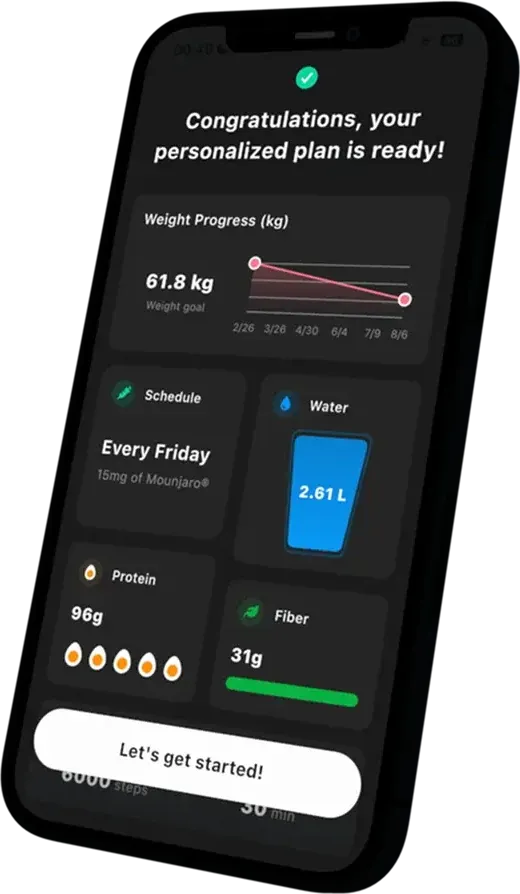
Since August 2026 the US label also allows 2.5 mg as an ongoing dose for blood-sugar control, not only as a starting dose. Not everyone climbs to 15 mg; many people stay on a lower dose that works for them. With six possible steps, the most useful thing to have at an appointment is a clear record of when each one started and how you felt on it, which is what Mingo’s weight chart shows: one color per dose, with a marker at each change.
What is Mounjaro approved for?
It depends on where you live. In the US, Mounjaro is approved for type 2 diabetes in adults and in children 10 and older, and since August 2026 for lowering the risk of heart attack, stroke and cardiovascular death in adults with type 2 diabetes at high risk (Mounjaro prescribing information). The US weight-management version of tirzepatide is sold as Zepbound.
In the UK and the European Union, Mounjaro is also authorised for weight management in adults with a BMI of 30 or more, or 27 to under 30 with at least one weight-related health problem (EMA product information; MHRA). That’s why many people outside the US log Mounjaro for weight loss.
In SURPASS-2, adults with type 2 diabetes on tirzepatide 5, 10 or 15 mg had larger drops in HbA1c and body weight after 40 weeks than those on semaglutide 1 mg: weight fell by 7.6, 9.3 and 11.2 kg on average, against 5.7 kg (Frías et al., NEJM 2021; figures from the Mounjaro label). Our Mounjaro vs Ozempic guide compares the two.
Which Mounjaro side effects should you track?
Side effects were more common at higher doses in the placebo-controlled type 2 diabetes trials (Mounjaro prescribing information, adverse reactions table):
| Side effect | Placebo | 5 mg | 10 mg | 15 mg |
|---|---|---|---|---|
| Nausea | 4% | 12% | 15% | 18% |
| Diarrhea | 9% | 12% | 13% | 17% |
| Decreased appetite | 1% | 5% | 10% | 11% |
| Vomiting | 2% | 5% | 5% | 9% |
| Constipation | 1% | 6% | 6% | 7% |
| Indigestion | 3% | 8% | 8% | 5% |
Because they rise with the dose, the week after each step-up is the one to watch. A 0 to 10 rating each day, plus a note of what you ate, shows whether a symptom fades after a few days or sticks. Mounjaro also carries a boxed warning about thyroid C-cell tumors seen in rodents and must not be used with a personal or family history of medullary thyroid carcinoma or MEN 2. If you use birth control pills, the label advises switching to a non-oral method, or adding a barrier method, for 4 weeks after starting and after each dose increase, because tirzepatide can make the pill less effective. Our Mounjaro guide covers the warning signs that need a call to your prescriber.
For the full list by dose, the warnings and when to call your prescriber, see our Mounjaro side effects guide.
What if you miss a Mounjaro dose?
If it’s been four days (96 hours) or less since the missed day, take it as soon as you can. If it’s been longer, skip it and take the next dose on your usual day. You can change your shot day if the two doses are at least three days (72 hours) apart (Mounjaro prescribing information). Mingo’s reminder and its two-hour nudge help you notice a missed shot early, inside that window.
Pens, KwikPens and vials
Mounjaro comes in single-dose pens and vials, and in a KwikPen or multi-dose vial that holds four weekly doses. Single-dose pens and vials can be kept out of the refrigerator, up to 30 °C (86 °F), for a total of 21 days. A KwikPen or multi-dose vial is discarded 30 days after first use or after four doses, whichever comes first (Mounjaro prescribing information). Mingo logs the dose in milligrams whatever the device; it doesn’t count the doses left, so note the date you opened a KwikPen in the shot’s notes.
What Mingo doesn’t do
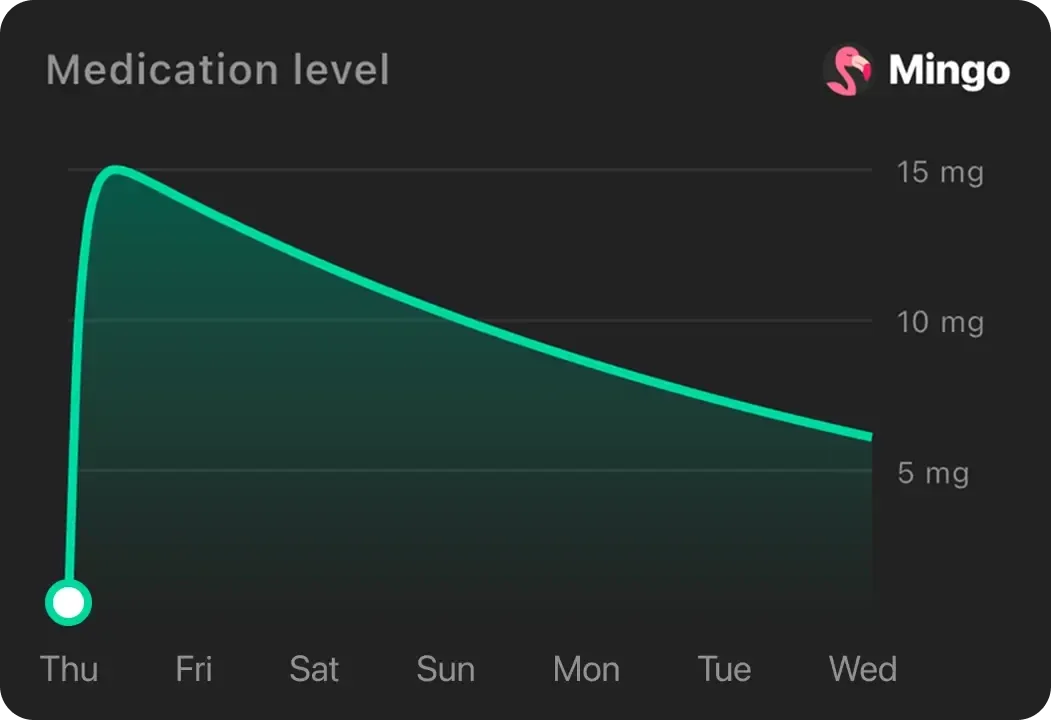
Mingo doesn’t decide when you move up a dose, and it doesn’t measure the medicine in your body: the level curve is calculated from what you log. It doesn’t track blood sugar either. It keeps the record of doses, symptoms, food and weight that you and your prescriber use to make those decisions.


