
The most common Ozempic side effects are nausea, vomiting, diarrhea, stomach pain and constipation. In the label’s type 2 diabetes trials, most reports of nausea, vomiting and diarrhea came while the dose was being raised. The label’s boxed warning is about thyroid tumors seen in rodents. Call your prescriber about severe stomach pain that won’t go away, changes in vision, or vomiting or diarrhea that doesn’t stop.
Mingo is a GLP-1 tracker app; this guide summarizes the prescribing information and published trials and is not medical advice.
Ozempic is approved for adults with type 2 diabetes, so every rate in its label was measured in people with diabetes, mostly at 0.5 mg and 1 mg. The label starts at 0.25 mg once a week for 4 weeks, then 0.5 mg, with 1 mg and 2 mg as later steps. Your prescriber decides when, or whether, you move up. For the side effects all GLP-1 medicines share, see our GLP-1 side effects guide.
How common are Ozempic side effects at each dose?
The table comes from section 6.1 of the Ozempic prescribing information (revised 5/2026). It pools 2 placebo-controlled trials in adults with type 2 diabetes, one of Ozempic alone and one of Ozempic added to basal insulin, where 521 people took Ozempic for 32.9 weeks on average. The first five rows are the label’s Table 1: reactions seen in at least 5% of people on Ozempic and more often than on placebo. The other rows come from the text of the same section, for the same trials.
| Side effect | Placebo (N=262) | Ozempic 0.5 mg (N=260) | Ozempic 1 mg (N=261) |
|---|---|---|---|
| Nausea | 6.1% | 15.8% | 20.3% |
| Vomiting | 2.3% | 5% | 9.2% |
| Diarrhea | 1.9% | 8.5% | 8.8% |
| Abdominal pain | 4.6% | 7.3% | 5.7% |
| Constipation | 1.5% | 5% | 3.1% |
| Any gastrointestinal reaction | 15.3% | 32.7% | 36.4% |
| Stopped Ozempic because of a gastrointestinal reaction | 0.4% | 3.1% | 3.8% |
| Indigestion (dyspepsia) | 1.9% | 3.5% | 2.7% |
| Burping (eructation) | 0% | 2.7% | 1.1% |
| Gas (flatulence) | 0.8% | 0.4% | 1.5% |
| Reflux (GERD) | 0% | 1.9% | 1.5% |
| Gastritis | 0.8% | 0.8% | 0.4% |
Nausea was the most common reaction at both doses, and nausea and vomiting were more frequent at 1 mg. Abdominal pain and constipation went the other way: both were reported more often at 0.5 mg. The label has no column for 0.25 mg, the starting dose. It adds that in a larger pool of 7 trials, with 3,150 people on Ozempic, and in the 2-year heart outcomes trial, the types and frequency of common reactions were similar.
What changes at 2 mg?
The 2 mg dose was tested against 1 mg in one 40-week trial, SUSTAIN FORTE, in adults with type 2 diabetes already taking metformin, some with a sulfonylurea as well. The Ozempic label reports gastrointestinal reactions in 34% of people on 2 mg and 30.8% on 1 mg, and no new safety signals among the 959 people treated. These people differed from those in the table, so compare the two doses inside this trial only.
Other changes the label reports
In the placebo-controlled trials, Ozempic 0.5 mg and 1 mg raised heart rate by 2 to 3 beats per minute on average, while on placebo it fell by 0.3. The pancreatic enzymes amylase and lipase rose by 13% and 22% on average from baseline, changes not seen on placebo. Those are blood-test values.
When do Ozempic side effects start, and how long do they last?
The label gives one timing fact: the majority of reports of nausea, vomiting and diarrhea occurred during dose escalation, the weeks when the dose is being stepped up. That is why the dose starts low: section 2.2 says to follow the escalation schedule to reduce the risk of gastrointestinal reactions. Cleveland Clinic says the same of GLP-1 medicines in general: side effects are more likely when you start or move to a higher dose.
What the label doesn’t report is how long each side effect lasts, or how symptoms change across the days after a shot. The way to see your own pattern is to note how you feel after each injection and each dose change, and bring that record to your appointments. Our guide to how long Ozempic takes to work covers the same weeks from the other side.
For context, section 12.3 puts semaglutide’s half-life at about 1 week, with a steady level reached after 4 to 5 weeks of weekly shots at the same dose. The label doesn’t tie these numbers to side effects.
How can you manage nausea, constipation, diarrhea and reflux on Ozempic?
These tips don’t replace your prescriber’s advice, and none involves changing or skipping a dose on your own. They come from the Ozempic Medication Guide, the US National Institute of Diabetes and Digestive and Kidney Diseases (NIDDK), and a multidisciplinary expert consensus on gastrointestinal side effects of GLP-1 medicines published in December 2022 (its Table 2, guidelines for patients).
Nausea and vomiting
The expert consensus suggests eating slowly, eating smaller portions and stopping when you feel full. It also suggests low-fat, easy-to-digest foods, not lying down after a meal and avoiding strong smells. If you’re vomiting, it puts hydration first, with smaller amounts of food in more frequent meals. The Medication Guide says it’s important to drink fluids to lower your chance of dehydration, because the fluid lost through nausea, vomiting and diarrhea may cause kidney problems.
Constipation
NIDDK’s constipation advice is to eat more high-fiber foods, drink plenty of water and other liquids when you eat more fiber, and get regular physical activity. A laxative is something your health care professional may recommend for a short time, so ask first. Section 6.2 of the label lists severe constipation, including fecal impaction, and intestinal blockage among reports since approval, so constipation that is severe or doesn’t ease is worth a call.
Diarrhea
Replace the fluid you lose. NIDDK’s diarrhea treatment page suggests water and liquids with electrolytes, such as broths, and says people with diabetes or kidney disease should talk with their doctor before drinking oral rehydration solutions. Its diet page lists what can make acute diarrhea worse: alcohol, caffeine, foods and drinks high in simple sugars, sugar alcohols such as those in sugar-free gum and candy, high-fat foods, and milk products with lactose.
Reflux, heartburn and burping
If reflux bothers you at night or lying down, NIDDK’s GERD diet page suggests eating meals at least 3 hours before you lie down or go to bed. Common triggers it lists include high-fat and spicy foods, citrus fruits, tomatoes, chocolate, mint, coffee and alcohol. Its GERD treatment page adds raising your head during sleep with a foam wedge or extra pillows, and says not to use antacids every day, or for severe symptoms, without talking with your doctor.
What are the serious side effects of Ozempic?
These come from the label’s boxed warning and section 5, Warnings and Precautions.
Boxed warning: thyroid C-cell tumors
In mice and rats, semaglutide caused thyroid C-cell tumors. It is unknown whether Ozempic causes these tumors, including a cancer called medullary thyroid carcinoma (MTC), in people. Ozempic must not be used by anyone with a personal or family history of MTC or with Multiple Endocrine Neoplasia syndrome type 2 (MEN 2).
The other warnings
- Pancreatitis. In the glycemic control trials, acute pancreatitis was confirmed in 7 people on Ozempic (0.3 cases per 100 patient-years) and 3 on comparator medicines (0.2 per 100 patient-years).
- Diabetic retinopathy complications and low blood sugar. Covered in their own sections below.
- Kidney injury from dehydration. Acute kidney injury, some cases needing hemodialysis, has been reported after approval, mostly in people whose nausea, vomiting or diarrhea led to dehydration. The label asks prescribers to monitor kidney function in these people, especially when starting or raising the dose.
- Severe gastrointestinal reactions. Reported in 0.4% of people on 0.5 mg and 0.8% on 1 mg, against 0% on placebo. Ozempic is not recommended for people with severe gastroparesis.
- Serious allergic reactions. Anaphylaxis and angioedema (swelling under the skin) have been reported. The label urges caution if you had either with another GLP-1 medicine.
- Gallbladder disease. Gallstones (cholelithiasis) were reported in 1.5% of people on 0.5 mg and 0.4% on 1 mg in the placebo-controlled trials, and in no one on placebo. Gallbladder inflammation (cholecystitis) has also been reported.
- Anesthesia and deep sedation. Ozempic slows stomach emptying, and there have been rare reports of food or liquid getting into the lungs (pulmonary aspiration) in people on GLP-1 medicines having procedures under general anesthesia or deep sedation. Tell every provider you take Ozempic before a planned procedure.
- Pen sharing. Never share an Ozempic pen, even with a new needle: it can pass on blood-borne infections.
When to call your prescriber or get emergency care
From the Ozempic Medication Guide:
Stop Ozempic and get medical help right away if you have signs of a serious allergic reaction: swelling of your face, lips, tongue or throat; problems breathing or swallowing; severe rash or itching; fainting or feeling dizzy; or a very rapid heartbeat. For anaphylaxis symptoms, Cleveland Clinic says to call 911 or go to the nearest emergency room.
Stop Ozempic and call your prescriber right away if you have severe pain in your stomach area that won’t go away, with or without vomiting. You may feel it from your abdomen through to your back.
Tell your prescriber right away if you have:
- nausea, vomiting or diarrhea that doesn’t go away
- pain in your upper stomach, fever, yellowing of your skin or eyes, or clay-colored stools, which can be signs of gallbladder problems
Tell your prescriber if you have:
- stomach problems that are severe or won’t go away
- changes in your vision
- a lump or swelling in your neck, hoarseness, trouble swallowing or shortness of breath
If you take too much Ozempic, call your prescriber or the Poison Help line at 1-800-222-1222, or go to the nearest emergency room right away.
Does Ozempic affect your eyes? What SUSTAIN-6 found
The retinopathy warning comes from SUSTAIN-6, published in 2016. It randomly assigned 3,297 adults with type 2 diabetes at high cardiovascular risk to Ozempic 0.5 mg or 1 mg, or to placebo, for 104 weeks. Retinopathy complications, defined as bleeding inside the eye (vitreous hemorrhage), blindness, or conditions needing an eye injection or laser treatment, happened in 3.0% of people on Ozempic and 1.8% on placebo, a hazard ratio of 1.76.
The label adds that the increase was larger in people who already had diabetic retinopathy: 8.2% on Ozempic against 5.2% on placebo, compared with 0.7% against 0.4% in people without a known history. It notes that a rapid improvement in blood sugar has been linked to a temporary worsening of diabetic retinopathy, and that the long-term effect of semaglutide on these complications hasn’t been studied.
What to do: the Medication Guide asks you to tell your prescriber before starting if you have a history of diabetic retinopathy, and to report any change in your vision. The label says people with that history should be monitored.
For balance: SUSTAIN-6 was designed to test heart safety, and the combined outcome of cardiovascular death, nonfatal heart attack or nonfatal stroke happened in 6.6% of people on Ozempic and 8.9% on placebo.
Can Ozempic cause low blood sugar?
The label says the risk of low blood sugar (hypoglycemia) may rise when Ozempic is combined with insulin or an insulin secretagogue such as a sulfonylurea. Section 6.1 shows the difference. The first two lines come from its Table 2 (the placebo-controlled trials), the third from the text below it:
- Ozempic alone (30 weeks). No one had severe low blood sugar. Documented symptomatic low blood sugar (70 mg/dL or less) happened in 1.6% on 0.5 mg and 3.8% on 1 mg, against 0% on placebo.
- Added to basal insulin (30 weeks). Severe low blood sugar happened in 1.5% on 1 mg, against 0% on 0.5 mg and on placebo. Documented symptomatic low blood sugar happened in 16.7% on 0.5 mg and 29.8% on 1 mg, against 15.2% on placebo.
- With a sulfonylurea. Severe low blood sugar happened in 0.8% on 0.5 mg and 1.2% on 1 mg.
“Severe” means an episode that needed another person’s help. The label says lowering the dose of the sulfonylurea or insulin may reduce the risk, which is your prescriber’s decision, and the Medication Guide asks you to talk with your provider about how to manage low blood sugar before you start.
Signs listed in the Medication Guide: dizziness or light-headedness, sweating, confusion or drowsiness, headache, blurred vision, slurred speech, shakiness, a fast heartbeat, anxiety, irritability or mood changes, hunger, weakness, and feeling jittery. Cleveland Clinic notes that severe hypoglycemia can be life-threatening without treatment, so follow the plan your care team gave you for treating a low.
Taking Ozempic for weight? Why Wegovy’s rates are higher
Ozempic and Wegovy contain the same medicine, semaglutide, but their labels measured side effects in different people at different doses. In the Wegovy label (revised 6/2026), 44% of adults with obesity or overweight on Wegovy 2.4 mg had nausea, against 16% on placebo, in 3 trials of up to 68 weeks. That is higher than any nausea figure in Ozempic’s table, and several things differ at once:
- Population. Ozempic’s trials enrolled adults with type 2 diabetes. Wegovy’s 2.4 mg trials enrolled adults with obesity or overweight, 19% of whom had type 2 diabetes.
- Dose. Ozempic’s table stops at 1 mg, and its highest dose is 2 mg. The Wegovy figures are for 2.4 mg.
- Length. The trials behind Ozempic’s table were shorter.
Both labels warn that rates from one drug’s trials can’t be directly compared with another drug’s, and may not reflect practice.
If you take Ozempic for weight without diabetes, no trial in its label measured side effects in people like you. The closest data are Wegovy’s, covered in our Wegovy side effects guide. Our semaglutide side effects guide puts every semaglutide product side by side, and the Ozempic weight loss guide covers what the two labels say about weight.
Keeping a side-effect log in Mingo
Both the expert consensus and NIDDK suggest a food and symptom diary to find what makes symptoms worse, and the label doesn’t say how long side effects last. A log covers both. Mingo, our GLP-1 tracker, logs each weekly Ozempic shot with its dose, injection site and notes, and lets you rate how you feel between shots.
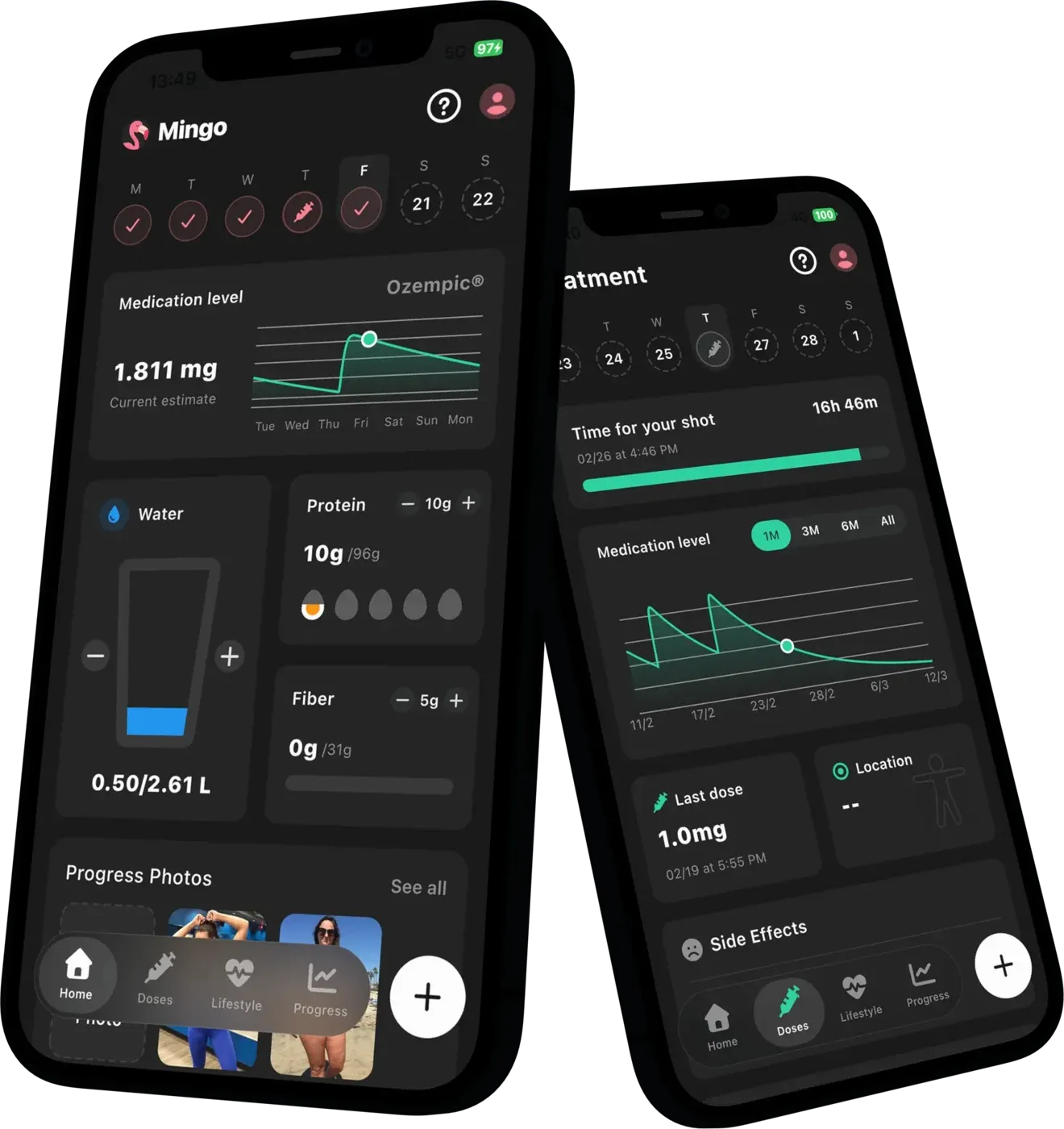
- 18 built-in symptoms, rated 0 to 10: nausea, constipation, diarrhea, stomach pain, bloating, heartburn, sulfur burps, metallic taste, suppressed appetite, food noise, fatigue, migraine, mood swings, hair loss, loose skin, muscle loss, injection-site reaction and injection anxiety. Vomiting isn’t built in, so add it as your own symptom.
- Symptoms against your estimated medication level. Mingo estimates the level from the doses you log and a half-life model, so you can see where your nausea scores fall around each shot and each dose step. It’s an estimate, not a blood test.
- Doses and sites. Each shot is logged with its dose and one of 12 injection sites on a body map, with optional left and right alternation. Reminders come on dose day, with an optional heads-up before and a nudge 2 hours later if the dose isn’t logged.
- Weight by dose. The weight chart is colored by the dose you were on, with a marker at each new dose.
- Meals by photo, voice, text or barcode, with daily protein, fiber and water targets. Photos, voice notes and descriptions are sent to Mingo’s server to estimate nutrients; the log itself stays on your phone, with no account.
- A PDF report of doses, estimated levels, weight, food and side effects for any period, to bring to your next appointment.
Mingo Pro is needed to log new entries after the first ones; reminders, the medication-level chart and the PDF report stay free. See how it works on the Ozempic tracker page.
Sources
- Novo Nordisk. Ozempic (semaglutide) injection prescribing information, revised 5/2026; Medication Guide revised 1/2025. DailyMed.
- Marso SP, et al. Semaglutide and cardiovascular outcomes in patients with type 2 diabetes (SUSTAIN-6). N Engl J Med. 2016;375:1834-1844.
- Frías JP, et al. Efficacy and safety of once-weekly semaglutide 2.0 mg versus 1.0 mg in patients with type 2 diabetes (SUSTAIN FORTE). Lancet Diabetes Endocrinol. 2021;9:563-574.
- Novo Nordisk. Wegovy (semaglutide) prescribing information, revised 6/2026. DailyMed.
- Gorgojo-Martínez JJ, et al. Clinical recommendations to manage gastrointestinal adverse events in patients treated with GLP-1 receptor agonists. J Clin Med. 2023;12(1):145.
- NIDDK pages on constipation, diarrhea and GER and GERD.
- Cleveland Clinic. GLP-1 agonists, medically reviewed July 2023.
Frequently asked questions
Does Ozempic cause hair loss?
Hair loss (alopecia) appears in the label among reports collected after Ozempic reached the market. Those reports are voluntary, so the label can't say how often it happens or confirm that the medicine caused it. It isn't in the label's table of common reactions from the diabetes trials. If you notice it, tell your prescriber and note when it started.
Can Ozempic make you tired, dizzy or change how food tastes?
It can. The label links fatigue, dizziness and dysgeusia (a change in taste) to Ozempic at a frequency above 0.4%, and lists headache among reports from after approval. Dizziness and headache can also be signs of low blood sugar, so check with your prescriber if you also take insulin or a sulfonylurea.
Are injection-site reactions common with Ozempic?
Not in the trials. Injection-site reactions such as discomfort or redness were reported in 0.2% of people on Ozempic in the placebo-controlled trials. The Medication Guide says to inject under the skin of the stomach area, thigh or upper arm, and to change (rotate) the site with each injection.
Can Ozempic change how my other medicines work?
Ozempic slows how fast your stomach empties, which may affect how pills taken alongside it are absorbed. In the label's clinical pharmacology trials, semaglutide didn't change the absorption of oral medicines to a clinically relevant degree, but the label still advises caution. Give your prescriber and pharmacist a full list of what you take, including over-the-counter medicines, vitamins and herbal supplements.
Should I stop Ozempic if the side effects are hard to live with?
Talk to your prescriber before you stop or skip a dose: they can review your dose and your other medicines with you. The Medication Guide makes two exceptions, where you stop and get help right away: signs of pancreatitis and signs of a serious allergic reaction. A log of what you felt, and when, makes that conversation quicker.


