
The most common Zepbound side effects are nausea, diarrhea, vomiting and constipation, followed by stomach pain, indigestion, injection-site reactions, fatigue, allergic reactions, belching, hair loss and reflux. Most nausea, vomiting and diarrhea in the trials happened during dose increases and eased over time. The boxed warning is about thyroid tumors seen in rats. Call your prescriber about severe or lasting stomach problems.
Mingo is a GLP-1 tracker app; this guide summarizes the prescribing information and published trials and is not medical advice.
It draws on the Zepbound prescribing information (revised August 2026) and the SURMOUNT trials. For who Zepbound is approved for, see our Zepbound safety guide.
How common is each Zepbound side effect?
The label pools two placebo-controlled trials of up to 72 weeks: Study 1 (SURMOUNT-1), in adults with obesity, or overweight plus a weight-related condition, without diabetes, and Study 2 (SURMOUNT-2), in adults with type 2 diabetes and a BMI of 27 or more. In all, 2,519 adults took Zepbound. Study 2 had no 5 mg group, so that column comes from Study 1 alone.
Table 1 of the label (revised 8/2026, section 6.1) lists every side effect reported in at least 2% of people on Zepbound and more often than on placebo:
| Side effect | Placebo (N=958) | 5 mg (N=630) | 10 mg (N=948) | 15 mg (N=941) |
|---|---|---|---|---|
| Nausea | 8% | 25% | 29% | 28% |
| Diarrhea | 8% | 19% | 21% | 23% |
| Vomiting | 2% | 8% | 11% | 13% |
| Constipation | 5% | 17% | 14% | 11% |
| Abdominal pain | 5% | 9% | 9% | 10% |
| Indigestion (dyspepsia) | 4% | 9% | 9% | 10% |
| Injection-site reactions | 2% | 6% | 8% | 8% |
| Fatigue | 3% | 5% | 6% | 7% |
| Allergic reactions (hypersensitivity) | 3% | 5% | 5% | 5% |
| Belching (eructation) | 1% | 4% | 5% | 5% |
| Hair loss | 1% | 5% | 4% | 5% |
| Reflux (GERD) | 2% | 4% | 4% | 5% |
| Gas (flatulence) | 2% | 3% | 3% | 4% |
| Abdominal distension | 2% | 3% | 3% | 4% |
| Dizziness | 2% | 4% | 5% | 4% |
| Low blood pressure (hypotension) | 0% | 1% | 1% | 2% |
Some rows group related terms: injection-site reactions include bruising, redness, itching, pain and rash, and fatigue also covers weakness, lethargy and malaise. Counted together, stomach and bowel side effects affected 56% of people at each dose, against 30% on placebo.
The label warns that rates from different drugs’ trials can’t be compared directly. Mounjaro has the same ingredient but was studied in other trials, in people with type 2 diabetes; see our Mounjaro side effects and tirzepatide side effects guides, or the GLP-1 side effects guide for all the medicines.
How many people stopped because of side effects?
Across both trials, 4.8%, 6.3% and 6.7% of people on 5, 10 and 15 mg stopped Zepbound for good because of side effects, against 3.4% on placebo. Stomach and bowel side effects alone led 1.9%, 3.3% and 4.3% to stop, against 0.5% on placebo.
Hair loss
The label ties hair loss to weight reduction. It was reported in 7.1% of women and 0.5% of men on Zepbound, against 1.3% and 0% on placebo. No one on Zepbound stopped treatment because of it. The label doesn’t say how long the shedding lasts.
Allergic reactions
Most were skin reactions, such as rash and itching. Reactions within a day of a shot occurred in 2.1% of people on Zepbound and 0.4% on placebo, and later reactions in 3.5% and 2.7%. They were more frequent in people who developed antibodies to tirzepatide (6.2%) than in those who didn’t (3%).
Less common side effects
- Low blood pressure on Zepbound was more frequent in people also taking blood pressure medicine (2.2%) than in those who weren’t (1.2%), and also occurred with stomach side effects and dehydration.
- Heart rate rose by 1 to 3 beats per minute on average, with no rise on placebo.
- Dry mouth or throat: 1%, against 0.1% on placebo. Taste changes: 0.4%, against none.
- Dysesthesia, an abnormal or unpleasant sensation: 0.2% to 0.4%, against 0.1%.
- Pancreatic enzymes rose on average (amylase 20% to 25%, lipase 28% to 35%). The label calls this of unknown meaning without signs of pancreatitis.
When do Zepbound side effects start, and how long do they last?
Neither the label nor the trials give a day-by-day timeline. What they report:
- Most nausea, vomiting and diarrhea happened during dose escalation and decreased over time (label, section 6.1).
- In SURMOUNT-1 (NEJM 2022), most stomach and bowel side effects were mild to moderate and occurred mainly during dose escalation, a period of up to 20 weeks in that trial.
- Most people who stopped because of side effects did so in the first few months, mainly due to stomach and bowel side effects.
- Zepbound slows stomach emptying. The slowdown is largest after the first dose and diminishes over time (section 12.2).
- Blood levels peak a median of 24 hours after a shot (range 8 to 72 hours, section 12.3). The label doesn’t say whether side effects follow that curve.
The label doesn’t say how long a bout of nausea lasts or when side effects settle. To find your own pattern, log how you feel each day and compare it with your shot day and dose steps.
What the label says about dose increases
Zepbound starts at 2.5 mg, and each step up comes after at least four weeks on the current dose. The label says this escalation reduces the risk of stomach and bowel side effects, and that a lower maintenance dose can be considered if one isn’t tolerated (section 2.1). Your prescriber decides; see our Zepbound dosage schedule guide. The label also asks prescribers to check kidney function in people whose side effects could dehydrate them, especially when starting and increasing the dose (section 5.3).
How can you manage nausea, constipation, diarrhea and reflux?
These tips come from the Zepbound Medication Guide, a Cleveland Clinic article (September 2026) and NIDDK, the US digestive diseases institute.
Nausea
- Eat smaller meals, slowly. A big meal on a GLP-1 medicine can bring on nausea and reflux (Cleveland Clinic).
- Limit high-fat, greasy and sugary foods, and don’t take a first or newly increased dose right after a big meal (Cleveland Clinic).
- Stay upright for about 30 minutes after eating (Cleveland Clinic).
- Unsweetened ginger or peppermint tea may help (Cleveland Clinic), but NIDDK lists mint as a reflux trigger. Ask your prescriber about anti-nausea medicine.
Constipation
- Add fiber-rich foods a little at a time, with plenty of liquids (NIDDK). If you feel bloated after a dose, go easy on fiber right after it (Cleveland Clinic).
- Physical activity and a footstool on the toilet may help (NIDDK).
- Ask a health professional which laxative suits you before taking one; NIDDK describes laxatives as short-term.
- Severe constipation and intestinal blockage have been reported since approval (section 6.2), so call if it’s severe or won’t improve.
Diarrhea
- Replace fluids and electrolytes with water, broths or oral rehydration solutions; with diabetes or kidney disease, ask your doctor about rehydration solutions first (NIDDK). The Medication Guide says fluids lower the chance of dehydration, which can harm the kidneys.
- Avoid alcohol, caffeine, fatty foods, lots of sugar, sugar alcohols and lactose while it lasts (NIDDK).
- Ask your prescriber before anti-diarrhea medicine (Cleveland Clinic). NIDDK says to see a doctor if diarrhea worsens or lasts more than 2 days while taking it.
- For chronic diarrhea, NIDDK suggests a food journal: what you eat and drink, your symptoms and when they occur. Take the notes to your doctor.
Reflux, heartburn and belching
- Keep meals small (Cleveland Clinic).
- For night symptoms, finish meals at least 3 hours before lying down and raise your head 6 to 8 inches with a wedge or pillows (NIDDK).
- Common triggers include acidic foods, alcohol, chocolate, caffeine, high-fat foods, mint and spicy foods (NIDDK).
What are the serious side effects of Zepbound?
Boxed warning. Tirzepatide caused thyroid C-cell tumors in rats. It is unknown whether Zepbound causes these tumors, including medullary thyroid carcinoma (MTC), in people. Zepbound must not be used by people with a personal or family history of MTC or with multiple endocrine neoplasia syndrome type 2 (MEN 2).
The other warnings (section 5), with the rates from the two weight trials:
- Severe stomach and bowel side effects: 1.7%, 2.5% and 3.1% at 5, 10 and 15 mg, against 1% on placebo. Zepbound isn’t recommended for people with severe gastroparesis.
- Kidney injury from dehydration: reported since approval, sometimes needing dialysis, mostly after nausea, vomiting or diarrhea. In the trials, 0.5% on Zepbound and 0.2% on placebo.
- Gallbladder problems: gallstones in 1.1% on Zepbound against 1% on placebo, gallbladder inflammation in 0.7% against 0.2%, gallbladder removal in 0.2% against none. The label links them to weight reduction.
- Pancreatitis: confirmed in 0.2% in both groups. Severe cases with tirzepatide, some fatal, have been reported since approval.
- Serious allergic reactions: anaphylaxis and angioedema (swelling under the skin) reported since approval; severe reactions in 0.1% on Zepbound in the trials, none on placebo.
- Low blood sugar: the risk is higher with insulin or a sulfonylurea. In Study 2 (type 2 diabetes), glucose fell below 54 mg/dL in 4.2% on Zepbound and 1.3% on placebo; on Zepbound, in 10.3% of people taking a sulfonylurea and 2.1% of those not taking one. In Study 1 (no diabetes), which didn’t systematically record low blood sugar, 0.3% against none.
- Diabetic retinopathy: in people with type 2 diabetes, it may worsen temporarily with a fast improvement in blood sugar.
- Aspiration during anesthesia: Zepbound slows stomach emptying, and rare cases of food entering the lungs have been reported with GLP-1 medicines during general anesthesia or deep sedation.
- Never share a KwikPen, even with a new needle.
The label’s warning on suicidal behavior and ideation was removed in February 2026, according to its list of recent major changes.
When to call your prescriber or get emergency care
From the Medication Guide and section 17 of the label:
Stop Zepbound and get medical help right away for signs of a serious allergic reaction: swelling of the face, lips, tongue or throat; trouble breathing or swallowing; severe rash or itching; fainting or dizziness; a very rapid heartbeat.
Stop Zepbound and call your prescriber right away for severe stomach pain that won’t go away, with or without nausea or vomiting, sometimes felt in the back.
Call your prescriber right away about nausea, vomiting or diarrhea that doesn’t go away, or upper stomach pain, fever, yellow skin or eyes, or clay-colored stools.
Tell your prescriber about a lump or swelling in your neck, hoarseness, trouble swallowing or shortness of breath; severe or lasting stomach problems; vision changes if you have type 2 diabetes; signs of low blood sugar, especially with insulin or a sulfonylurea; and any planned surgery with anesthesia or deep sedation.
If you take too much, call your prescriber or Poison Help at 1-800-222-1222, or go to an emergency room right away. You can report side effects to the FDA at 1-800-FDA-1088.
Zepbound for sleep apnea: side effects in SURMOUNT-OSA
Zepbound is also approved for moderate to severe obstructive sleep apnea in adults with obesity. SURMOUNT-OSA (NEJM 2024) was two 52-week trials in adults without diabetes: trial 1 without positive airway pressure (PAP) therapy, trial 2 with it. Doses rose by 2.5 mg every 4 weeks to the highest tolerated dose, 10 or 15 mg.
The label says side effects were similar to those in the weight trials. The paper’s Table 4 gives them; these are its digestive-symptom and injection-site rows (it also lists infections, gastroenteritis among them, joint pain and high blood pressure):
| Side effect | Trial 1, tirzepatide (N=114) | Trial 1, placebo (N=120) | Trial 2, tirzepatide (N=119) | Trial 2, placebo (N=114) |
|---|---|---|---|---|
| Diarrhea | 26.3% | 12.5% | 21.8% | 8.8% |
| Nausea | 25.4% | 10.0% | 21.8% | 5.3% |
| Vomiting | 17.5% | 4.2% | 9.2% | 0.9% |
| Constipation | 15.8% | 2.5% | 15.1% | 4.4% |
| Belching | 7.9% | 0% | 8.4% | 0.9% |
| Reflux (GERD) | 7.9% | 0.8% | 5.0% | 0% |
| Injection-site reaction | 7.0% | 0.8% | 5.0% | 0% |
| Indigestion (dyspepsia) | 4.4% | 1.7% | 9.2% | 0.9% |
| Abdominal pain | 6.1% | 3.3% | 4.2% | 1.8% |
| Upper abdominal pain | 3.5% | 1.7% | 5.9% | 1.8% |
These are all adverse events reported during treatment, from different trials, so they can’t be lined up against the label’s table.
The stomach and bowel events were generally mild to moderate and most frequent during dose escalation. Adverse events led 4.4% (trial 1) and 3.4% (trial 2) of people on tirzepatide to stop, against 1.7% and 7.0% on placebo. Severe or serious stomach and bowel events affected 3.5% and 3.4% on tirzepatide, none on placebo. Two people on tirzepatide in trial 2 had confirmed pancreatitis; the label gives 0.84 cases per 100 patient-years on Zepbound in these trials, none on placebo.
Pens and vials: injection-site reactions and what to log
Zepbound comes as single-dose pens, single-dose vials, multi-dose vials and KwikPens holding four weekly doses (section 3). The label doesn’t report side-effect rates by presentation.
Most people on Zepbound in the weight trials developed antibodies to tirzepatide (64.5%), and injection-site reactions were more frequent in them (11.3%) than in those without (1%). The label found no clinically significant effect of the antibodies on how well Zepbound works.
The instructions for use say to rotate the site every week and to press gauze on any blood without rubbing. The vial instructions add: avoid skin that is tender, bruised, scaly, hard, scarred or damaged, and rotate to lower the risk of pitted, thickened or lumpy skin. With vials, the label calls for a new syringe and needle every time and a syringe that can measure the dose, such as a 1 mL syringe (0.5 mL from a single-dose vial, 0.6 mL from a multi-dose vial). If you switch presentations, the label says to get trained on the new one.
For each shot, note the dose, the site and whether it came from a pen or a vial. If a reaction appears, rate it and describe it, so you can see whether it follows one site or one presentation.
Birth control pills after starting and after each dose increase
Because Zepbound slows stomach emptying, it may make birth control pills less effective. The label advises switching to a non-oral method, or adding a barrier method, for 4 weeks after starting Zepbound and for 4 weeks after each dose increase. Hormonal contraceptives not taken by mouth should not be affected (sections 7.2 and 8.3). With a single 5 mg dose, a combined pill’s peak hormone levels fell by 55% to 66% (section 12.3).
The label also says to stop Zepbound when a pregnancy is recognized (section 8.1). Mingo’s weight chart marks each new dose, so you can see when each 4-week window started.
Keeping a side-effect log in Mingo
The trials describe groups; a log describes you. Mingo, our app, has 18 built-in symptoms rated on 0 to 10 sliders: nausea, constipation, diarrhea, stomach pain, bloating, heartburn, sulfur burps, metallic taste, suppressed appetite, food noise, fatigue, migraine, mood swings, hair loss, loose skin, muscle loss, injection-site reaction and injection anxiety. Add vomiting as your own symptom. Each symptom can be charted against your estimated medication level, calculated from your logged doses and a half-life model: an estimate, not a blood test.
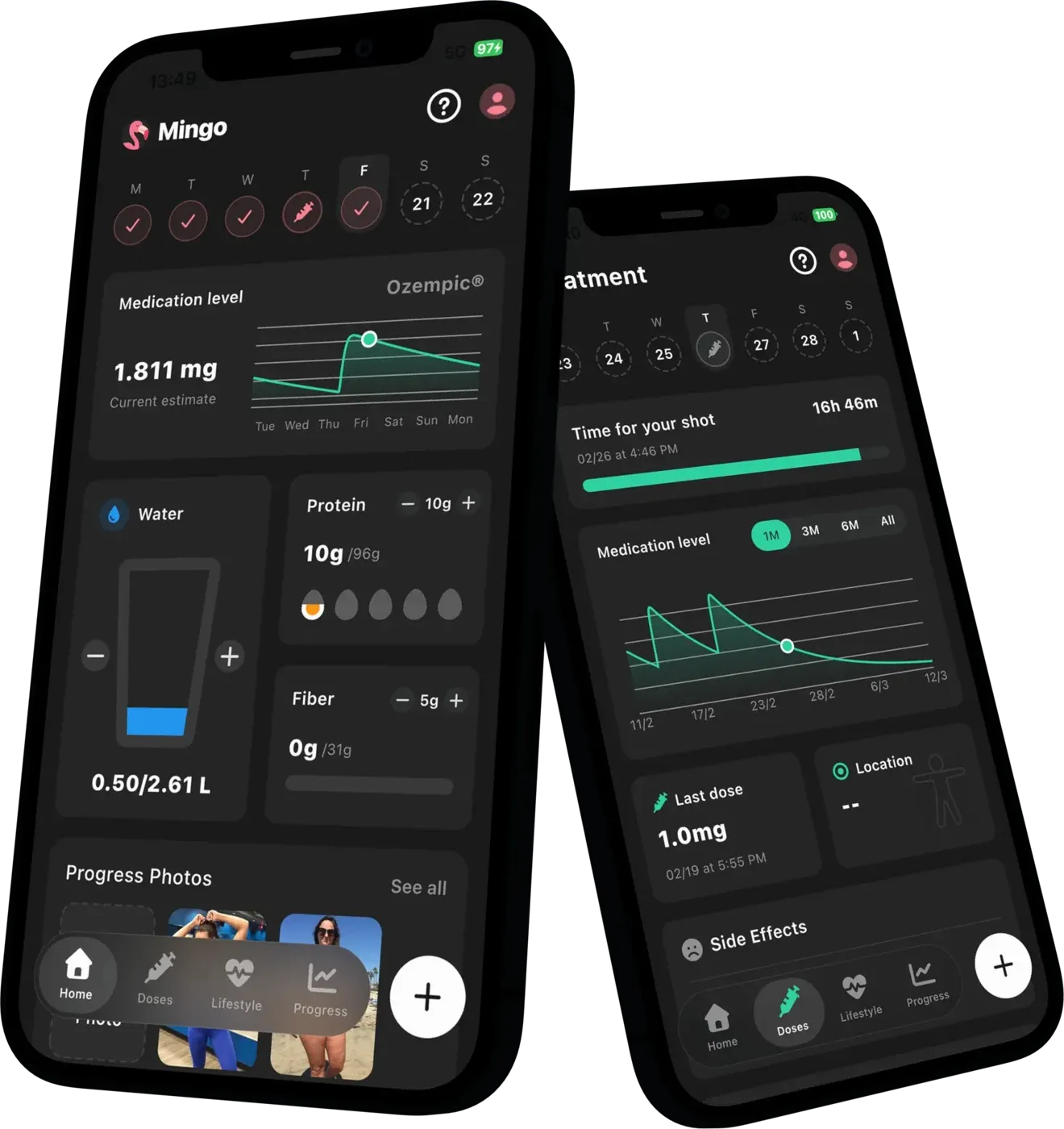
Log each shot with its dose, the site on a 12-site body map (with optional left and right alternation) and notes such as pen or vial. Mingo reminds you on shot day, can send a heads-up before, and nudges you 2 hours later if the dose isn’t logged. The weight chart is colored by dose, with a marker at each new dose. Meals go in by photo, voice, text or barcode, with daily protein, fiber and water targets. For appointments, export a PDF of doses, estimated levels, weight, food and side effects for any period.
Mingo Pro is needed to log new entries after your first ones; reminders, the medication-level chart and the PDF stay free. The log stays on your phone, with no account; meal photos, voice notes and descriptions go to Mingo’s server to estimate nutrients. Mingo doesn’t measure sleep or breathing. See the Zepbound tracker page.
Sources
- Zepbound prescribing information, Medication Guide and instructions for use, revised 8/2026 (DailyMed).
- Jastreboff AM, et al. SURMOUNT-1. N Engl J Med. 2022;387:205-216.
- Malhotra A, et al. SURMOUNT-OSA. N Engl J Med. 2024;391:1193-1205.
- Cleveland Clinic, digestive side effects of GLP-1 medications, September 9, 2026.
- NIDDK pages on constipation, diarrhea and GER and GERD, linked above.
Frequently asked questions
Do Zepbound side effects come back after each dose increase?
They can. The label says most nausea, vomiting and diarrhea in the weight trials happened during dose escalation, and it calls for gradual steps to reduce that risk. It doesn't describe what happens at each individual step, so a daily symptom log is the clearest way to see whether yours return after an increase. If a dose isn't tolerated, the label lets your prescriber consider a lower maintenance dose.
Can Zepbound cause low blood sugar if I don't have diabetes?
It can, although the label says the risk is higher when Zepbound is used with insulin or a sulfonylurea. The label notes that low blood sugar has also been linked to Zepbound and similar medicines in adults without type 2 diabetes. Signs listed in the Medication Guide include dizziness, sweating, shakiness, confusion, headache, blurred vision and a fast heartbeat.
Is it normal to feel tired on Zepbound?
Fatigue is one of the common side effects in the label, and the term there also covers weakness, lethargy and malaise. The label doesn't say when it starts or how long it lasts. Tiredness with sweating, shakiness or confusion can be a sign of low blood sugar, and vomiting or diarrhea that won't stop can dehydrate you, so tell your prescriber if it comes with those.
Should I stop Zepbound before surgery?
That is a decision for your prescriber and the team doing the procedure. The label says there isn't enough data to know whether pausing Zepbound or changing fasting rules lowers the risk of food entering the lungs during anesthesia or deep sedation. It does say to tell every provider involved that you take Zepbound before any planned surgery or procedure.
Does Zepbound cause depression or suicidal thoughts?
The current label has no warning about it: its list of recent major changes shows that the warning on suicidal behavior and ideation was removed in February 2026. In the SURMOUNT-OSA sleep apnea trials, five people had a severe or serious event of depression or suicidal thoughts or behavior, two on tirzepatide and three on placebo. The Medication Guide says to talk to your prescriber about any side effect that bothers you or doesn't go away.


