
How is Zepbound started and increased?
Every Zepbound treatment starts at 2.5 mg once a week for four weeks. The label is explicit that 2.5 mg is for getting started, not a maintenance dose. After that the dose goes to 5 mg, and it can rise in 2.5 mg steps, each after at least four weeks on the current dose (Zepbound prescribing information):
| Dose | Role |
|---|---|
| 2.5 mg | Starting dose, 4 weeks |
| 5 mg | Possible maintenance dose (weight) |
| 7.5 mg | Step up |
| 10 mg | Possible maintenance dose (weight or sleep apnea) |
| 12.5 mg | Step up |
| 15 mg | Maximum and possible maintenance dose |
Our Zepbound dosage schedule guide goes through each step in more detail. In Mingo, every shot keeps its dose, and the weight chart shows a marker the first time you log a new one.
What results did the trials show?
In SURMOUNT-1, adults with obesity and without diabetes lost on average 15.0%, 19.5% and 20.9% of their body weight after 72 weeks on 5, 10 and 15 mg, against 3.1% on placebo (Jastreboff et al., NEJM 2022). In SURMOUNT-5, the head-to-head trial against semaglutide at the highest tolerated doses, weight fell by 20.2% on tirzepatide and 13.7% on semaglutide after 72 weeks (Aronne et al., NEJM 2025). These are averages across thousands of people; your own trend is what your log shows. Our Zepbound vs Wegovy guide compares the two medicines.
Since December 2024, Zepbound is also approved in the US for moderate to severe obstructive sleep apnea in adults with obesity, at a maintenance dose of 10 or 15 mg (FDA approval letter).
Which Zepbound side effects should you track?
These were the most common side effects in the 72-week weight-reduction trials (Zepbound prescribing information, adverse reactions table):
| Side effect | Placebo | 5 mg | 10 mg | 15 mg |
|---|---|---|---|---|
| Nausea | 8% | 25% | 29% | 28% |
| Diarrhea | 8% | 19% | 21% | 23% |
| Constipation | 5% | 17% | 14% | 11% |
| Vomiting | 2% | 8% | 11% | 13% |
| Abdominal pain | 5% | 9% | 9% | 10% |
| Injection-site reactions | 2% | 6% | 8% | 8% |
| Fatigue | 3% | 5% | 6% | 7% |
| Hair loss | 1% | 5% | 4% | 5% |
Most of these are among Mingo’s 18 built-in symptoms, so you can rate them from 0 to 10 in a few taps and see if they cluster after shot day or after a dose increase. Zepbound has a boxed warning about thyroid C-cell tumors seen in rodents and must not be used with a personal or family history of medullary thyroid carcinoma or MEN 2. If you take birth control pills, the label advises switching to a non-oral method, or adding a barrier method, for 4 weeks after starting and after each dose increase. Our Zepbound safety guide lists the signs that need a call to your prescriber.
For the full list by dose, the warnings and when to call your prescriber, see our Zepbound side effects guide.
Pens or vials: what to log
Zepbound comes as single-dose pens and as single-dose vials in all six strengths, and also as multi-dose vials and KwikPens that each hold four weekly doses (Zepbound prescribing information). Whatever you use, log the dose in milligrams and the site. The label lists the abdomen and thigh as sites, and the back of the upper arm when someone else gives the injection, and says to rotate the site with each dose.
Single-dose pens and vials can be kept out of the refrigerator, up to 30 °C (86 °F), for a total of 21 days. Mingo doesn’t convert syringe units or track how much is left in a vial: measure each dose the way your pharmacist and the instructions for use describe.
What if you miss a Zepbound dose?
Take it within four days (96 hours) of the missed day. After that, skip it and take the next one on your usual day. Your shot day can move if the two doses are at least three days (72 hours) apart (Zepbound prescribing information). Mingo’s reminder and the nudge two hours later help you catch a missed shot well inside that window.
What Mingo doesn’t do
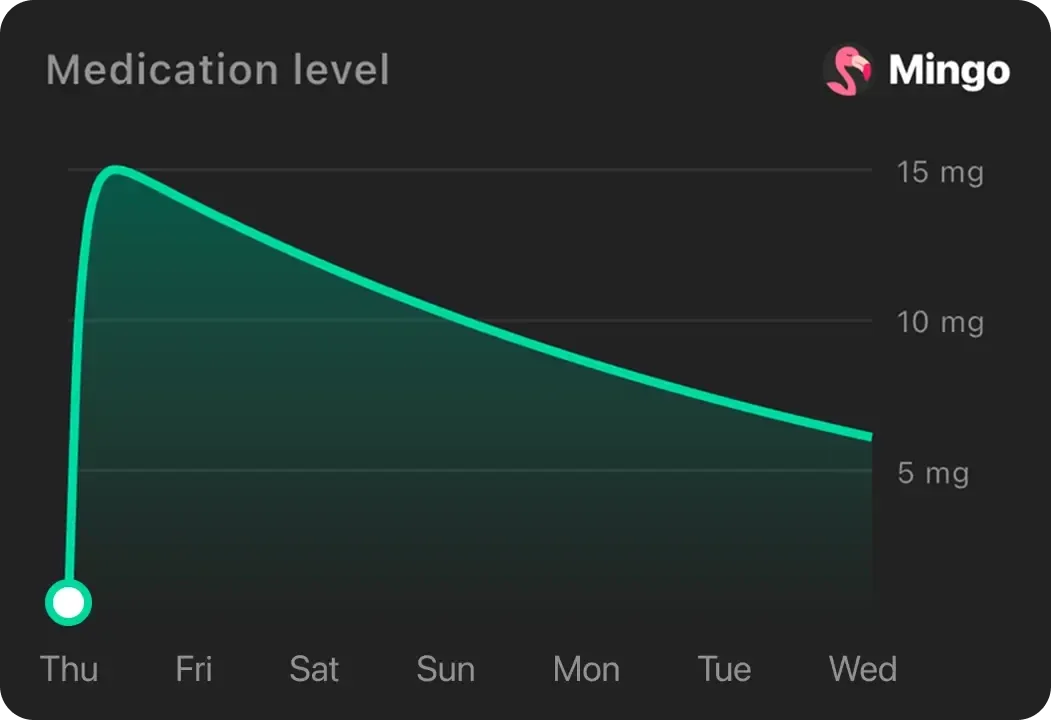
Mingo doesn’t choose your dose, convert vial units or measure tirzepatide in your blood; the level curve is an estimate from your logged doses. It doesn’t track sleep or breathing for sleep apnea. It keeps a clear record of doses, symptoms, food and weight for you and your prescriber.


