
The most common semaglutide side effects are digestive: nausea, vomiting, diarrhea, constipation and stomach pain. That holds for Ozempic, Wegovy, the Wegovy pill and Rybelsus, but their label rates differ with the dose, the route and who was in the trials. Most nausea, vomiting and diarrhea was reported during dose increases. Every label also lists serious risks, such as pancreatitis.
Mingo is a GLP-1 tracker app; this guide summarizes the prescribing information and published trials and is not medical advice.
Four products, one molecule
Semaglutide is the active ingredient in all of these. What changes is how much reaches your blood, how often you take it and who it was tested in:
- Ozempic is a once-weekly injection for adults with type 2 diabetes. It starts at 0.25 mg and can be raised in steps up to 2 mg. Its side-effect table comes from trials of 0.5 mg and 1 mg.
- Wegovy injection is a once-weekly injection for weight reduction, for lowering the risk of major heart events in adults with heart disease and obesity or overweight, and for a liver condition called MASH. The usual maintenance dose is 2.4 mg; the label allows up to 7.2 mg for weight reduction in adults.
- Wegovy tablets, the Wegovy pill, are taken once a day and build up to 25 mg, for weight reduction and heart risk reduction in adults.
- Rybelsus is a daily tablet for type 2 diabetes: 3 mg to start, then 7 mg or 14 mg. Ozempic tablets (1.5 mg, 4 mg and 9 mg) share its label and its safety data, but the label says the two are not interchangeable milligram for milligram.
The table gives the headline digestive side effects from each US label on DailyMed: Ozempic (revised 5/2026), Wegovy injection and tablets (revised 6/2026) and Rybelsus and Ozempic tablets (revised 1/2026). Each product’s placebo group sits under it, because the placebo rates differ too.
| Product, dose and trial population | Any digestive side effect | Nausea | Vomiting | Diarrhea | Constipation | Stopped due to digestive side effects |
|---|---|---|---|---|---|---|
| Ozempic 0.5 mg weekly, type 2 diabetes | 32.7% | 15.8% | 5% | 8.5% | 5% | 3.1% |
| Ozempic 1 mg weekly, type 2 diabetes | 36.4% | 20.3% | 9.2% | 8.8% | 3.1% | 3.8% |
| Placebo, Ozempic trials | 15.3% | 6.1% | 2.3% | 1.9% | 1.5% | 0.4% |
| Wegovy 2.4 mg weekly, obesity or overweight | 73% | 44% | 24% | 30% | 24% | 4.3% |
| Placebo, Wegovy injection trials | 47% | 16% | 6% | 16% | 11% | 0.7% |
| Wegovy tablets 25 mg daily, obesity or overweight without diabetes † | 74.0% | 46.6% | 30.9% | 17.6% | 20.1% | 3.4% |
| Placebo, Wegovy tablet trial † | 42.2% | 18.6% | 5.9% | 8.8% | 9.8% | 2% |
| Rybelsus 7 mg daily, type 2 diabetes | 32% | 11% | 6% | 9% | 6% | 4% |
| Rybelsus 14 mg daily, type 2 diabetes | 41% | 20% | 8% | 10% | 5% | 8% |
| Placebo, Rybelsus trials | 21% | 6% | 3% | 4% | 2% | 1% |
Sources: Ozempic Table 1, Wegovy Table 3 and Rybelsus Table 2, plus section 6.1 of each label (two, three and two placebo-controlled trials). The Rybelsus label applies its data to Ozempic tablets too.
† The Wegovy label has no separate table for the tablets; it says their common side effects were similar in type and frequency to the injection’s, and it gives the stopping rate. The digestive total is from the OASIS 4 trial paper (NEJM, 2025). Nausea, vomiting, diarrhea and constipation are from OASIS 4’s results on ClinicalTrials.gov, posted February 25, 2026: non-serious adverse events of any cause over 71 weeks, in 204 people on the tablet and 102 on placebo.
Why do semaglutide side effects differ between Ozempic, Wegovy and the pills?
It’s tempting to read that table as a ranking. Each label warns against it in section 6.1; in the Ozempic label’s words, rates from its trials “cannot be directly compared to rates in the clinical trials of another drug.” A few things explain most of the gaps.
The dose, and how much reaches the blood
Inside a single trial, a higher dose usually brought more nausea and vomiting. In the trial comparing Ozempic 1 mg with 2 mg, digestive side effects were reported by 30.8% on 1 mg and 34% on 2 mg. The Wegovy label says altered skin sensations such as burning, skin pain or sensitive skin (dysesthesia) “increased with increasing dosage and drug levels in the blood”: 22% of people on 7.2 mg reported them, against 6% on 2.4 mg. On the 25 mg tablet, 5% did, and nobody on placebo.
Milligrams don’t compare across routes. The Wegovy label estimates that about 1% to 2% of a tablet’s semaglutide is absorbed, against 89% of an injection (the Rybelsus label gives 0.4% to 1% for Rybelsus). What matters is the level in the blood: in people with obesity or overweight, on average about 77 nmol/L on the 25 mg tablet, about 75 nmol/L on the 2.4 mg injection and about 230 nmol/L on 7.2 mg. The label predicts comparable levels from the tablet and the 2.4 mg shot in people without type 2 diabetes, with more variation between people on the tablet.
Who was in the trials
Ozempic’s and Rybelsus’s tables come from adults with type 2 diabetes. Wegovy’s come from adults with obesity or overweight: 19% in the injection trials had type 2 diabetes, and the tablet trial excluded it. The placebo rows show how much the setting matters: with no drug involved, nausea was reported more than twice as often in the Wegovy injection trials as in the Ozempic trials.
Trial length, cut-offs and the trial itself
People took Ozempic for a mean of 32.9 weeks and Rybelsus for 41.8 weeks in those trials; the Wegovy injection trials ran up to 68 weeks and the tablet trial up to 64. The tables also use different cut-offs (5% or more for Ozempic and Rybelsus, 2% for Wegovy), so a side effect can be missing from one just because of the threshold. Even one dose gives different numbers in different trials. The table’s Wegovy 2.4 mg row comes from the main weight-loss trials; in the two 72-week trials of 7.2 mg (Table 4), the same 2.4 mg dose came with nausea in 35% of adults, and 7.2 mg in 39%. Comparisons inside one trial, like that one, are the fair ones.
Do semaglutide side effects go away?
The labels don’t say how long side effects last, only when they cluster. For Ozempic and Rybelsus, most reports of nausea, vomiting and diarrhea came during dose escalation, and the Wegovy label says digestive reactions were most often reported then. Every label raises the dose in steps to reduce the risk of these side effects, and the Wegovy label lets a prescriber delay an injection step by 4 weeks if a dose isn’t tolerated. The drug also lingers: the Ozempic label says it stays in circulation for about 5 weeks after the last dose. Only your own log can show how long yours last.
What helps, according to the labels and Cleveland Clinic:
- Drink fluids. Nausea, vomiting and diarrhea can cause dehydration, which may cause kidney problems. All three Medication Guides say drinking fluids helps reduce that chance.
- Eat smaller meals, slowly. Cleveland Clinic notes that GLP-1 medicines slow stomach emptying, so a big meal may not fit and can bring on nausea and reflux.
- Limit the foods that set you off. Its list includes sugary, high-fat, spicy and ultra-processed foods.
- Stay upright after eating. For nausea, Cleveland Clinic suggests staying upright for 30 minutes after a meal.
- Tell your prescriber. Cleveland Clinic notes they may slow your dose increases or suggest other ways to manage symptoms. The Medication Guides say to use semaglutide exactly as your provider tells you.
Serious side effects in every semaglutide label
The boxed warning and the Warnings and Precautions (section 5) are nearly the same across the three labels:
- Thyroid C-cell tumors. Semaglutide caused them in rodents; whether it does in people is unknown. It is not for anyone with a personal or family history of medullary thyroid carcinoma (MTC) or with MEN 2.
- Acute pancreatitis, including severe and fatal cases.
- Gallbladder disease, such as gallstones and gallbladder inflammation.
- Low blood sugar, with a higher risk when combined with insulin or a sulfonylurea.
- Acute kidney injury from dehydration, mostly after nausea, vomiting or diarrhea.
- Severe digestive reactions. Reported in 0.4% on Ozempic 0.5 mg and 0.8% on 1 mg (0% on placebo), 4.1% on Wegovy injection (0.9% on placebo), 2% on Wegovy tablets (0% on placebo), and 0.6% on Rybelsus 7 mg and 2% on 14 mg (0.3% on placebo). None of these products is recommended with severe gastroparesis.
- Serious allergic reactions, including anaphylaxis and angioedema.
- Diabetic retinopathy complications in people with type 2 diabetes.
- Pulmonary aspiration under general anesthesia or deep sedation, rarely reported with GLP-1 medicines, which slow stomach emptying.
- A faster resting heart rate, a warning in the Wegovy label only.
When to call your prescriber or get emergency care
The Medication Guides for Ozempic, Wegovy and Rybelsus say:
- Stop and call right away if you have severe stomach pain that won’t go away, with or without vomiting, sometimes felt through to your back.
- Stop and get medical help right away for swelling of your face, lips, tongue or throat, problems breathing or swallowing, severe rash or itching, fainting or feeling dizzy, or a very rapid heartbeat.
- Call for pain in your upper stomach, fever, yellowing of your skin or eyes, or clay-colored stools.
- Tell your provider right away about nausea, vomiting or diarrhea that does not go away. Also tell them about a lump or swelling in your neck, hoarseness, trouble swallowing, shortness of breath or any change in vision.
- On Wegovy, tell your provider if your heart races or pounds at rest for several minutes.
- If you take too much, call your provider or Poison Help at 1-800-222-1222, or go to the nearest emergency room.
- Before surgery or sedation, tell every provider that you take semaglutide.
Can semaglutide cause vision problems? NAION and the eyes
Two different eye problems are linked to semaglutide.
NAION. Non-arteritic anterior ischemic optic neuropathy is an eye condition that may cause loss of vision. On June 6, 2025, the European Medicines Agency’s safety committee, PRAC, concluded that NAION is a very rare side effect of semaglutide, meaning it may affect up to 1 in 10,000 people taking it. Several large epidemiological studies suggest about twice the risk in adults with type 2 diabetes taking semaglutide, which works out to about one extra case per 10,000 person-years of treatment. Clinical trial data also pointed to a slightly higher risk than placebo.
The EMA recommended adding NAION to the product information for Ozempic, Rybelsus and Wegovy, and the current EU product information for Ozempic lists it as very rare. Its patient leaflet describes vision loss in one eye without any pain, and its prescriber section says there is no identified time interval for when NAION may develop after starting treatment. The EMA’s advice: if you have a sudden loss of vision or rapidly worsening eyesight, contact your doctor without delay; if NAION is confirmed, semaglutide should be stopped.
The US labels used here (revised January to June 2026) don’t list NAION, but their Medication Guides tell you to report any change in vision to your healthcare provider.
Diabetic retinopathy. In the 2-year SUSTAIN-6 trial of semaglutide 0.5 mg and 1 mg injections in adults with type 2 diabetes and high cardiovascular risk, diabetic retinopathy complications occurred in 3.0% on semaglutide and 1.8% on placebo, according to the Ozempic and Wegovy labels, with a larger increase in people who already had retinopathy. The labels add that rapid improvement in blood sugar has been linked to temporary worsening, and that people with a history of retinopathy should be monitored.
Is compounded semaglutide safe? What the FDA reports
Compounded semaglutide is made by a compounding pharmacy, not the approved manufacturer. The FDA says compounded drugs are not FDA-approved, are not reviewed for safety, effectiveness or quality before they are marketed, and should be used only when a patient’s needs can’t be met by an approved drug (FDA’s concerns with unapproved GLP-1 drugs used for weight loss, content current as of October 1, 2026).
On July 26, 2024, the FDA alerted health care providers, compounders and patients to dosing errors with compounded semaglutide injections. It had received reports of adverse events, some requiring hospitalization, that may be related to overdoses from two kinds of dosing errors:
- Measuring. Most reports described patients drawing up more than the prescribed dose from a multiple-dose vial, taking 5 to 20 times the intended amount. Many were new to self-injection, and confusion between milliliters, milligrams and “units” may have contributed.
- Calculating. Several reports described health care providers converting milligrams to units or milliliters incorrectly, which led to 5 to 10 times the intended dose.
The reported effects included nausea, vomiting, abdominal pain, fainting, headache, migraine, dehydration, acute pancreatitis and gallstones.
The FDA’s current page adds reports that may be linked to compounded doses beyond the approved labels: more per dose, more frequent doses or faster increases. As of May 31, 2026, it had 990 reports of adverse events associated with compounded semaglutide, likely an undercount, since federal law does not require state-licensed pharmacies that are not outsourcing facilities to report them; the FDA adds that it can’t always tell whether the drug caused a reported event. It warns that some compounders may use salt forms (semaglutide sodium and semaglutide acetate), which are different active ingredients from the approved one. For multiple-dose vials, it says to discard the vial 28 days after first use, use a new sterile needle and syringe for every dose, and not use an injectable that arrives warm.
If you use compounded semaglutide, the FDA encourages you to ask your prescriber or compounder how to measure and inject the intended dose. Then log what you actually took: the dose in milligrams, the amount you drew up, the vial’s concentration and the date you opened it, plus every side effect. That record helps a prescriber spot a measuring error.
Semaglutide side-effect guides by product
Ozempic. Our Ozempic side effects guide covers the label’s rates at 0.5 mg and 1 mg, the 1 mg versus 2 mg trial, low blood sugar with insulin or sulfonylureas, and the retinopathy findings, all from adults with type 2 diabetes.
Wegovy injection. Wegovy side effects covers the longest list in any semaglutide label: side effects at 2.4 mg from the weight-loss trials, the separate table for 7.2 mg, heart rate, hair loss and how often people stopped treatment.
Wegovy pill. Wegovy pill side effects looks at the OASIS 4 trial behind the 25 mg tablet and the morning routine the label requires (an empty stomach, no more than 4 ounces of water, then at least 30 minutes before food, drinks or other medicines), so you can tell a side effect from a mistimed dose.
Rybelsus and Ozempic tablets. Our Rybelsus guide covers the daily diabetes tablet, its dose steps and what to track. Ozempic tablets share its label and its side-effect data.
For tirzepatide and other GLP-1 medicines, see our GLP-1 side effects overview; for approvals and weight results, see semaglutide for weight loss.
Keeping a side-effect log in Mingo
Mingo is our app: a GLP-1 tracker that works with Ozempic, Wegovy, the Wegovy pill, Rybelsus and compounded semaglutide. It records side effects next to your doses, so you see your own pattern, not a trial average.
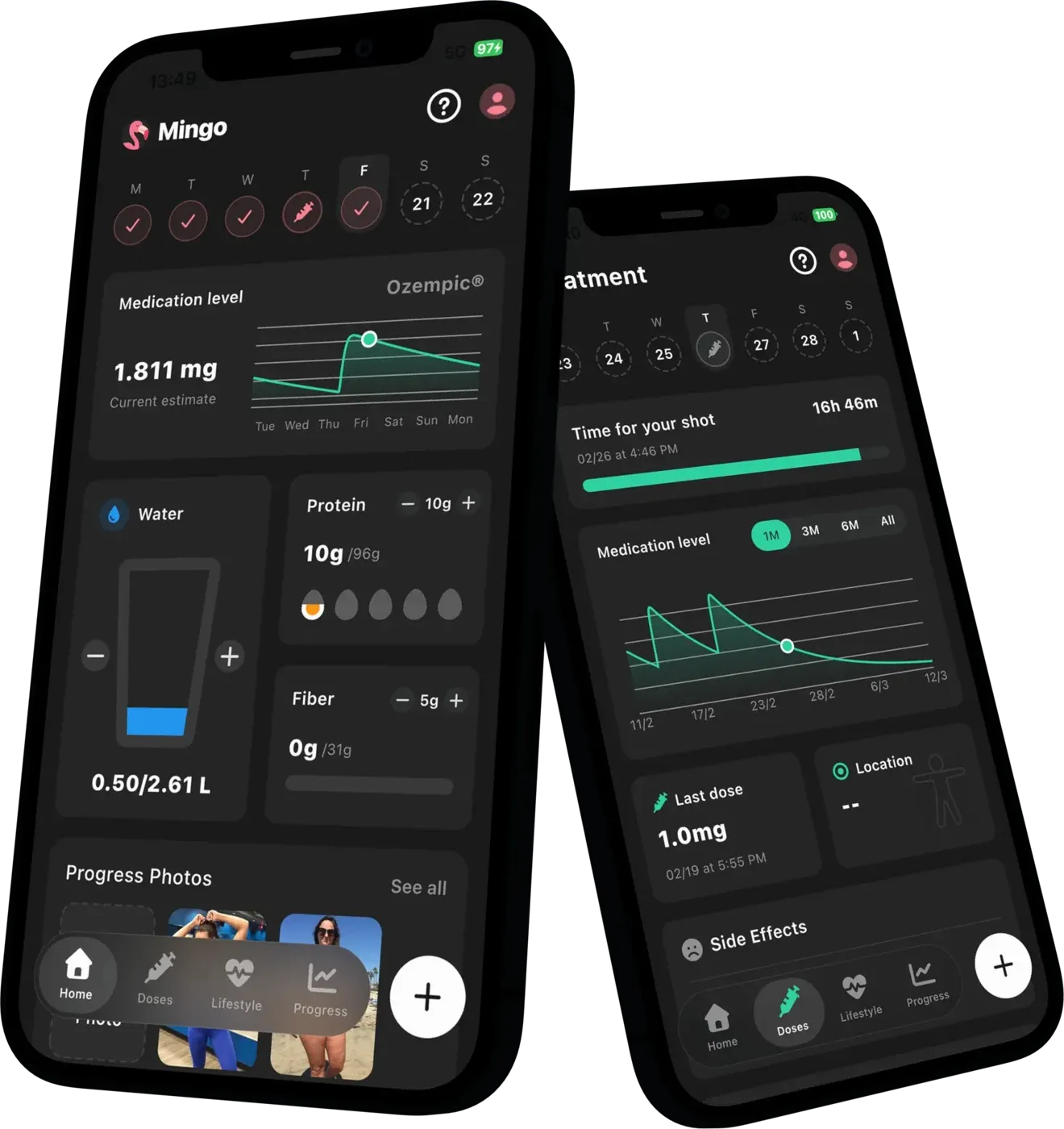
Symptoms. Mingo has 18 built-in symptoms, each rated on a 0 to 10 slider, from nausea, constipation, diarrhea, bloating, heartburn and sulfur burps to fatigue, hair loss and injection-site reactions. Vomiting isn’t one of them, so add it as your own symptom if you need it.
Symptoms against your medication level. Each symptom can be charted against your estimated semaglutide level, calculated from the doses you log with a half-life model. It’s an estimate, not a blood test, but it shows whether nausea follows a shot or a dose increase.
Doses. Log each shot or tablet with the dose, the injection site (12 sites on a body map, with optional left and right alternation) and notes, where a compounded vial’s concentration can go. Reminders arrive on dose day, with an optional heads-up before and a nudge 2 hours later if the dose isn’t logged.
Weight and food. The weight chart is colored by the dose you were on, with a marker at each new dose. Log meals by photo, voice, text or barcode, with daily protein, fiber and water targets. Meal photos, voice notes and descriptions are sent to Mingo’s server to estimate nutrients; the log itself stays on your phone, with no account.
For your appointment. A PDF report gathers your doses, estimated levels, weight, food and side effects for any period.
Mingo Pro is needed to log new entries after your first ones; reminders, the medication-level chart and the PDF report stay free. See how it works for each product on our semaglutide tracker page.
Sources
- Ozempic injection prescribing information and Medication Guide, revised 5/2026. DailyMed.
- Wegovy injection and tablets prescribing information and Medication Guide, revised 6/2026. DailyMed.
- Rybelsus and Ozempic tablets prescribing information and Medication Guide, revised 1/2026. DailyMed.
- Wharton S, et al. Oral semaglutide at a dose of 25 mg in adults with overweight or obesity (OASIS 4). N Engl J Med. 2025;393:1077-1087.
- OASIS 4 (NCT05564117) results. ClinicalTrials.gov, posted February 25, 2026.
- Marso SP, et al. Semaglutide and cardiovascular outcomes in patients with type 2 diabetes (SUSTAIN-6). N Engl J Med. 2016;375:1834-1844.
- European Medicines Agency. PRAC concludes NAION is a very rare side effect of semaglutide. June 6, 2025.
- European Medicines Agency. Ozempic: EPAR and product information.
- FDA. FDA’s concerns with unapproved GLP-1 drugs used for weight loss. Current as of October 1, 2026.
- FDA. Dosing errors associated with compounded injectable semaglutide products. July 26, 2024.
- Cleveland Clinic. How to manage the digestive side effects of GLP-1 medications. September 9, 2026.
Frequently asked questions
What are the most common side effects of semaglutide?
Digestive ones. Nausea, vomiting, diarrhea, constipation and stomach pain lead the side-effect lists in the Ozempic, Wegovy and Rybelsus labels, and most reports of nausea, vomiting and diarrhea came while the dose was being increased. How often they happen depends on the product, the dose and who was in the trials, so compare yourself with the label for the product you take.
Does the semaglutide pill have fewer side effects than the injection?
The labels don't include a trial that compares them head to head. The Wegovy label says the common side effects of the 25 mg tablet were similar in type and frequency to those of the 2.4 mg injection, and that the two give similar average blood levels in people without type 2 diabetes. Rybelsus is a different case: it was tested in people with type 2 diabetes, so its rates can't be set against Wegovy's.
Can semaglutide cause vision loss?
Rarely. The European Medicines Agency's safety committee concluded in 2025 that NAION, an eye condition affecting the optic nerve that may cause loss of vision, is a very rare side effect of semaglutide. In people with type 2 diabetes, the US labels also report more diabetic retinopathy complications on semaglutide than on placebo. Contact your doctor without delay if your vision drops suddenly or gets worse quickly.
Is compounded semaglutide the same as Ozempic or Wegovy?
No. The FDA says compounded drugs are not FDA-approved and are not reviewed for safety, effectiveness or quality before they are marketed. It has received reports of overdoses with compounded semaglutide injections, mostly from people drawing up more than the prescribed dose from multiple-dose vials, and it says some compounders may use salt forms of semaglutide that are a different active ingredient from the approved one. Ask your prescriber or compounder exactly how to measure your dose.
How long do semaglutide side effects last?
None of the labels gives a duration. They say most nausea, vomiting and diarrhea was reported during dose increases, and that semaglutide stays in the body for weeks after the last dose. Logging your symptoms next to your doses is the most reliable way to see how long yours last.
When should I call a doctor about semaglutide side effects?
The Medication Guides say to stop and call right away for severe stomach pain that won't go away, and to get medical help at once for signs of a serious allergic reaction, such as a swollen face or throat or trouble breathing. Also tell your prescriber about vomiting or diarrhea that doesn't stop, signs of gallbladder problems, a lump in your neck or any change in vision. Tell every provider that you take semaglutide before surgery or sedation.


