Earliest dates, not a timetable
Every GLP-1 label describes its dose steps the same way: start low, and go up only “after at least 4 weeks” on the current dose (30 days for the daily pills). That wording sets a floor, not a schedule (Zepbound, Wegovy and Ozempic prescribing information). The calculator shows the floor as dates: the first day each new dose could start if you moved up as soon as the label allows.
Most titration tables online show the same steps as “weeks 1 to 4, weeks 5 to 8”, which reads like a timetable you’re behind on if you stay put. You’re not. Staying longer on a dose is within every label, and for some medicines the label only allows a step when there’s a reason for it.
Where the steps stop
Not every row in a titration schedule is a dose to stay on. Some are stops on the way up; others are maintenance doses, and the label leaves the choice between them to your prescriber, based on how you respond and what you tolerate:
| Medicine | Starting dose only | Doses you can stay on |
|---|---|---|
| Zepbound | 2.5 mg | 5, 10 or 15 mg for weight; 10 or 15 mg for sleep apnea |
| Mounjaro | None: 2.5 mg can continue | Any step from 2.5 to 15 mg; going up only if more blood-sugar control is needed |
| Wegovy injection | 0.25 mg | 2.4 mg (recommended) or 1.7 mg; 7.2 mg for some adults |
| Ozempic | 0.25 mg | 0.5 mg; 1 or 2 mg if more control is needed; 1 mg with kidney disease |
| Wegovy pill | 1.5 mg | 25 mg |
| Rybelsus | 3 mg | 7 mg; 14 mg if more control is needed |
| Ozempic tablets | 1.5 mg | 4 mg; 9 mg if more control is needed |
| Foundayo | 0.8 mg | 5.5 mg and up; 9, 14.5 and 17.2 mg based on response |
Two details trip people up. Wegovy’s 7.2 mg is only for adults who have tolerated 2.4 mg for at least 4 weeks and need more weight loss, so week 21 is the very earliest it could start. And the 3 mg Rybelsus and 1.5 mg Ozempic tablets starting doses don’t control blood sugar on their own: they’re there to let your stomach adjust (Rybelsus and Ozempic tablets prescribing information). For the full picture of each medicine, see the Zepbound, Mounjaro, Wegovy, Ozempic and semaglutide dosage charts.
Why you might stay longer on a dose
The steps are slow because stomach side effects rise with the dose. In the Zepbound weight-reduction trials, nausea affected 25%, 29% and 28% of people on 5, 10 and 15 mg, against 8% on placebo; on Wegovy 2.4 mg it was 44%, against 16% on placebo (Zepbound and Wegovy prescribing information). The labels give your prescriber two levers:
- Delay the next step. The Wegovy label says to consider delaying an increase by 4 weeks if a dose isn’t tolerated; for the Wegovy pill, it lets the increase be delayed.
- Settle on a lower maintenance dose. The Zepbound label says to consider a lower maintenance dose if one isn’t tolerated, and lists 5 mg as a maintenance dose in its own right.
Use the “stay longer” option under any step in the calculator to see what a delay does: every later date moves back by the same amount. For example, Zepbound started on a Monday reaches 5 mg four Mondays later; with 4 extra weeks on 2.5 mg, 5 mg starts eight Mondays later, and 15 mg moves from week 21 to week 25 at the earliest.
What a missed dose does to your dates
The labels count the time spent on a dose and don’t say whether a single skipped dose should delay the next step. If your prescriber wants you to hold a step after a missed dose, the “stay longer” option shows the new dates. The missed-dose windows differ by medicine: Zepbound and Mounjaro can be taken up to 4 days late, Ozempic up to 5 days, and Wegovy if the next dose is more than 2 days away. Longer breaks matter more:
- Wegovy: after 2 or more missed doses in a row, the label says to restart the steps at a lower dose. Run the calculator again from your restart date.
- Foundayo: after 7 or more missed daily doses in a row, the label also says to restart the steps at a lower dose.
- Zepbound and Mounjaro: the labels have no restart rule. In the trials, people who missed 3 or more doses restarted at 5 mg and stepped up again (Lilly Medical); that’s trial practice, so ask your prescriber.
The missed dose calculator gives the rule for your medicine with your own dates.
Dates worth writing down
A few label rules hang on the date of a dose change, which is where a calendar helps:
- Birth control pills with Zepbound or Mounjaro: switch to a non-oral method, or add a barrier method, for 4 weeks after starting and for 4 weeks after each dose increase. The calculator’s dates show when each window starts.
- Moving between the Wegovy pill and the injection: from 2.4 mg injections, start 25 mg tablets one week after the last shot; from 25 mg tablets, start the 2.4 mg injection the day after the last tablet (Wegovy prescribing information).
- Pens change with the dose: each Zepbound and Mounjaro single-dose pen holds one strength, and Ozempic’s pens only dial certain doses, so a new step can mean a different pen. The date of your next step is the date it needs to be in hand.
- A planned procedure: tell the team you take a GLP-1, whatever step you’re on; the labels warn about breathing in stomach contents under anesthesia or deep sedation.
Keeping track of each step
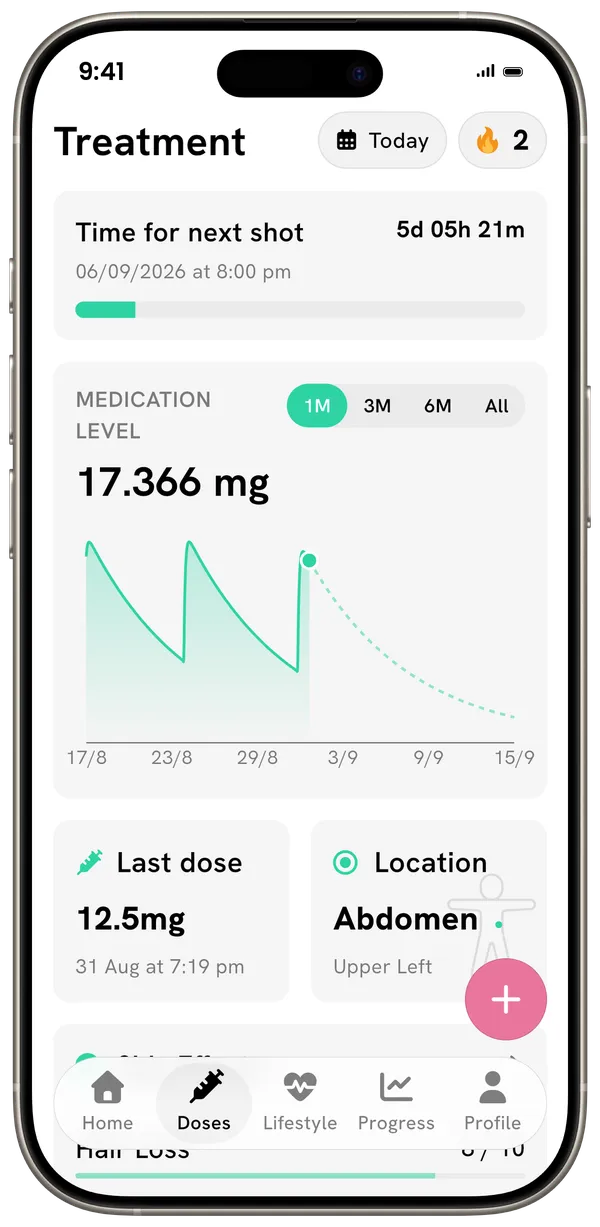
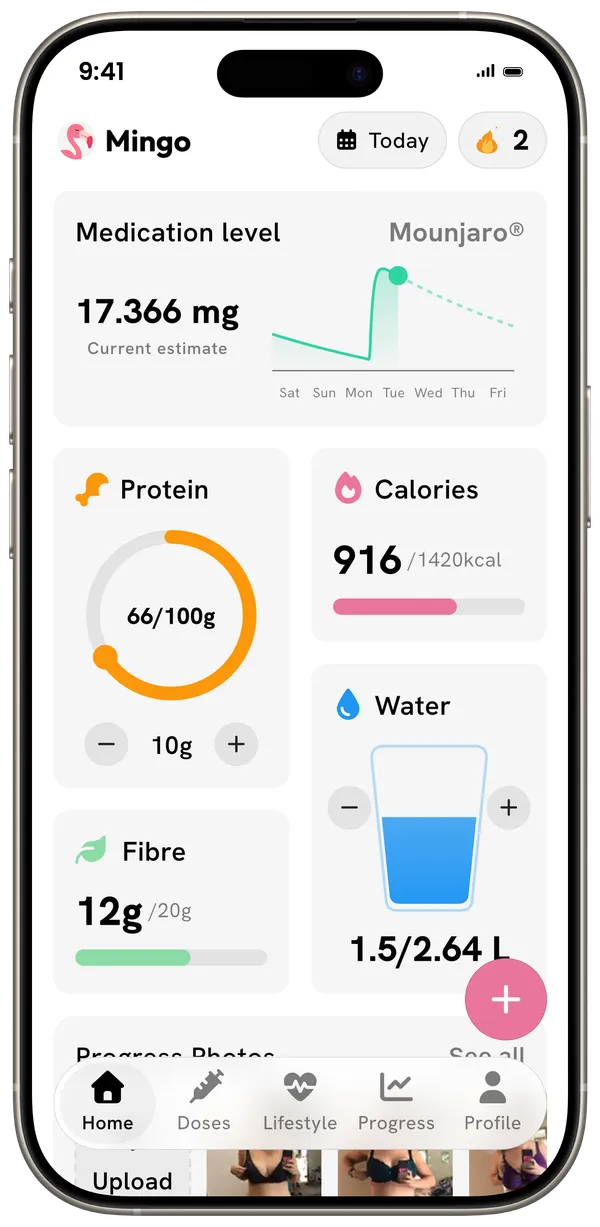
The calendar shows what the label allows; your real schedule is the one you live. In Mingo, every dose is saved with its date and strength, the weight chart marks the first dose of each new step, and side effects are rated from 0 to 10 on the same timeline, so when your prescriber asks how the last step went, the answer is already on your phone. Mingo doesn’t choose your dose or tell you when to step up; your prescriber does.


