Food noise, in the researchers’ words
“Food noise” started as something patients said, not a medical term, and it got far more attention once GLP-1 medicines arrived and people described the chatter going quiet. In 2025 a team at Pennington Biomedical Research Center gave it a working definition: persistent, intrusive thoughts about food that are disruptive to daily life and make healthy behaviors difficult. Then they built the questionnaire above to measure it.
It’s not the same as being hungry. None of the five FNQ statements asks about hunger. They ask whether your thoughts about food feel constant, uncontrollable, take up too much time, distract you, or affect your life. You can have a full stomach and a loud head.
| Hunger | A craving | Food noise | |
|---|---|---|---|
| What it is | Your body asking for food | A strong want for one particular food | Repeated, unwanted thoughts about food |
| What it’s about | Your stomach and energy | That food | Food in general: meals, snacks, plans, rules |
| What the FNQ asks about | Not asked | Not asked | All five statements |
How the questionnaire was tested
The FNQ was tested on a nationally representative online sample of 400 US adults, with 396 answering every question. People in a weight-loss program or taking weight-loss medicines were left out. The results:
| What was measured | Result |
|---|---|
| Internal consistency (Cronbach’s α) | 0.93: the five statements measure one thing |
| Same people, about a week later | r = 0.79: scores were stable |
| Average score (SD) | 7.4 (5.4), middle score 6, full range 0 to 20 |
| Women vs men | 8.0 vs 6.1 |
| Dieting to lose weight vs not | 9.1 vs 6.7 |
Scores didn’t differ significantly by BMI category. The authors say more research is needed on what the score means clinically. That’s why no total is labelled “high” on this page: the paper doesn’t set a threshold, and we don’t make one up.
What GLP-1 studies have found so far
Food noise is talked about far more than it has been measured. No randomized trial has used the FNQ yet. Here is all the evidence we could read in full, from strongest to weakest for this question:
| Study | Who | What they found | The catch |
|---|---|---|---|
| ECO 2026 abstract (Pennington Biomedical, WW) | 417 adults in a digital weight program; 92 started a GLP-1 medicine | FNQ fell 4.1 points in one month with a GLP-1 medicine vs 1.2 with behavioral support alone | Observational, one month, conference abstract, funded by WW |
| INFORM survey (Novo Nordisk) | 550 current semaglutide users | Median FNQ 13 before treatment, 6 now | “Before” was recalled, no control group, funded by the maker |
| US national survey (Hayashi & Masterson) | 1,000 adults, one question about food noise | Current GLP-1 users reported frequent food noise more often (26% vs 16%) | Cross-sectional; the authors think people with more food noise are the ones who start these medicines |
| Interview study (JAMA Network Open) | 30 current or former users | Most described food noise getting much quieter | Interviews show what it feels like, not how common it is |
Put together: people on GLP-1 medicines consistently report less food noise, and the one study with a comparison group found a bigger drop with the medicine. But nobody has run the placebo-controlled trial that would show how big the effect really is, or whether it lasts.
Why these medicines might turn the volume down
The labels don’t mention food noise. The Wegovy and Zepbound labels both describe GLP-1 as “a physiological regulator of appetite and caloric intake”. They say the medicine lowers calorie intake, likely by affecting appetite.
Small lab studies get closer to food noise without measuring it directly:
- Semaglutide 1 mg (30 people, 12 weeks): 24% less eaten across a day of free-choice meals, fewer food cravings, and a lower preference for high-fat foods.
- Semaglutide 2.4 mg (72 people, 20 weeks): 35% less eaten at lunch, better control of eating, and fewer, weaker cravings.
- Tirzepatide (114 people, 6 weeks): about 525 fewer calories at lunch than placebo and fewer cravings. Brain scans showed less activity in reward-related areas when people saw photos of high-fat, high-sugar foods.
Cravings and reward responses overlap with food noise, but they aren’t the same thing. So “GLP-1s quiet food noise by acting on the brain’s reward system” is a reasonable idea, not a proven mechanism.
What to bring to your prescriber
Food noise isn’t on any dosing chart, but it’s worth mentioning, especially when your dose changes. A few things that make the conversation useful:
- Your scores over time. Take the check every two weeks and save your scores. A trend means more than a single number.
- When it comes back. Note whether food noise returns at a certain point in the week, after a dose change, or after a missed or late dose.
- What else is going on. Side effects like nausea, and how you’re eating and sleeping, give your prescriber the rest of the picture.
- Anything that worries you. Bingeing, purging, or restricting food very hard needs a direct conversation, whatever your score.
A falling score isn’t a reason to change your dose on your own, and a rising one isn’t proof the medicine has stopped working. They’re notes for a conversation.
When food thoughts need more than a score
The FNQ measures how much thoughts about food bother you. It doesn’t screen for eating disorders. If food thoughts come with bingeing, making yourself sick, or cutting food right down, talk to your doctor and reach out to an eating disorder service: the National Eating Disorders Association in the US or Beat in the UK.
Using this check well
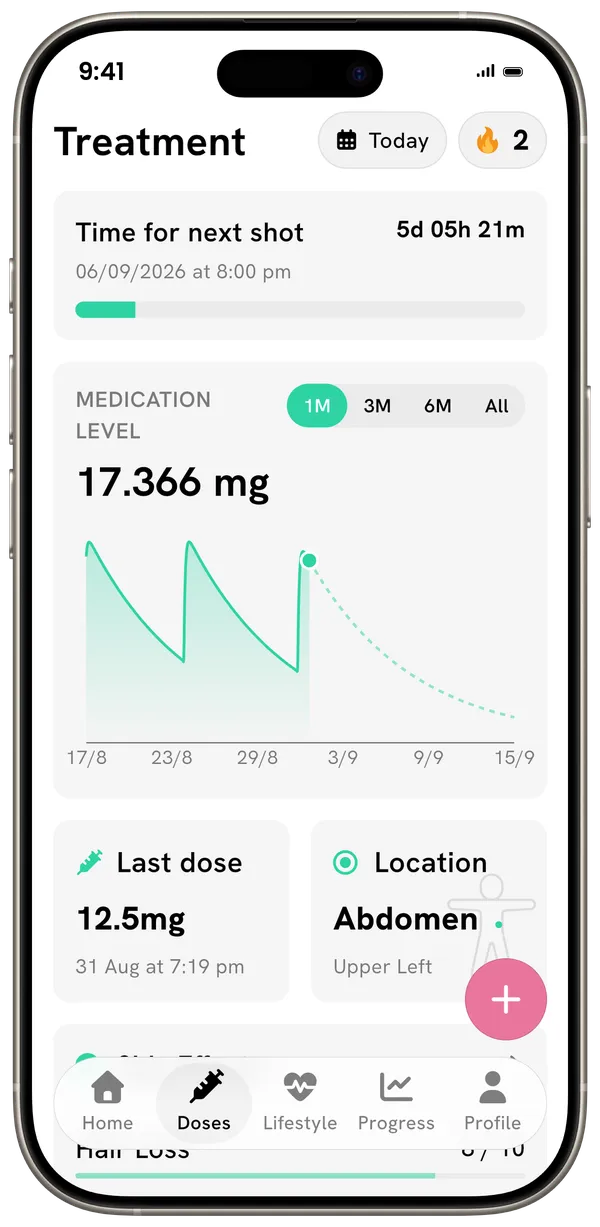
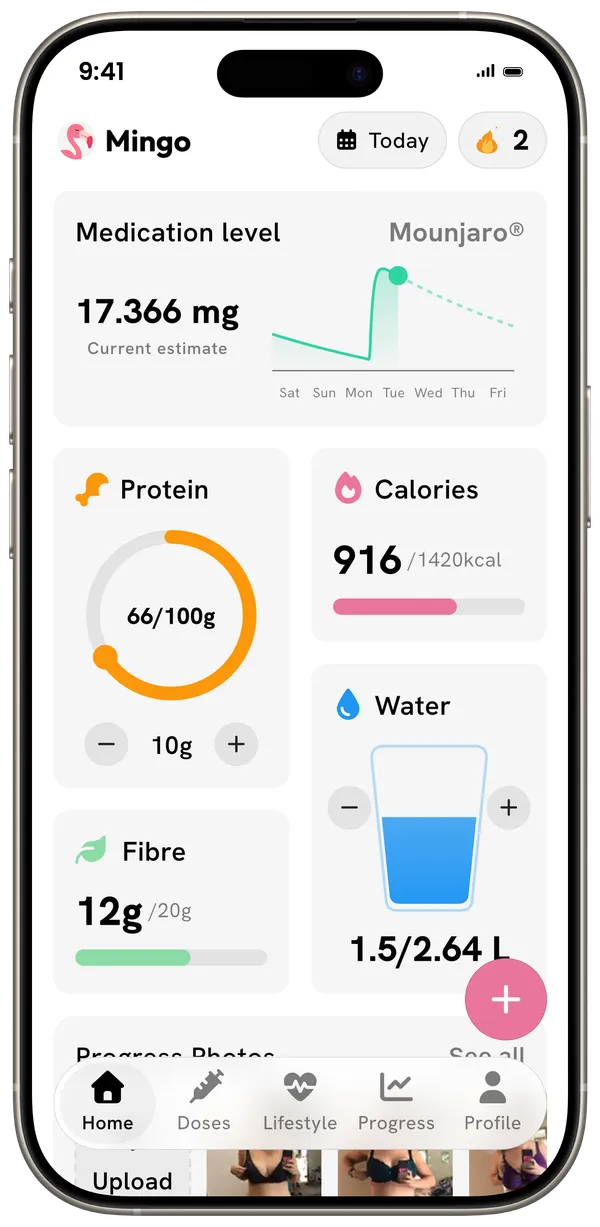
Answer about the last two weeks, as the instructions say, and try to take it under similar conditions each time. Your answers and scores never leave this browser. If you clear your browser data, the saved scores go with it. For a record that stays with your treatment, log food noise in the app next to your doses.


