Home time or local time
What the labels care about is the time between two doses, not which weekday or hour your phone shows. That leaves two simple ways to handle a shot day abroad.
- Keep home time. Inject at the same moment you would at home, whatever the local clock says. Doses stay exactly 7 days apart. The catch is the hour: 9:00 a.m. in New York is 11:00 p.m. in Tokyo and 3:00 a.m. in Auckland.
- Switch to local time. Inject at your usual hour on the local clock. Flying east, the first gap gets shorter by the time difference; flying west, longer. Coming home reverses it.
The time difference between any two places on Earth is at most about 26 hours, so even the biggest jump leaves around 142 hours between doses, far more than any label’s minimum. Pick whichever fits your days; the planner shows both, with the hours counted, daylight-saving changes included.
The only rule: the minimum gap
Each label lets you move your shot day, as long as two doses stay far enough apart: at least 3 days (72 hours) for Zepbound, Mounjaro and Trulicity, more than 2 days (48 hours) for Ozempic, and 2 or more days for Wegovy (Zepbound, Ozempic and Trulicity prescribing information, section 2; Wegovy patient information). The table above has them next to each pen’s out-of-fridge limit.
Those limits matter when you move a dose by days, not hours, which is what happens when your shot day lands on a flight.
When the shot day is a travel day
Injecting at the airport or mid-flight is nobody’s idea of fun. If your shot day is the day you leave or the day after, the planner offers a third option: take it the day before you fly, at your usual time. That’s 5 or 6 days after your previous dose, well clear of the minimum. Your next dose then stays on your usual day, 8 or 9 days later. A longer gap like that works like a dose taken a day or two late, which every weekly label’s missed-dose window covers (up to 4 days for Zepbound and Mounjaro, 5 for Ozempic). Our missed dose calculator has each rule.
What you shouldn’t do is take a dose early and then another on your usual day a day or two later: that breaks the minimum gap.
Coming home
Going back to your usual day is automatic: your next shot day at home, at your usual time, is shown with the hours since your last dose on the trip, for each option. If you switched to local time while away, that first gap at home is longer or shorter by the time difference, by the same margin as on the way out, and still well within the label.
If you’d rather keep a new day for good, you can: the labels allow it as long as the switch keeps the minimum gap.
Carrying your pens
The labels set how long each pen can be out of the fridge (the table above), and the same few rules for all of them: never freeze a pen, and don’t use one that has frozen; protect it from heat and light; keep it in its original carton. In practice that’s easiest with pens in your carry-on, where you can keep an eye on them, rather than in a checked bag. In the US, the TSA allows medically necessary liquids in reasonable quantities above the usual limit, as long as you tell the officers and let them inspect them.
The days out of the fridge add up: a Zepbound single-dose pen has 21 days in total at room temperature, not 21 days per trip. For which pen is which, see the Zepbound dosage chart, Mounjaro dosage chart, Wegovy dosage chart and Ozempic dosage chart.
Keeping your schedule on the road
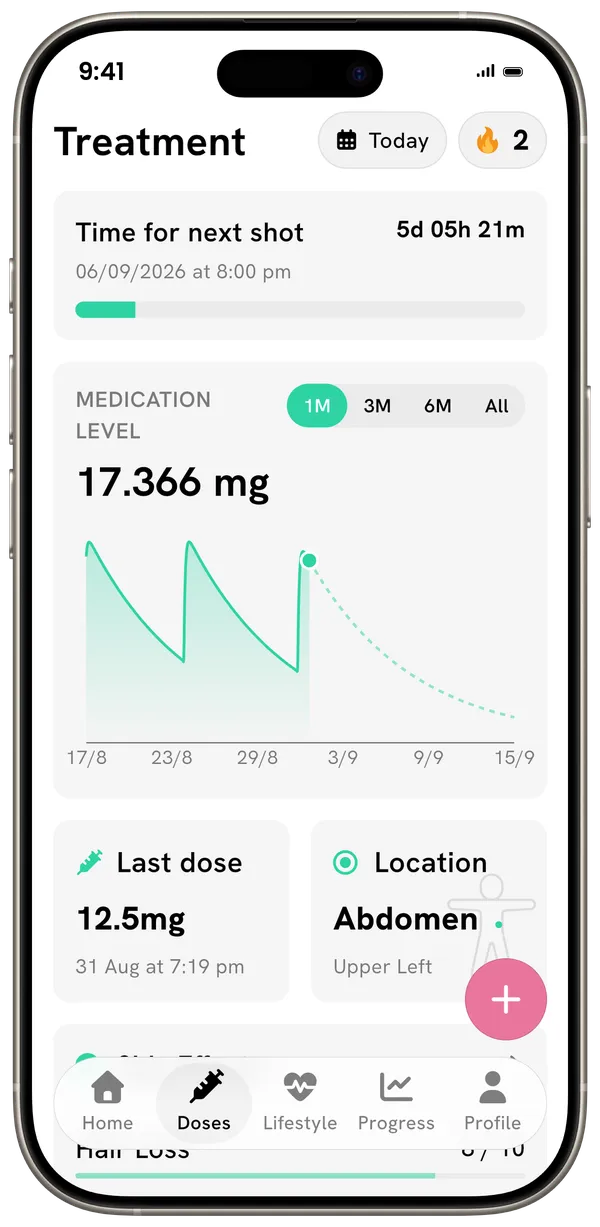
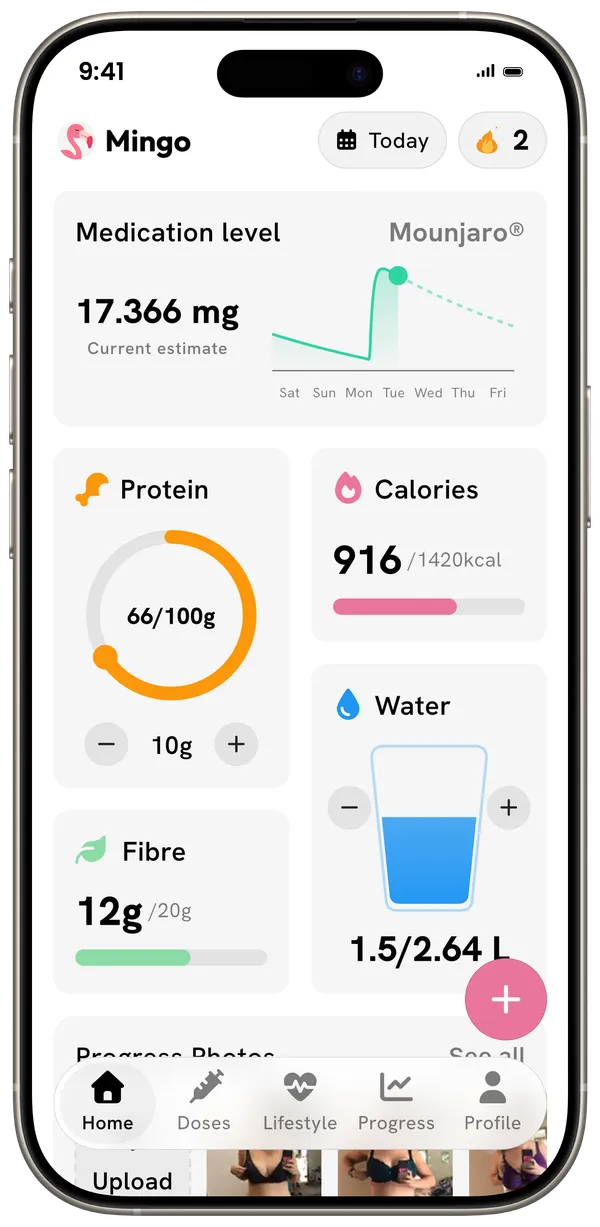
A trip is when shots get missed. In Mingo you can change your shot day and time in treatment settings, every dose is logged with its date, and you get a reminder on shot day plus a nudge two hours later if nothing was logged.


