Skip to content

GLP-1 tool

Waist to Height Ratio Calculator

Your waist to height ratio is your waist size divided by your height. Enter both to see your ratio, the NICE band it falls in, and the largest waist that keeps you under half your height.

Updated

Height

Midway between the bottom of your ribs and the top of your hips (just above the belly button), after breathing out normally.

Quick answer

Waist to height ratio is your waist divided by your height, both in the same unit. NICE's guideline NG246 says to keep your waist to less than half your height: 0.4 to 0.49 indicates no increased health risks, 0.5 to 0.59 increased risks and 0.6 or more further increased risks, such as type 2 diabetes, high blood pressure and heart disease. It applies to adults with a BMI under 35.

Waist size limits by height

The largest waist that keeps you under each NICE line. Under the 0.5 column means a healthy ratio.

HeightWaist under 0.5Waist from 0.6
4 ft 10 in (147 cm)29 in (74 cm)34.8 in (88 cm)
5 ft 0 in (152 cm)30 in (76 cm)36 in (91 cm)
5 ft 2 in (157 cm)31 in (79 cm)37.2 in (94 cm)
5 ft 4 in (163 cm)32 in (81 cm)38.4 in (98 cm)
5 ft 6 in (168 cm)33 in (84 cm)39.6 in (101 cm)
5 ft 8 in (173 cm)34 in (86 cm)40.8 in (104 cm)
5 ft 10 in (178 cm)35 in (89 cm)42 in (107 cm)
6 ft 0 in (183 cm)36 in (91 cm)43.2 in (110 cm)
6 ft 2 in (188 cm)37 in (94 cm)44.4 in (113 cm)
6 ft 4 in (193 cm)38 in (97 cm)45.6 in (116 cm)
6 ft 6 in (198 cm)39 in (99 cm)46.8 in (119 cm)

How much waists shrank in the GLP-1 trials

Average change in waist size, from the current US labels. Everyone in these trials also had diet and exercise counseling.

Medicine and doseTrialWaist at the startChangeOn placebo
Wegovy 2.4 mgSTEP 168 weeks45.1 in (115 cm)−5.3 in (14 cm)−1.6 in (4 cm)
Wegovy 2.4 mgwith type 2 diabetesSTEP 268 weeks45.1 in (115 cm)−3.7 in (9 cm)−1.8 in (5 cm)
Zepbound / Mounjaro 5 mgSURMOUNT-172 weeks44.6 in (113 cm)−5.5 in (14 cm)−1.6 in (4 cm)
Zepbound / Mounjaro 10 mgSURMOUNT-172 weeks45.2 in (115 cm)−7 in (18 cm)−1.6 in (4 cm)
Zepbound / Mounjaro 15 mgSURMOUNT-172 weeks45 in (114 cm)−7.3 in (19 cm)−1.6 in (4 cm)
Zepbound / Mounjaro 10 mgwith type 2 diabetesSURMOUNT-272 weeks45 in (114 cm)−4.3 in (11 cm)−1.3 in (3 cm)
Zepbound / Mounjaro 15 mgwith type 2 diabetesSURMOUNT-272 weeks45.1 in (115 cm)−5.2 in (13 cm)−1.3 in (3 cm)

Log your waist next to your weight

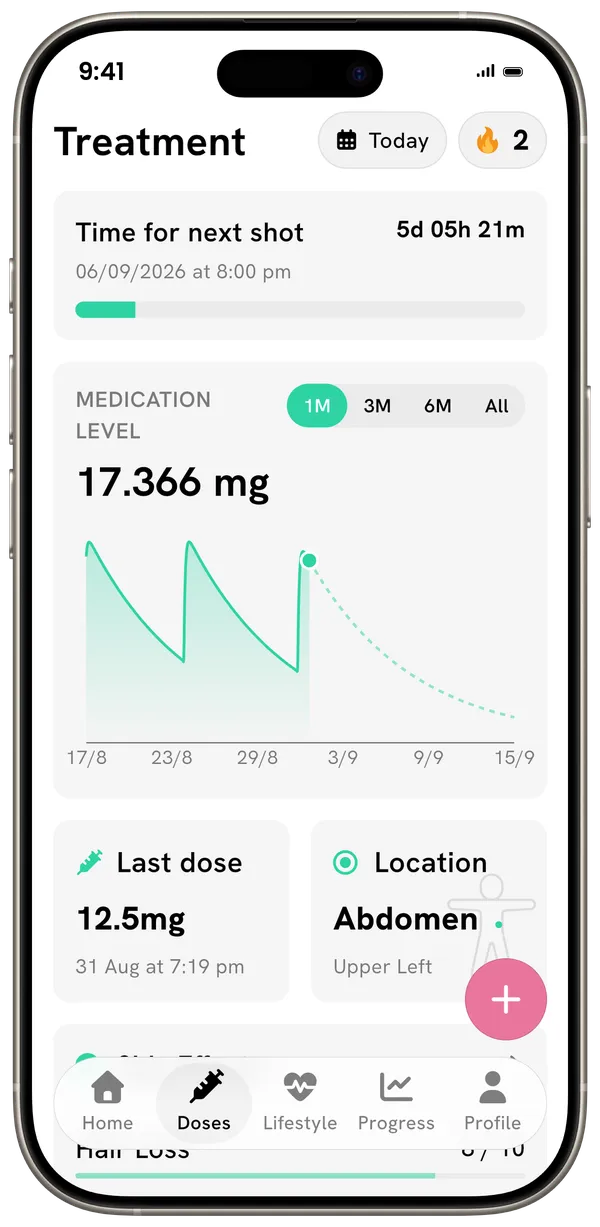
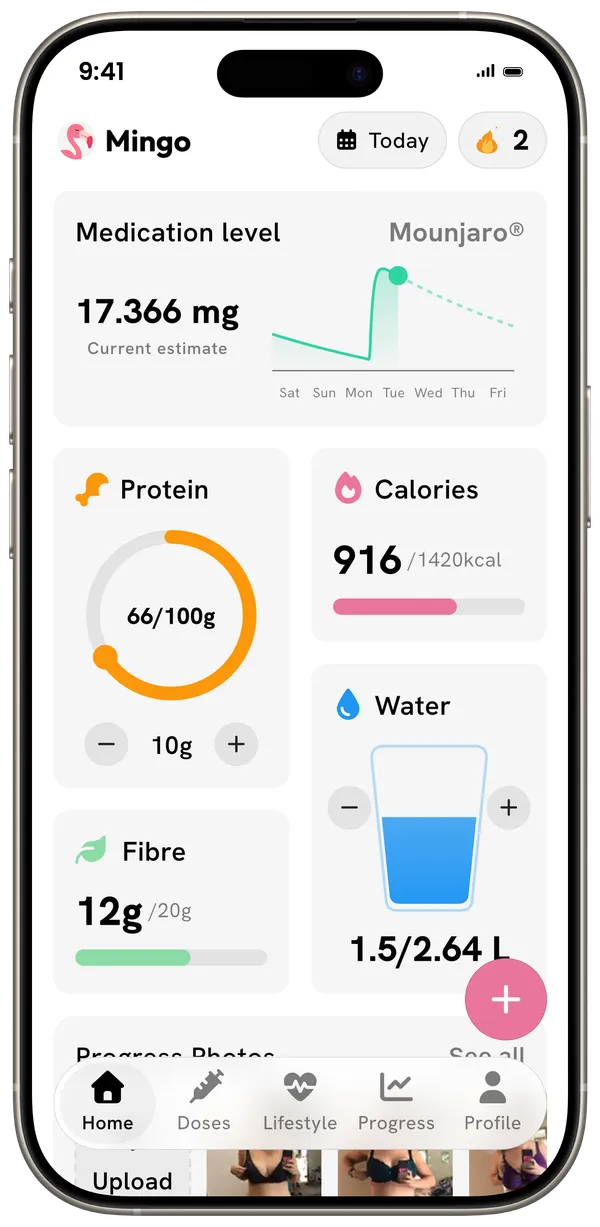
In Mingo you can log your waist and seven other body measurements, with a how-to for each spot, and see how each one changes over time next to your weight and your doses. Once a week is plenty.

Rated 4.7 out of 5 on the App Store · 1,579 ratings

How to measure your waist

The method below is the one in NICE’s guideline (NG246, box 1), with the NHS’s extra tips:

  1. Stand up straight. Find the bottom of your ribs and the top of your hip bone, on your side.
  2. Wrap a tape measure around your waist halfway between the two. That’s usually just above your belly button.
  3. Keep the tape level and snug, without pressing into the skin.
  4. Breathe out normally, don’t hold your stomach in, and read the tape.

Then measure your height without shoes, in the same unit. If you know your height in feet and inches, convert it to inches first: 5 ft 7 in is 67 inches.

Common mistakes: using your trouser size instead of a tape, measuring at the narrowest point instead of halfway between ribs and hips, holding your breath or pulling your stomach in, and measuring at different times of day from one week to the next.

What your ratio means

NICE’s guideline sets three bands for adults (recommendation 1.9.14):

Ratio NICE band What NICE says it indicates
0.4 to 0.49 Healthy central adiposity No increased health risks
0.5 to 0.59 Increased central adiposity Increased health risks
0.6 or more High central adiposity Further increased health risks

The health risks it names are type 2 diabetes, high blood pressure (hypertension) and cardiovascular disease. The bands are the same for men and women and for all ethnicities, and they hold for people with a lot of muscle. NICE gives no band below 0.4.

The message NICE asks health professionals to give is simple: keep your waist to less than half your height. When the ratio shows increased risk, NICE encourages people to get advice from a healthcare professional, who may suggest further checks such as a cardiometabolic risk assessment.

Who it’s for, and who it isn’t

NICE recommends the ratio, alongside BMI, for adults with a BMI under 35. The NHS’s own calculator adds that it shouldn’t be used if you’re pregnant, have or think you may have an eating disorder, or have a growth disorder or another condition that affects your height (NHS). It’s a screening number, not a diagnosis.

Many people start a GLP-1 medicine with a BMI above 35. For them, the ratio becomes part of NICE’s picture once their BMI falls below 35, which makes it a useful number to start tracking as treatment goes on.

Why waist, and not only BMI

BMI uses only weight and height, so it can’t tell where fat sits. NICE says to interpret BMI with caution because it isn’t a direct measure of central adiposity (fat around the middle), and with extra caution in people with high muscle mass. It also notes that people from South Asian, Chinese, other Asian, Middle Eastern, Black African or African-Caribbean backgrounds are prone to central adiposity, with cardiometabolic risk at a lower BMI. The waist-to-height ratio adds that missing piece with one tape measure.

This guideline, NG246, replaced NICE’s older obesity guideline CG189 in January 2025; the waist-to-height recommendations themselves date from NICE’s 2022 update.

Waist size and GLP-1 medicines

The trials behind Wegovy and Zepbound measured waist size at the start and the end. The table above lists the averages from the current US labels. In short: in STEP 1, waists shrank by 13.5 cm (about 5.3 inches) over 68 weeks on Wegovy 2.4 mg, and in SURMOUNT-1 by 14.0, 17.7 and 18.5 cm (about 5.5 to 7.3 inches) over 72 weeks on tirzepatide 5, 10 and 15 mg. People with type 2 diabetes saw smaller changes, as they did for weight.

Waist size isn’t the same as belly fat, but the two moved together. In a body-scan substudy of SURMOUNT-1, people on tirzepatide lost 40.1% of their visceral fat, the fat around the organs, against 7.3% on placebo (Look et al., 2025).

The trials reported waist in centimeters, not as a ratio, and each person’s change varied around these averages. To see how the ratio maps to your own height, use the table of waist limits above. For your weight, the weight loss percentage calculator tracks your progress toward 5, 10, 15 and 20%, and the lean body mass calculator covers how much of the weight lost in the trials was muscle and other lean tissue.

Measuring it over time

Your waist can change a little from one day to the next, so one measurement is a snapshot. Measure in the same place, at the same time of day (for example, in the morning before breakfast), about once a week, and look at the trend.

Frequently asked questions

What is a healthy waist to height ratio?

Between 0.4 and 0.49, according to NICE: your waist is less than half your height. NICE calls that healthy central adiposity, with no increased health risks.

How do I calculate my waist to height ratio?

Measure your waist and your height in the same unit, then divide the waist by the height. NICE's example: a 38-inch waist and a height of 5 ft 7 in (67 inches) give 38 ÷ 67 = 0.57.

How big should my waist be for my height?

Less than half your height. At 5 ft 4 in (64 inches) that's under 32 inches; at 5 ft 10 in (70 inches), under 35 inches; at 170 cm, under 85 cm. The table on this page lists every height from 4 ft 10 in to 6 ft 6 in.

Is waist to height ratio better than BMI?

They measure different things. NICE recommends using both for adults with a BMI under 35: BMI as a measure of overall weight, and the waist-to-height ratio because BMI isn't a direct measure of fat around the middle (central adiposity).

Are the bands different for men and women?

No. NICE says the same bands apply to both sexes and all ethnicities, including adults with high muscle mass.

Who shouldn't use the waist to height ratio?

NICE applies it to adults with a BMI under 35. The NHS also says not to use its calculator if you're pregnant, have or think you may have an eating disorder, or have a growth disorder or another condition that affects your height.

Where exactly do I measure my waist?

Halfway between the bottom of your ribs and the top of your hips, which is usually just above the belly button. Breathe out normally before you read the tape, and don't hold your stomach in.

Do GLP-1 medicines reduce waist size?

In the trials, yes, on average. In STEP 1, waists shrank by 13.5 cm (about 5.3 inches) over 68 weeks on Wegovy 2.4 mg, against 4.1 cm on placebo. In SURMOUNT-1, they shrank by 14.0 to 18.5 cm over 72 weeks on tirzepatide 5 to 15 mg, against 4.0 cm on placebo.

Sources

Updated .

  1. NICE guideline NG246, Overweight and obesity management (January 2025, updated January 2026), recommendations 1.9.5 to 1.9.15 and box 1
  2. NHS. Calculate your waist to height ratio
  3. Wegovy prescribing information, revised 6/2026, section 14, Table 13 (DailyMed)
  4. Zepbound prescribing information, revised 8/2026, section 14, Table 3 (DailyMed)
  5. Look M et al. Body composition changes during weight reduction with tirzepatide in the SURMOUNT-1 study. Diabetes Obes Metab 2025

GLP-1 calculators and dose charts