Skip to content

GLP-1 tool

Weight Loss Percentage Calculator, With Milestone Dates

This weight loss percentage calculator shows how much of your starting weight you've lost, how far you are from 5, 10, 15 and 20%, and, with a start date, when you'd reach each milestone at your pace so far.

Updated

Your first weigh-in or first dose. Adds your weekly pace and the date you'd reach each milestone at that pace.

Shows how many people in that medicine's trial got to each milestone.

Quick answer

To calculate weight loss percentage, subtract your current weight from your starting weight, divide by your starting weight and multiply by 100. From 220 lb to 198 lb is 22 ÷ 220 × 100 = 10%. The units don't matter as long as both weights use the same one. A 5% loss is a common first milestone: for someone who weighs 200 pounds, it's 10 pounds.

5, 10, 15 and 20% of your starting weight

Find the starting weight closest to yours: each cell is how much you'd lose and the weight you'd be at.

Starting weight5%10%15%20%
150 lb7.5 → 142.5 lb15 → 135 lb22.5 → 127.5 lb30 → 120 lb
175 lb8.8 → 166.3 lb17.5 → 157.5 lb26.3 → 148.8 lb35 → 140 lb
200 lb10 → 190 lb20 → 180 lb30 → 170 lb40 → 160 lb
225 lb11.3 → 213.8 lb22.5 → 202.5 lb33.8 → 191.3 lb45 → 180 lb
250 lb12.5 → 237.5 lb25 → 225 lb37.5 → 212.5 lb50 → 200 lb
275 lb13.8 → 261.3 lb27.5 → 247.5 lb41.3 → 233.8 lb55 → 220 lb
300 lb15 → 285 lb30 → 270 lb45 → 255 lb60 → 240 lb
325 lb16.3 → 308.8 lb32.5 → 292.5 lb48.8 → 276.3 lb65 → 260 lb
350 lb17.5 → 332.5 lb35 → 315 lb52.5 → 297.5 lb70 → 280 lb

How many people reached each milestone in the trials

Out of 100 adults without diabetes in each medicine's main trial, from the current US labels. The full picture, including the averages, is in the GLP-1 weight loss calculator.

Medicine and doseLost 5%+Lost 10%+Lost 15%+Lost 20%+
Wegovy (injection) 2.4 mgSTEP 1, 68 weeks83 in 10066 in 10048 in 10030 in 100
Wegovy (injection) 7.2 mgSTEP UP, 72 weeks89 in 10080 in 10064 in 10046 in 100
Wegovy pill 25 mgOASIS 4, 64 weeks77 in 10060 in 10047 in 10028 in 100
Zepbound / Mounjaro 5 mgSURMOUNT-1, 72 weeks86 in 10069 in 10048 in 10030 in 100
Zepbound / Mounjaro 10 mgSURMOUNT-1, 72 weeks89 in 10078 in 10066 in 10050 in 100
Zepbound / Mounjaro 15 mgSURMOUNT-1, 72 weeks91 in 10084 in 10071 in 10057 in 100
Foundayo 5.5 mgATTAIN-1, 72 weeks59 in 10032 in 10014 in 1006 in 100
Foundayo 9 mgATTAIN-1, 72 weeks63 in 10040 in 10020 in 1009 in 100
Foundayo 17.2 mgATTAIN-1, 72 weeks72 in 10055 in 10036 in 10018 in 100
Saxenda 3 mgSCALE Obesity and Prediabetes, 56 weeks62 in 10034 in 100Not reportedNot reported

The Saxenda label reports people who lost at least 5% and more than 10%, not 15 or 20%.

Watch your % go up in Mingo

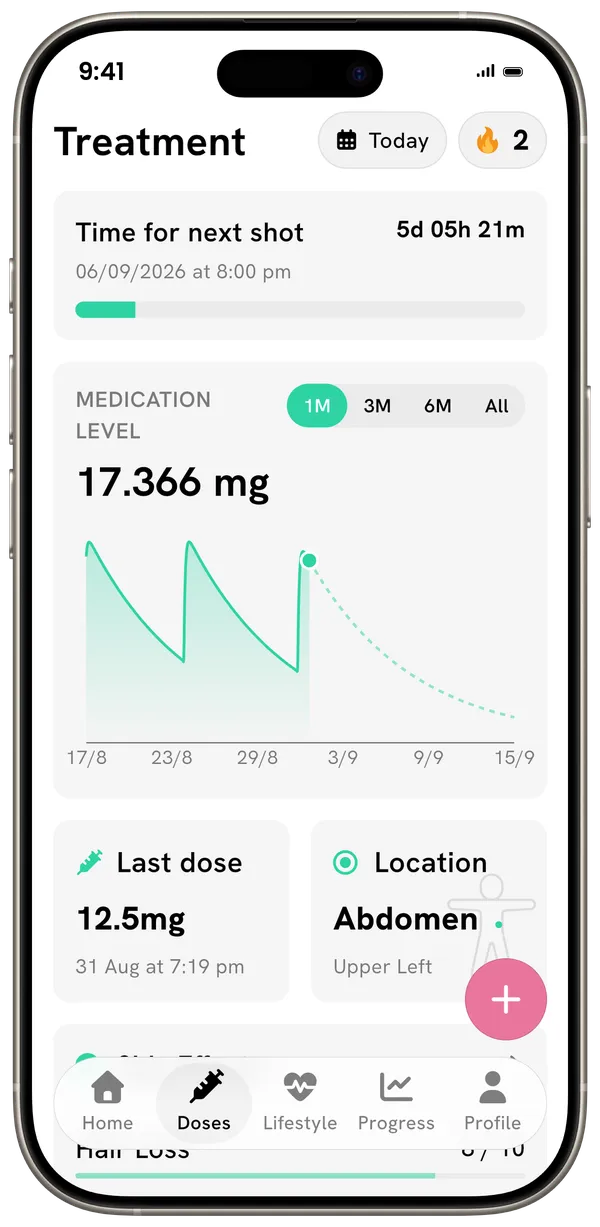
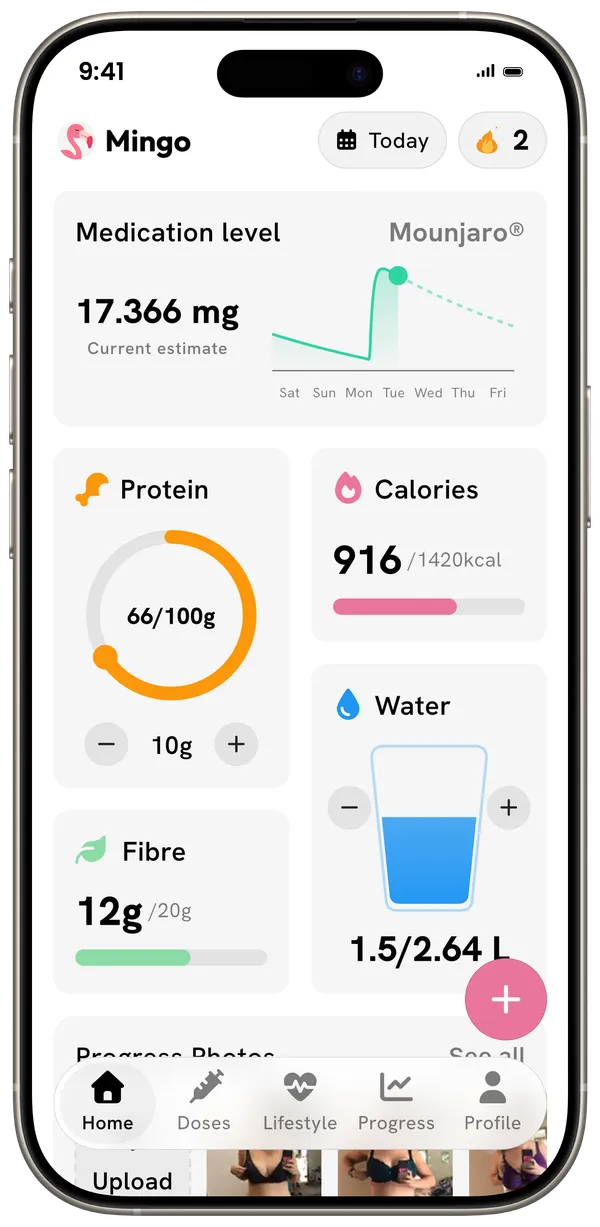
Log your weigh-ins in Mingo and it tracks how far you are toward your goal weight, gives you a badge when you've lost 5, 10 and 15% of your starting weight, and puts your % lost on a progress card you can share. Set the weekly pace you're aiming for and it shows your estimated goal date.

Rated 4.7 out of 5 on the App Store · 1,579 ratings

The formula, step by step

Weight loss percentage = (starting weight − current weight) ÷ starting weight × 100.

  1. Take your starting weight: say 240 lb.
  2. Subtract your current weight, 216 lb: you’ve lost 24 lb.
  3. Divide by your starting weight: 24 ÷ 240 = 0.10.
  4. Multiply by 100: you’ve lost 10% of your body weight.

It works the same in kilograms (from 110 kg to 99 kg is 11 ÷ 110 × 100 = 10%) or in stones, as long as both weights use the same unit. If your weight has gone up, the result is negative.

This is the same formula the Mingo app uses for the % on its progress card, so the number here and the number in the app match.

Why a percentage tells you more than pounds

Twenty pounds means something different at 180 lb than at 320 lb. A percentage puts everyone on the same scale:

Lost From 180 lb From 250 lb From 320 lb
20 lb 11.1% 8.0% 6.3%
30 lb 16.7% 12.0% 9.4%
40 lb 22.2% 16.0% 12.5%

It’s also how the clinical trials of GLP-1 medicines report results, so a percentage is the only way to compare your own progress with what they found. The CDC uses the same idea: it notes that even modest weight loss can help blood pressure, cholesterol and blood sugar, and gives the example that 5% of 200 pounds is 10 pounds (CDC).

Why 5, 10, 15 and 20%

These are the four thresholds the US prescribing information for Wegovy, Zepbound and Foundayo uses to report how many people in each trial lost “at least” that much (Saxenda’s label reports 5 and 10%). That makes them natural milestones: when you reach one, you can look up how many people in a trial got that far. Pick your medicine and dose in the calculator to add that column, and the second table on this page lists every dose with data, straight from the labels.

The labels for Ozempic, Rybelsus, Trulicity, Victoza and the US Mounjaro label don’t report these thresholds: their trials were in people with type 2 diabetes and measured blood sugar. Mounjaro is the same medicine as Zepbound, so at 5, 10 and 15 mg the calculator uses Zepbound’s obesity trial, SURMOUNT-1.

The averages and the full spread of results, applied to your weight, are in the GLP-1 weight loss calculator. That page answers “what can I expect?”; this one answers “where am I now?”.

Milestone dates: what “at your current pace” means

Give the calculator the date you started and it works out your average loss per week so far, in pounds or kilograms and as a percentage of your starting weight. It then divides what’s left to each milestone by that weekly figure to get a date.

Two things to keep in mind:

  • It’s a straight line through two points. Weight loss rarely moves in a straight line: there are faster weeks, slower weeks and stalls. Treat the dates as a rough guide that changes every time you update your numbers.
  • It needs at least two weeks. A pace from a few days of weigh-ins mostly measures water and timing, so the calculator waits until your start date is at least 14 days ago.

On a GLP-1 medicine the first weeks are on a low starting dose that steps up every four weeks (see the Wegovy dosage chart and the Zepbound dosage chart), so your early pace may not be your later one. The CDC notes that people who lose about 1 to 2 pounds a week are more likely to keep the weight off than people who lose faster. If you’re losing much faster or slower than you expected, that’s a conversation for your prescriber.

% of body weight vs % of your goal

Two percentages often get mixed up:

Compares what you’ve lost with Example: start 200 lb, goal 160 lb, now 180 lb
% of body weight lost Your starting weight 20 ÷ 200 = 10%
% of the way to your goal How much you set out to lose 20 ÷ 40 = 50%

This calculator shows the first, plus how much is left to your goal and the date you’d reach it at your pace.

Getting a number you can trust

  • Use the same scale, at the same time of day, in the same conditions: for example, in the morning after the bathroom and before breakfast.
  • Compare weeks, not days. One weigh-in can be off by a few pounds of water.
  • Keep your starting weight fixed. Recalculating from a later “start” makes your percentage look smaller than it is.

Tracking it week by week

A one-off calculation tells you where you are today. In Mingo you log each weigh-in, see how far you are toward your goal, and get a badge when you pass 5, 10 and 15% of your starting weight. Your % lost also appears on a progress card you can share, and the chart marks each dose change so you and your prescriber can see what each step did.

Frequently asked questions

How do I calculate my weight loss percentage?

Subtract your current weight from your starting weight, divide the result by your starting weight, and multiply by 100. Going from 180 lb to 171 lb is 9 ÷ 180 × 100 = 5%.

How much is 5% of my body weight?

Multiply your starting weight by 0.05. At 200 lb that's 10 lb, at 250 lb it's 12.5 lb, and at 90 kg it's 4.5 kg. The table on this page shows 5, 10, 15 and 20% for common starting weights.

Should I use my starting weight or my current weight?

Your starting weight. Weight loss percentage is always measured against where you began, which is how the GLP-1 trials report it and how the Mingo app calculates it.

What's the difference between % of body weight lost and % of my goal?

% of body weight lost compares what you've lost with your starting weight. % of goal compares it with how much you set out to lose. If you started at 200 lb with a goal of 160 lb and now weigh 180 lb, you've lost 10% of your body weight and you're 50% of the way to your goal.

How is the milestone date calculated?

From your average weekly loss between your start date and today. If you've lost 12 lb in 8 weeks, that's 1.5 lb a week, and the calculator divides what's left to each milestone by 1.5 lb. It's arithmetic on your own numbers, not a prediction: weight rarely drops in a straight line.

How fast should I be losing weight?

The CDC says people who lose about 1 to 2 pounds a week are more likely to keep it off than people who lose faster. On a GLP-1 medicine, your prescriber sets the pace of your dose steps; ask them what to expect for you.

How many people reach 10% or 15% on a GLP-1?

In the main trials, among adults without diabetes, 66 in 100 on Wegovy 2.4 mg lost at least 10% after 68 weeks and 48 in 100 at least 15%. On Zepbound or Mounjaro 15 mg, 84 in 100 lost at least 10% and 71 in 100 at least 15% after 72 weeks.

Why did my percentage go down this week?

Day-to-day weight moves with water, food and the time you weigh yourself, so a single weigh-in can go up even while the trend goes down. Weigh at the same time, in the same conditions, and look at the trend over several weeks.

Sources

Updated .

  1. Wegovy prescribing information, revised 6/2026, section 14 (DailyMed)
  2. Zepbound prescribing information, revised 8/2026, section 14 (DailyMed)
  3. Foundayo prescribing information, revised 7/2026, section 14, Table 6 (DailyMed)
  4. Saxenda prescribing information, revised 2/2026, section 14, Table 4 (DailyMed)
  5. CDC. Steps for Losing Weight
  6. Wilding JPH et al. Once-weekly semaglutide in adults with overweight or obesity (STEP 1). N Engl J Med 2021
  7. Jastreboff AM et al. Tirzepatide once weekly for the treatment of obesity (SURMOUNT-1). N Engl J Med 2022

GLP-1 calculators and dose charts