Where the numbers come from
Every number in this calculator is copied from the clinical-studies section of the current US prescribing information for Wegovy, Zepbound, Foundayo and Saxenda. For each medicine and dose it takes three things from one trial: the average weight lost, the share of people who lost at least 5, 10, 15 and 20% (Saxenda’s label reports only 5% and more than 10%, so its chart has three groups instead of five), and the placebo group for comparison. Your weight is then multiplied by those percentages.
Two things it deliberately doesn’t do:
- It doesn’t draw a week-by-week curve. The labels report weight at the end of each trial, not at every week, and a smooth line between “week 0” and “week 72” would look more precise than the evidence is.
- It doesn’t mix numbers from different analyses. Trials report results in more than one way (for example, counting everyone who started, or only people who stayed on the medicine), and the second way gives bigger numbers. The labels use the first, more conservative one for every medicine here, so the doses can be compared fairly.
The average hides a wide range
An average of 15% doesn’t mean most people lose 15%. In the Wegovy 2.4 mg trial, the spread looked like this out of every 100 people (Wegovy prescribing information):
| Weight lost after 68 weeks | People out of 100 |
|---|---|
| 20% or more | 30 |
| 15 to 20% | 18 |
| 10 to 15% | 18 |
| 5 to 10% | 17 |
| Less than 5% | 17 |
That’s why the calculator shows 100 dots instead of one number. If your goal is to lose 20%, the useful question isn’t “what’s the average?” but “how many people got there?”, and the answer changes a lot by medicine and dose: 30 in 100 on Wegovy 2.4 mg, 46 in 100 on Wegovy 7.2 mg, and 30, 50 and 57 in 100 on Zepbound or Mounjaro 5, 10 and 15 mg.
With type 2 diabetes, expect less
People with type 2 diabetes lost less weight in their own trials, on the same doses:
| Medicine and dose | Without diabetes | With type 2 diabetes |
|---|---|---|
| Wegovy 2.4 mg | 14.9% (STEP 1, 68 weeks) | 9.6% (STEP 2, 68 weeks) |
| Zepbound / Mounjaro 10 mg | 19.5% (SURMOUNT-1, 72 weeks) | 12.8% (SURMOUNT-2, 72 weeks) |
| Zepbound / Mounjaro 15 mg | 20.9% (SURMOUNT-1, 72 weeks) | 14.7% (SURMOUNT-2, 72 weeks) |
| Foundayo 17.2 mg | 11.1% (ATTAIN-1, 72 weeks) | 9.6% (ATTAIN-2, 72 weeks) |
| Saxenda 3 mg | 7.4% (SCALE Obesity and Prediabetes, 56 weeks) | 5.4% (SCALE Diabetes, 56 weeks) |
Tick “I have type 2 diabetes” and the calculator switches to those trials. For the doses that were never tested in people with diabetes (Zepbound 5 mg, Wegovy 7.2 mg and the Wegovy pill), it shows the results without diabetes and tells you so.
How fast it happens
The trials report the end result, but two of them give a look at the first months. In STEP 4, people on semaglutide had lost 10.6% on average after a 20-week run-in that included the dose steps up to 2.4 mg (Rubino et al., JAMA 2021). In SURMOUNT-4, people on tirzepatide had lost 20.9% after 36 weeks on the highest dose they could tolerate (Aronne et al., JAMA 2024). Neither group was the same as in the main trials, so treat these as rough markers, not as points on your own curve.
The slow start is by design: every GLP-1 medicine begins at a low dose and steps up every four weeks to limit stomach side effects. The Wegovy dosage chart and Zepbound dosage chart show each step.
What happens if you stop
It matters as much as the loss itself. Three trials followed people after they stopped:
| Trial | What happened |
|---|---|
| STEP 1 extension (semaglutide) | People had lost 17.3% by week 68. One year after stopping, they had regained 11.6 percentage points, about two thirds of the loss, for a net loss of 5.6% |
| STEP 4 (semaglutide) | From week 20 to week 68, people who stayed on lost another 7.9%; those switched to placebo regained 6.9% |
| SURMOUNT-4 (tirzepatide) | From week 36 to week 88, people who stayed on lost another 5.5%; those switched to placebo regained 14.0% |
Sources: Wilding et al., 2022; Rubino et al., 2021; Aronne et al., 2024. The labels describe these medicines as treatment for chronic weight management: the effect lasts while you take them. Any plan to stop or lower your dose is one to make with your prescriber.
Comparing medicines
Each row in the calculator comes from a different trial, with different people, so the numbers aren’t a direct contest. There is one head-to-head trial: in SURMOUNT-5, adults without diabetes on the highest tolerated dose of tirzepatide lost 20.2% after 72 weeks, against 13.7% on semaglutide (Aronne et al., NEJM 2025). Our Zepbound vs Wegovy guide covers the other differences, from side effects to how each is taken.
Saxenda’s trial was shorter (56 weeks) than the others (68 to 72), and Foundayo is a daily pill, like the Wegovy pill. Ozempic isn’t in the calculator because it isn’t approved for weight loss, and Mounjaro appears together with Zepbound because they’re the same medicine, tirzepatide, at the same doses. In the UK and EU, Mounjaro is also authorised for weight management.
Tracking your own results
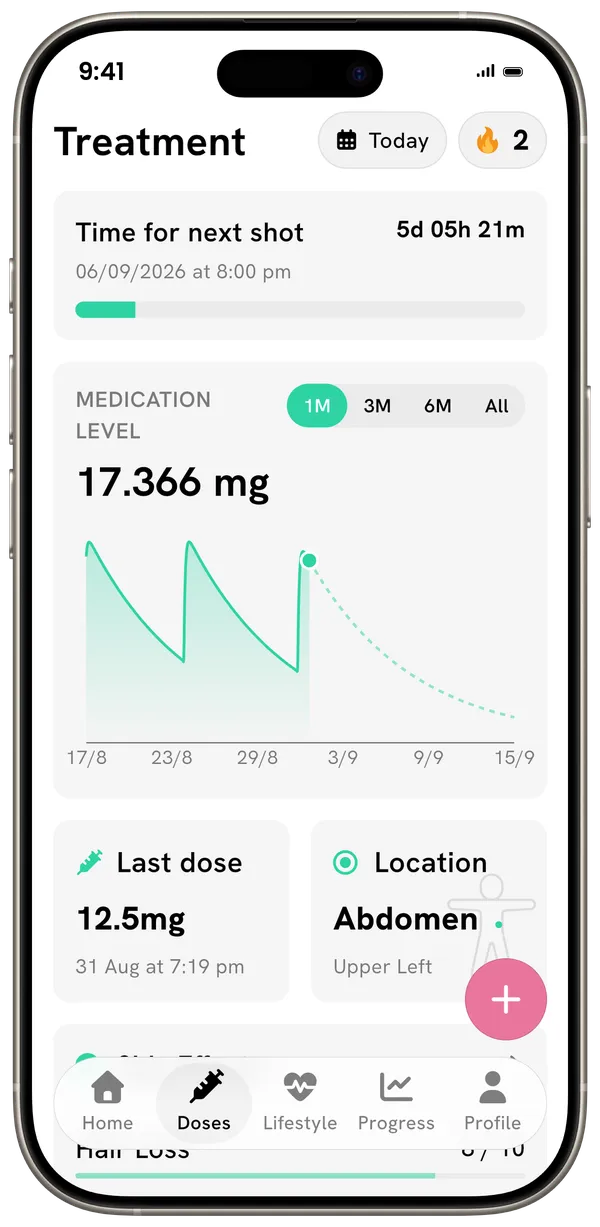
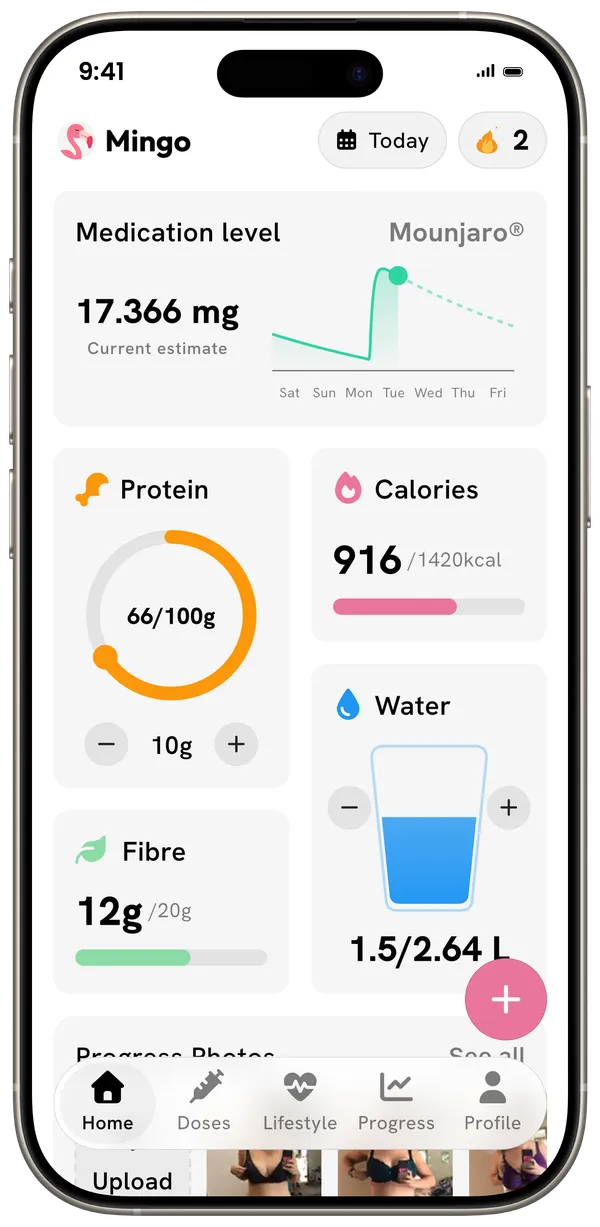
A trial average tells you what’s typical; only your own weigh-ins tell you how it’s going for you. In Mingo you set a weight goal and the weekly pace you’re aiming for, see your estimated goal date, and log every weigh-in on a chart that marks each dose change, so you and your prescriber can see what each step did.


