Why water and fiber matter more on a GLP-1 medicine
Your GLP-1 water intake and your fiber are the two habits most tied to the side effects people notice first. Semaglutide (Ozempic, Wegovy) and tirzepatide (Mounjaro, Zepbound) slow digestion and shrink appetite. Nausea, diarrhea, vomiting and constipation are among the most common side effects on every one of their labels, and each of them pulls in one of two directions: losing fluid, or a gut that moves too slowly.
The labels are specific about the fluid side. Zepbound (section 5.3), Mounjaro (5.5), Wegovy (5.5) and Ozempic (5.6) all carry the same warning, “Acute Kidney Injury Due to Volume Depletion”: there have been reports of kidney injury, some needing dialysis, mostly in people who became dehydrated from nausea, vomiting or diarrhea (Zepbound prescribing information). The label asks prescribers to check kidney function in people with these side effects, especially when starting and raising the dose.
Constipation is the other half. In the Wegovy weight-loss trials, 24% of people on 2.4 mg reported it, against 11% on placebo (Wegovy prescribing information, Table 3). On Zepbound it was 11 to 17% depending on dose, against 5% on placebo (Zepbound prescribing information, Table 1). A 2025 joint advisory from four US nutrition and obesity societies says constipation “should be managed proactively”, starting with adequate fluids and fiber from foods (Mozaffarian et al., 2025).
Thirst may not remind you either. In a small 2021 trial, the GLP-1 medicine dulaglutide cut how much people drank by about 17% and lowered their thirst (Winzeler et al., 2021). Those 34 people had primary polydipsia, a condition of drinking too much, so it doesn’t prove the same happens to everyone on a GLP-1. It’s still a reason to drink to a number rather than to thirst.
Neither water nor fiber needs a prescription, and both are easy to forget when you’re barely hungry. A number to aim for helps.
What each label says
The same two warnings run through every label, with different trial numbers:
| Medicine | Kidney warning (dehydration) | Constipation in the label’s trials |
|---|---|---|
| Zepbound (tirzepatide) | Section 5.3 | 11–17% by dose vs 5% on placebo (weight-loss trials) |
| Wegovy (semaglutide) | Section 5.5 | 24% on 2.4 mg vs 11% on placebo (weight-loss trials) |
| Mounjaro (tirzepatide) | Section 5.5 | 6–7% by dose vs 1% on placebo (type 2 diabetes trials) |
| Ozempic (semaglutide) | Section 5.6 | 3–5% by dose vs 1.5% on placebo (type 2 diabetes trials) |
Sources: the Zepbound, Wegovy, Mounjaro and Ozempic prescribing information, section 6.1. The diabetes trials used lower doses and different people, so the rates aren’t directly comparable. The calculator gives the same goals on every medicine: none of these labels sets a water or fiber amount.
The advisory singles out people with, or at risk of, kidney problems: they should get advice on preventing dehydration before starting (Mozaffarian et al., 2025). The labels add that the first weeks and each dose increase are when to watch most closely.
How the water goal works
No label or guideline gives a water number for GLP-1 medicines. The Mingo app starts from your current weight and multiplies it by an amount that rises with activity:
| Activity level | Water per kg of body weight | Per 10 lb of body weight |
|---|---|---|
| Sedentary | 30 mL | about 4.6 oz |
| Lightly active | 33 mL | about 5.1 oz |
| Active | 35 mL | about 5.4 oz |
| Very active | 37 mL | about 5.7 oz |
Then two limits apply:
- At least 2,000 mL (about 68 oz) a day, so a smaller body doesn’t get a goal below what most adults need.
- No more than 4,000 mL (about 135 oz) a day. Water needs don’t keep rising with every extra pound, and a per-weight rule would otherwise suggest 6 liters or more for a 200 kg (440 lb) person.
For comparison, the National Academies set adequate total water at about 2.7 L a day for women and 3.7 L for men, from drinks and food together, with about a fifth usually coming from food (Institute of Medicine, 2005). The European Food Safety Authority sets 2.0 L for women and 2.5 L for men (EFSA, 2010). The app’s goal lands in that range for most people and goes higher for larger or more active bodies. It’s meant as what you drink: on a GLP-1 you eat less, so less water comes from food.
How the fiber goal works
The textbook fiber numbers are 25 g a day for women and 38 g for men up to age 50, and 21 g and 30 g from 51. They come from one rule: 14 g of fiber for every 1,000 calories you eat (Institute of Medicine, 2005).
On a GLP-1 medicine you eat a lot less than the diets those numbers were built on, so the app applies the rule itself to your calorie goal:
- It works out the app’s daily calorie goal for you, from your weight, height, age, sex and activity, with a deficit for weight loss.
- It takes 14 g per 1,000 kcal of that goal.
- It compares that with the guideline for your age and sex, and keeps the lower one.
- It never goes below 20 g a day.
Because the app’s calorie goal on a GLP-1 is between 1,200 and about 1,660 kcal, most people get a fiber goal of 20 to 23 g. That’s on purpose: the app’s code notes the calorie rule is there to avoid overloading the gut on a low-calorie intake, and the joint advisory recommends raising fiber gradually. If you eat more than the app’s calorie goal, the same 14 g per 1,000 kcal applies to what you actually eat.
What counts toward your water
The National Academies count all beverages toward total water, tea and coffee included, and food usually supplies about a fifth (Institute of Medicine, 2005). The Wegovy patient information puts it simply: “It is important for you to drink fluids to help reduce your chance of dehydration” (Wegovy prescribing information). A few habits make it easier on a GLP-1:
- Sip through the day. A full glass at once can be hard when you feel full; small sips every hour add up.
- Drink between meals. Liquid with a meal fills the little room you have and leaves less space for protein.
- Front-load it. Getting half your goal in before lunch leaves less to catch up on later.
- Set reminders. If thirst isn’t prompting you, a reminder or a marked bottle will.
Getting fiber without making things worse
The joint advisory suggests increasing fiber from foods gradually, naming prunes and other dried fruit, and says fiber supplements may also help (Mozaffarian et al., 2025). In practice:
- Add a few grams a week, not 15 g overnight. A slow gut needs time.
- Raise water with fiber. The advisory pairs the two: adequate fluids and fiber, not fiber alone.
- Use whole foods first. Fruit (prunes and other dried fruit included), vegetables, beans, lentils, oats and whole grains; ask your prescriber or pharmacist before adding a fiber supplement.
- Check the label. Packaged foods list fiber per serving, which makes 20 to 23 g easy to add up.
When to call your prescriber
The labels tell patients to report nausea, vomiting or diarrhea that doesn’t stop, because the fluid loss can affect the kidneys (Wegovy prescribing information). Call your prescriber if:
- nausea, vomiting or diarrhea doesn’t go away, or you can’t keep fluids down;
- you have severe stomach pain;
- constipation is severe or doesn’t ease with fluids and fiber. The labels list severe constipation, including fecal impaction, among reports after approval.
Our tirzepatide side effects guide and semaglutide side effects guide cover the rest.
What this calculator doesn’t do
It doesn’t know about heart failure, kidney disease, a fluid limit from your doctor, pregnancy or a diet your care team has set; in those cases their numbers come first. It doesn’t change with your medicine or dose, because we haven’t found guidance that sets water or fiber by GLP-1 dose. It doesn’t add extra water for hot weather or a hard workout beyond your activity level. And it isn’t medical advice.
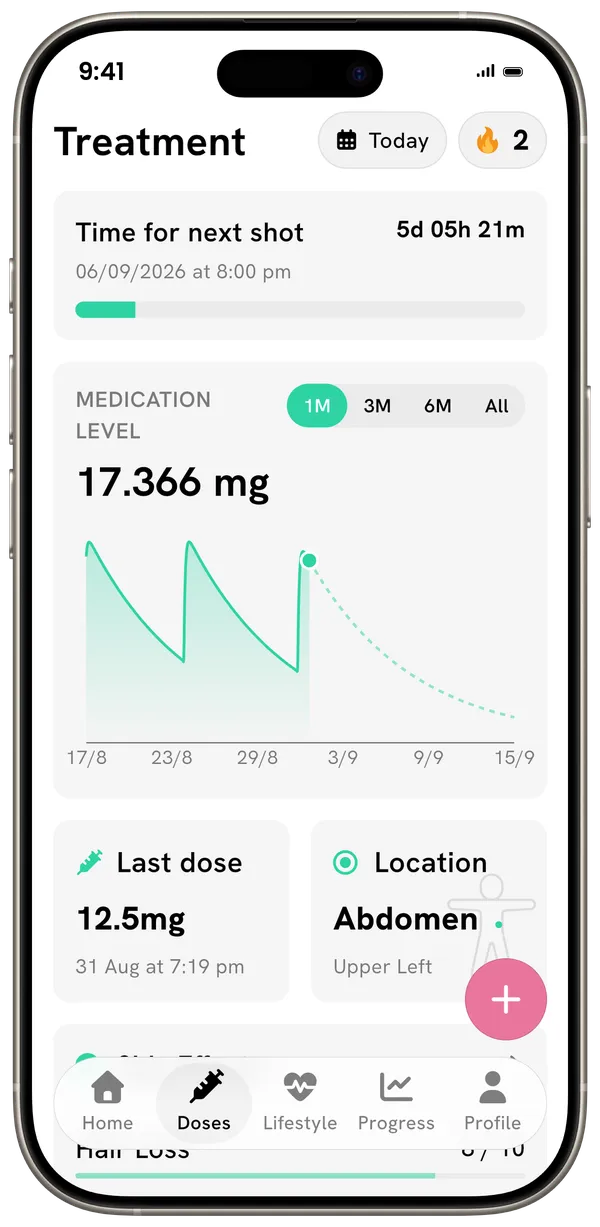
Track it next to your doses
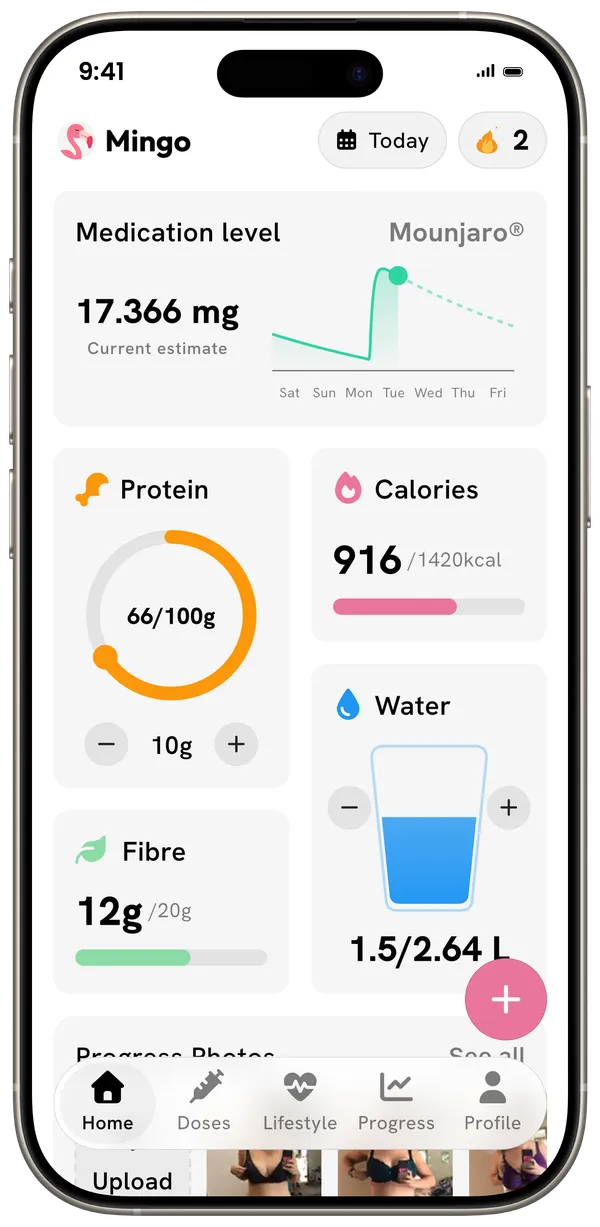
In the Mingo app, these same two goals are set during onboarding. Water logs against the daily goal, with reminders if you haven’t logged any; fiber shows up in each meal you log by photo, voice or barcode. Seeing both next to your doses and side effect ratings shows whether the constipation or low-water days follow your shot day or a dose increase.


