Who gives the shot changes the map
The rule people get wrong most often is the arm, and it depends on the maker and the device:
- Zepbound, Mounjaro and Trulicity (Lilly): you or someone else can inject the stomach or thigh. The back of the upper arm is for someone else to inject (Zepbound instructions). This holds for the single-dose pen, the vials and the KwikPen.
- Wegovy and Ozempic pens (Novo Nordisk): the stomach, thigh or upper arm, with no helper needed (Wegovy and Ozempic instructions).
- Wegovy and Ozempic prefilled syringes: the newer manual syringes say the back of the upper arm “only with help from someone else”.
- Saxenda and Victoza (daily, liraglutide): both list the stomach, thigh and upper arm. Saxenda’s picture shows the upper arms with no helper rule; Victoza’s instructions add “only if caregiver administered” for the arm (Saxenda and Victoza instructions).
That’s why the planner asks who gives the shot: switch to “Someone else injects me” and the arms appear on the map for every medicine.
The belly button gap
Keep at least 2 inches (5 cm) away from your belly button. The Zepbound and Mounjaro KwikPen, Wegovy pen, and Wegovy and Ozempic syringe instructions put it in words; the Zepbound single-dose pen, the Ozempic pen, Saxenda and Victoza show it in their pictures, with the injection area drawn around the belly button but not on it. On the map it’s the dashed circle. Everywhere else on the abdomen, upper or lower, left or right, is fair game.
How the planner picks your next spot
The instructions only say to use a different site each time (each week for the weekly shots, each injection for Saxenda and Victoza). They don’t give a pattern or a distance, so the planner uses a simple one:
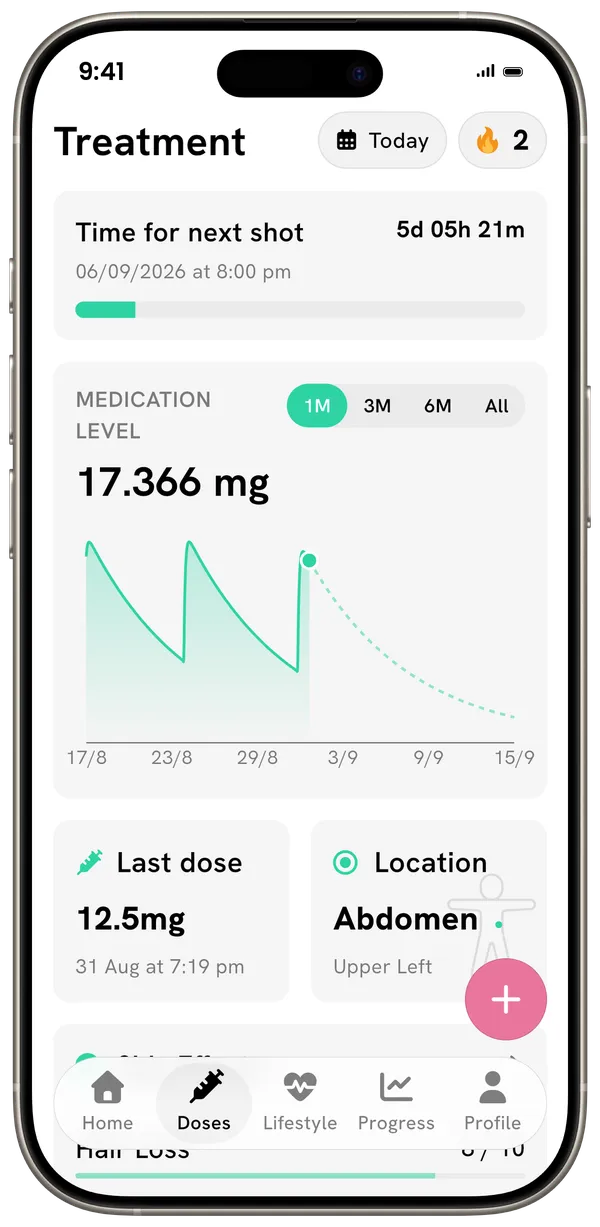
- Next shot: the same spot on the other side. Upper left abdomen last week, upper right this week. This is the same rule the Mingo app uses when it suggests where to inject.
- The weeks after: switch side and area every week, taking the spot that has waited longest, so you use every allowed spot before coming back to one.
- The two centre abdomen spots have no other side, so after one of them the planner moves you to another area.
It’s a convenience, not a medical rule. If a spot is sore, scarred or bruised, skip it and take the next one on the list.
Is one spot better than another?
For how well the medicine works, no. The prescribing information for Zepbound, Mounjaro, Wegovy and Ozempic each says that injecting in the abdomen, thigh or upper arm gives similar exposure, meaning about the same amount of medicine reaches your blood. Claims that the thigh “absorbs slower” or that the stomach “burns more belly fat” don’t come from the labels. Choose by comfort and by what you can reach.
Skin to skip
The labels say what to avoid, in slightly different words:
| Instructions | Don’t inject where the skin is |
|---|---|
| Zepbound, Mounjaro (vial instructions) | Tender, bruised, scaly or hard; scarred or damaged; pitted, thickened or lumpy |
| Wegovy pen | Tender, bruised, red or hard; scars or stretch marks |
| Ozempic, Trulicity, Saxenda, Victoza | Not listed in the instructions |
Lilly explains why rotation matters: using the same spot again and again can cause lipodystrophy (pits or thickened skin) and localized cutaneous amyloidosis (lumps under the skin), and the instructions say not to inject into skin like that. After the shot, if you see a little blood, press with gauze or a cotton ball; don’t rub.
Keeping track without a notebook
The hardest part of rotation is remembering where last week’s shot went. In Mingo you pick the site when you log a dose (left or right arm, six spots on the abdomen, inner or outer thigh). The next time you log, it shows where the last shot went and, if you’ve turned on alternating sides, suggests the other side. If you also want to know what to do when a dose slips, the missed dose calculator gives the label’s answer with your dates, and the Zepbound dosage chart lists every dose step.


