Eight targets, one set of answers
Most macro calculators stop at calories, protein, carbs and fat. On a GLP-1 medicine, the day has more to it: small meals make fiber easy to miss, less food means less water from food, and staying active helps the weight you lose be fat rather than muscle. So this calculator gives back everything the Mingo app’s plan does when you sign up:
| Target | How it’s set |
|---|---|
| Calories | Your estimated energy needs minus 750 kcal, within a minimum and a maximum, then rebuilt from your macros |
| Protein | 1.2 to 1.6 g per kg of current weight by activity level, at least 80 g |
| Fat | 27.5% of calories |
| Carbs | What’s left of the calories, between 50 and 150 g |
| Fiber | The US adequate intake for your age and sex, or 14 g per 1,000 kcal if lower, at least 20 g |
| Water | 30 to 37 mL per kg of body weight by activity level, 2 to 4 liters |
| Steps | 4,000 to 10,000 by activity level, a little lower with age |
| Exercise | 20 to 60 minutes a day by activity level, a little lower from age 50 |
Open “How we got these numbers” under your result to see each step with your own numbers in it.
How your calories are set
First, the calculator estimates how much energy your body uses at rest with the Mifflin-St Jeor equation, the one a systematic review found most often lands within 10% of measured values in both people with and without obesity (Frankenfield et al., 2005). It uses your weight, height, age and sex (Mifflin et al., 1990); if you choose other or prefer not to say, it uses the average of the male and female equations.
Then it multiplies by your activity level to estimate what you burn in a day:
| Activity level | Multiplier | Calorie maximum |
|---|---|---|
| Sedentary | 1.2 | 1,800 kcal |
| Lightly active | 1.375 | 2,000 kcal |
| Active | 1.55 | 2,200 kcal |
| Very active | 1.725 | 2,400 kcal |
From that it subtracts 750 kcal. In SURMOUNT-1, the trial behind Zepbound, everyone was counseled to eat 500 kcal a day below their needs (Jastreboff et al., 2022). Mingo uses a larger deficit because appetite is lower on these medicines, and a goal closer to what people actually eat is easier to track against. If your BMI is 22 or under, no deficit is subtracted.
Two limits keep the result in a sensible range: a minimum of 1,200 kcal a day for women, 1,500 kcal for men and 1,350 kcal for other or prefer not to say, and the maximum for your activity level in the table above.
Why protein comes first
When you lose weight, part of what you lose is lean mass, not just fat. That’s why the 2025 joint advisory from the American College of Lifestyle Medicine, the American Society for Nutrition, the Obesity Medicine Association and The Obesity Society puts protein first on GLP-1 treatment, at 1.2 to 1.6 g per kg of body weight a day during weight loss (Mozaffarian et al., 2025).
The calculator sets protein before anything else: 1.2 g/kg if you’re sedentary, up to 1.6 g/kg if you’re very active, never below 80 g, with a cap for each activity level so a high body weight doesn’t produce a target nobody can eat. The protein calculator explains the caps and splits the target across your meals.
Fat, carbs and the final calorie number
Once protein is set, fat gets 27.5% of the calories and carbs get what’s left, with two limits:
- Carbs stop at 150 g a day. If the calories left over would allow more, carbs stay at 150 g and fat is recalculated to remain 27.5% of the new, smaller total. The calorie goal you see is then the sum of protein, fat and carbs, so for many people it ends up a few hundred kcal below their energy needs minus 750.
- The minimum still holds. If the sum comes in under the minimum for your sex, carbs are raised (up to 200 g, then fat) until it’s reached.
That’s why the calorie goal and the macros always add up exactly, and why your number can be lower than a generic macro calculator gives you. If it feels too low to sustain, or you’re losing faster than your prescriber expects, raise it: the goal is there to track against, not a prescription.
Fiber and water
Fiber starts from the US adequate intake: 25 g a day for women and 38 g for men up to age 50, and 21 g and 30 g after that (Institute of Medicine, 2005). Those intakes are based on 14 g per 1,000 kcal eaten, so on a smaller calorie budget the calculator uses 14 g per 1,000 kcal of your goal instead, whichever is lower, and never less than 20 g. If you choose other or prefer not to say, it uses the male values.
Water is 30 mL per kg of body weight if you’re sedentary, rising to 37 mL per kg if you’re very active, kept between 2 and 4 liters a day. For comparison, the National Academies put typical total water at about 2.7 liters a day for women and 3.7 liters for men, with about 20% of it coming from food (Institute of Medicine, 2005). Eating less food means less of that 20%, which is one reason to keep an eye on what you drink.
Steps and exercise
The steps goal starts at 4,000 a day if you’re sedentary and goes up to 10,000 if you’re very active. It’s lowered a little from age 30 and more from 65, and rounded to the nearest 250. In a meta-analysis of 15 studies, more daily steps went with lower mortality up to about 6,000 to 8,000 steps a day in adults 60 and older and 8,000 to 10,000 in younger adults (Paluch et al., 2022), so the goals sit at or below those levels, where most of the benefit is.
Exercise starts at 20 minutes a day if you’re sedentary and goes up to 60 if you’re very active, a little lower from age 50. The US guidelines recommend at least 150 minutes of moderate activity a week, about 21 minutes a day, plus muscle-strengthening activities at least two days a week (Physical Activity Guidelines for Americans, 2018). Strength training matters more than usual when you’re losing weight fast and want to keep your muscle.
What this calculator doesn’t do
- It doesn’t change with your medicine or dose. We haven’t found guidance that sets calories or macros by GLP-1 dose, so we don’t pretend to.
- It isn’t for everyone. Kidney disease, pregnancy or breastfeeding, type 1 diabetes, an eating disorder, or a medical diet from your care team: their targets come first.
- It doesn’t update itself. Your targets depend on your current weight; recalculate as it changes. The dose charts explain the separate question of what the labels allow when a dose is hard to tolerate, for example the semaglutide dosage chart.
- It isn’t a meal plan. It gives you numbers to aim for; a dietitian can look at what you actually eat.
Track the eight goals every day
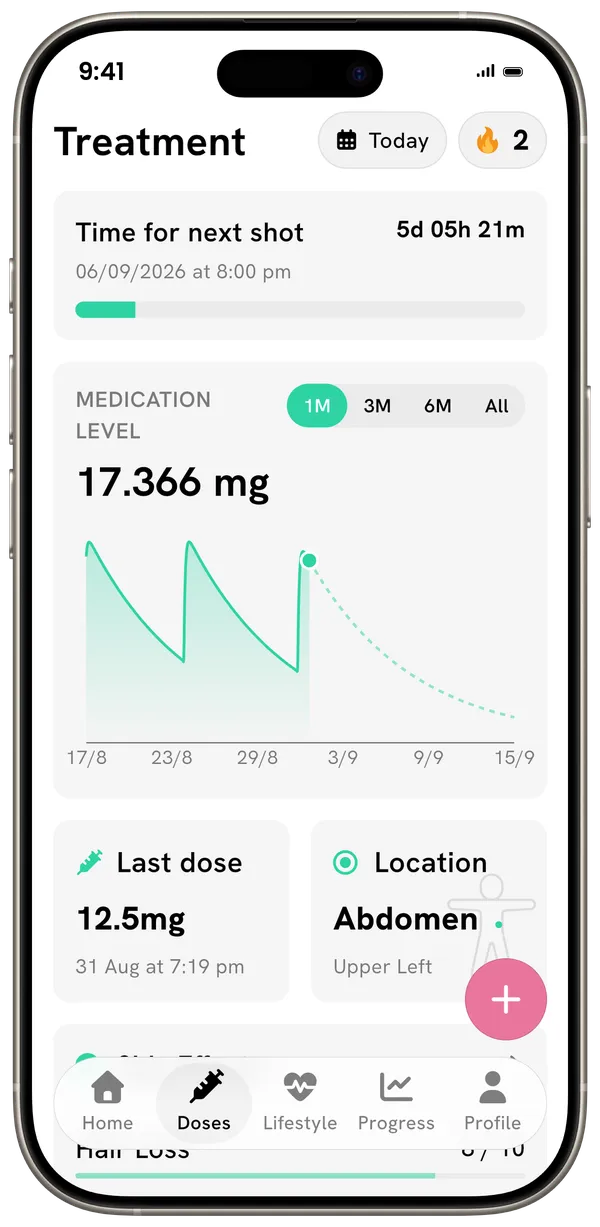
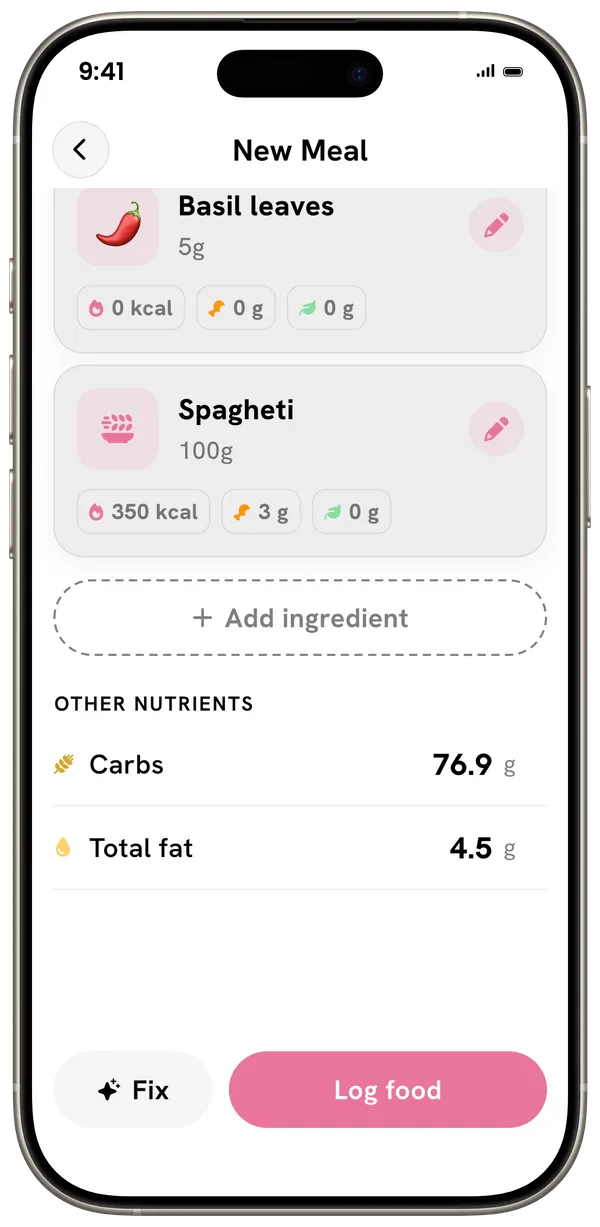
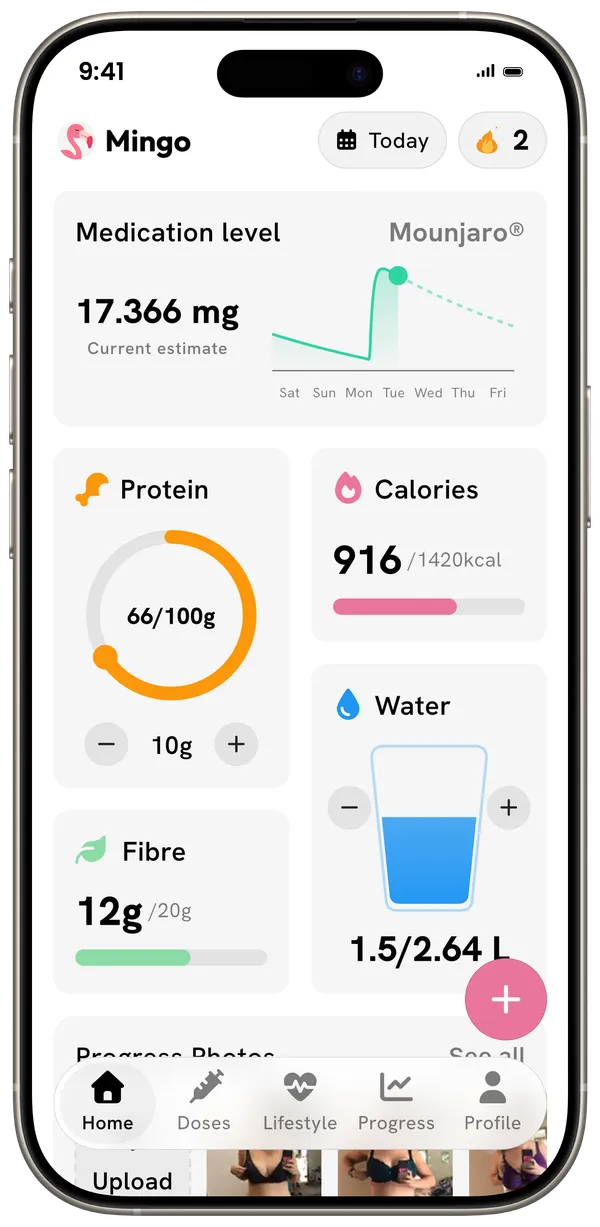
The Mingo app sets these same eight goals when you sign up. You log meals by photo, voice, text or barcode, and the app shows your calories, protein, carbs, fat, fiber and water against them, next to your steps, workouts, doses, side effects and weight. You can change any goal at any time, so if your prescriber or dietitian gives you different numbers, use theirs.


