What the labels say about timing
For the weekly GLP-1 shots, the rules about timing are generous. The US labels for Ozempic, Wegovy, Mounjaro and Zepbound say to take the shot once a week, on the same day, at any time of day, with or without meals. None of them names a best day.
So the honest answer to “what’s the best day?” is the day you’ll actually keep. People tend to choose in one of three ways:
- Routine first. A day with a fixed rhythm, like Sunday evening, is hard to forget.
- Side effects first. If the first day or two after a shot brings nausea or tiredness, some people pick a day so those land on a weekend or a quiet stretch.
- Appetite first. If one day of the week is always harder, such as Friday nights out or the weekend at home, some people want the medicine working hardest then.
Mingo’s suggestion is built for the third approach.
Morning or night?
The labels allow either, and no study has shown that the hour changes how well the medicine works. What the hour can change is how the first day feels and how easy the shot is to remember. A few practical ways people decide:
| If this sounds like you | A time that often fits |
|---|---|
| Nausea or tiredness tends to show up in the first hours | Evening, so some of it happens while you sleep |
| You forget things once the day gets busy | Morning, tied to something you already do, like coffee |
| Your schedule changes a lot week to week | The same evening slot, with a reminder set in Mingo |
| You travel across time zones | Keep the same weekday where you are, and check spacing with your pharmacist |
None of this is a rule. If your first choice doesn’t suit you, change the hour on your usual day; that doesn’t change your schedule.
How Mingo suggests a shot day
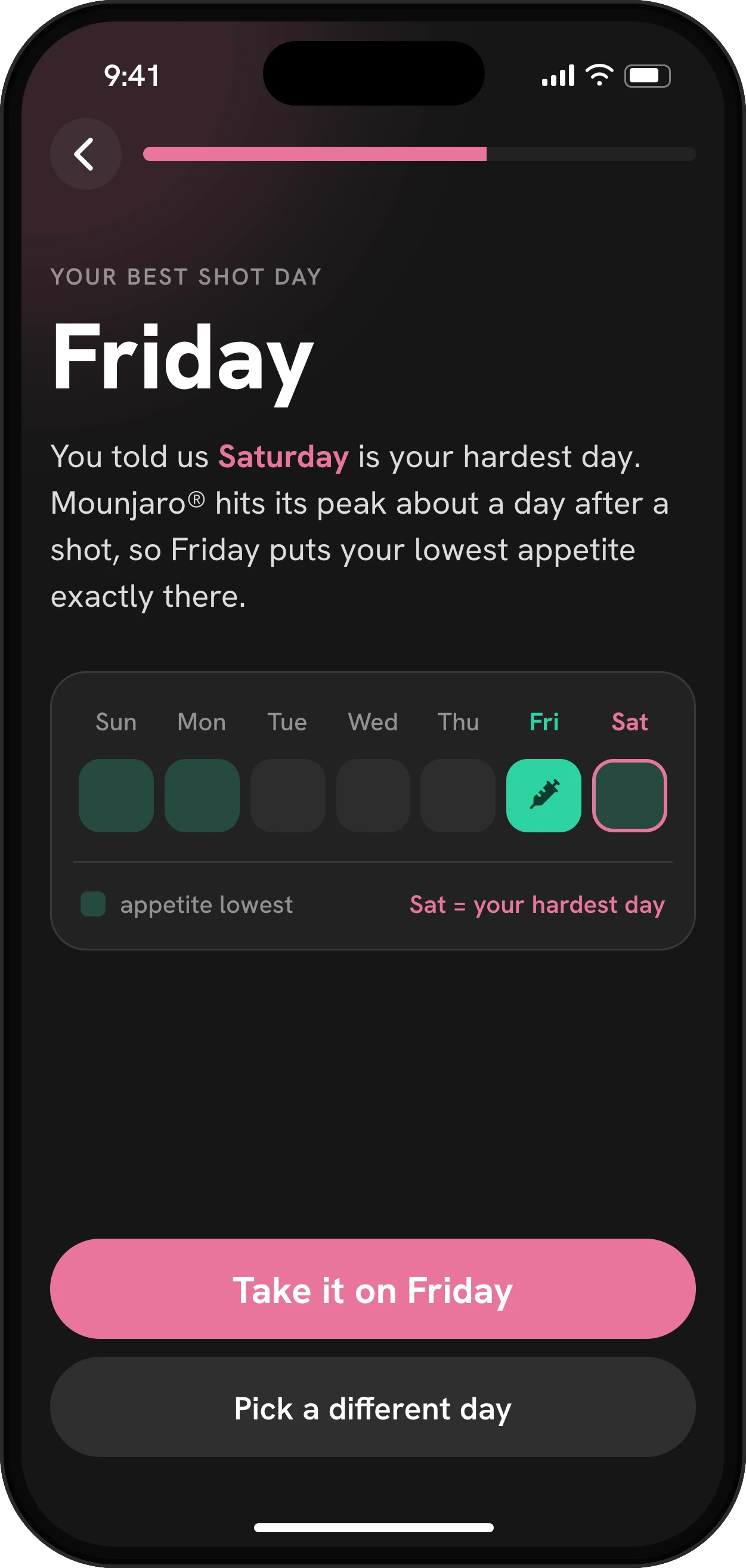
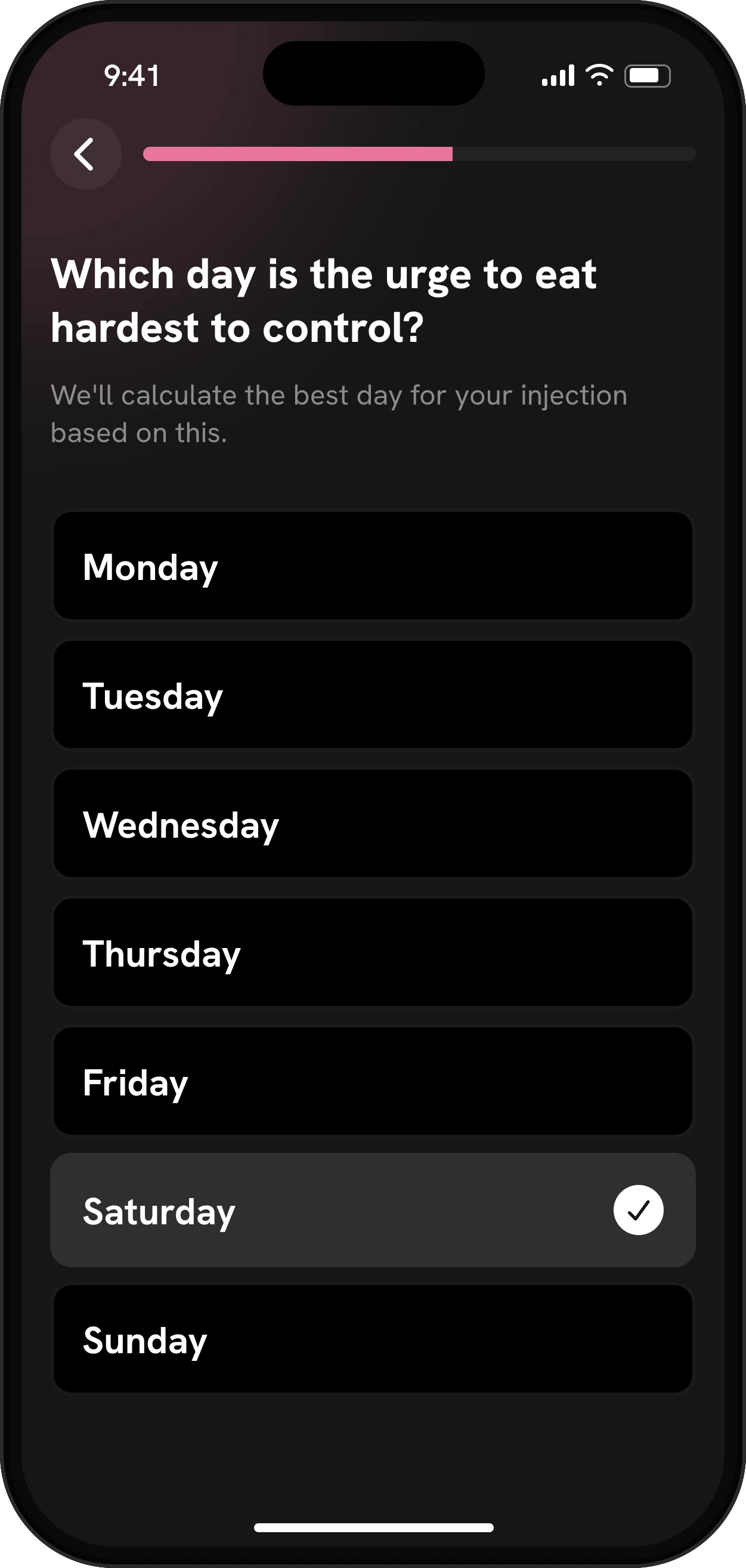
When you set up Mingo, it asks one question: which day is the urge to eat hardest to control? Then it does the math for your medicine.
- It models one dose. Using your medicine’s published half-life and time to peak, it draws how the estimated level rises and fades over the week after a shot. This is the same model behind the medication level chart.
- It scores waking hours only. Each day is scored from 8 a.m. to 10 p.m., assuming an evening shot. Hunger is a waking problem, so night hours don’t count.
- It finds the lead time. It works out how many days after a shot the estimated level is highest across your waking hours.
- It counts back from your hardest day. The suggested shot day is your hardest day minus that lead time.
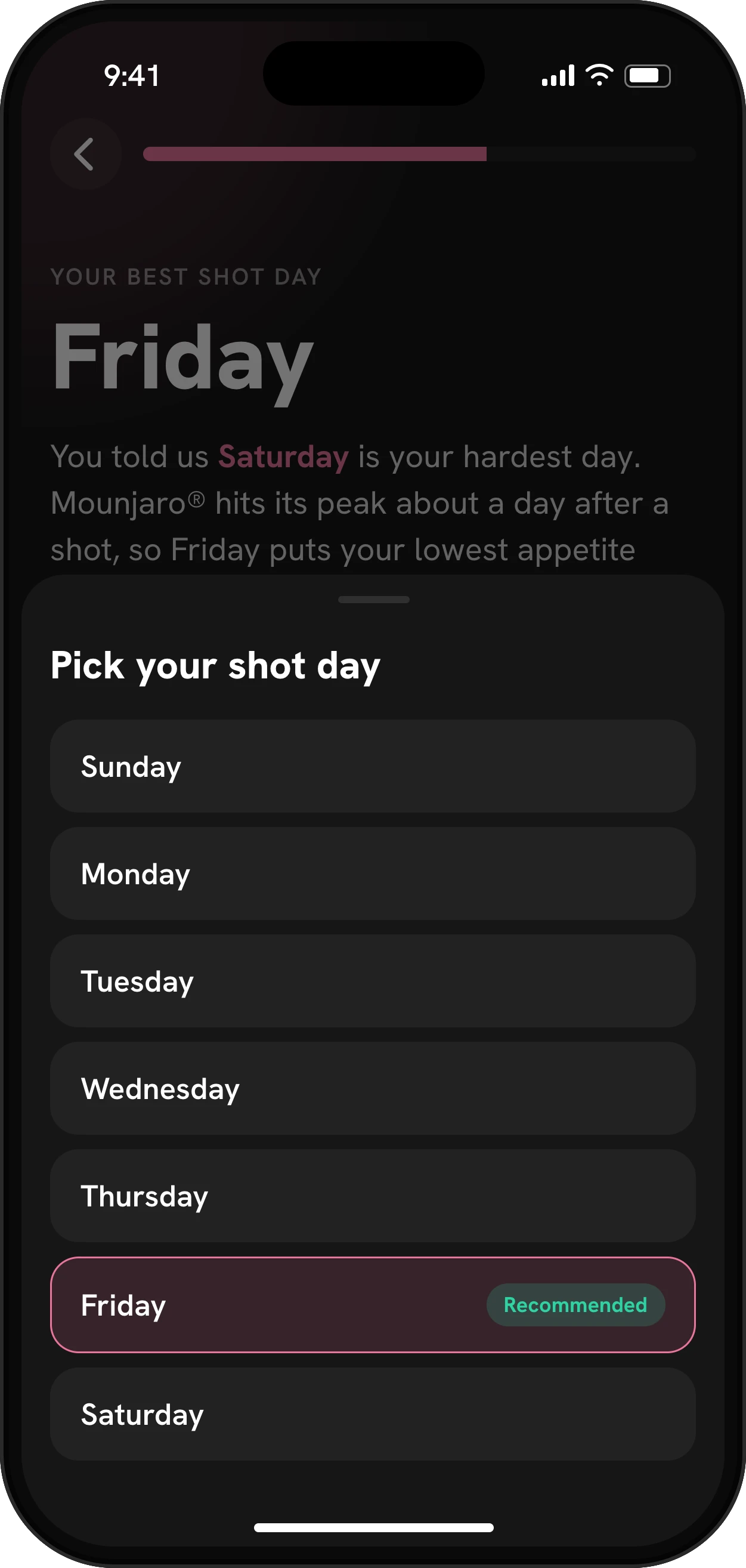
For semaglutide, tirzepatide and dulaglutide, the lead comes out as one day, so the suggestion is the evening before your hardest day. For a shorter-acting medicine, the answer can be the same day. The screen shows your week as a chart, with the hardest day and the days of steadier appetite marked, and a button to take the suggested day or pick another.
The idea behind it is that GLP-1 medicines reduce appetite: in a 20-week trial of semaglutide 2.4 mg in 72 adults with obesity, people ate 35% less at an all-you-can-eat lunch than on placebo, and reported less hunger and fewer, weaker food cravings (Friedrichsen et al., 2021). Whether timing your shot around a hard day helps you is less certain, because no study has tested it. Treat the suggestion as a sensible starting point and watch how your weeks feel.
Changing your shot day safely
If you’re already on a schedule and want to move it, the labels set a minimum gap between two doses: at least 2 days (48 hours) for Ozempic and Wegovy, and at least 3 days (72 hours) for Mounjaro, Zepbound and Trulicity. After the switch, keep to the new day each week. Ask your prescriber first, especially during a dose step. Our dose schedule calculator lays out your next dates, and the missed dose calculator helps if a shot slips.
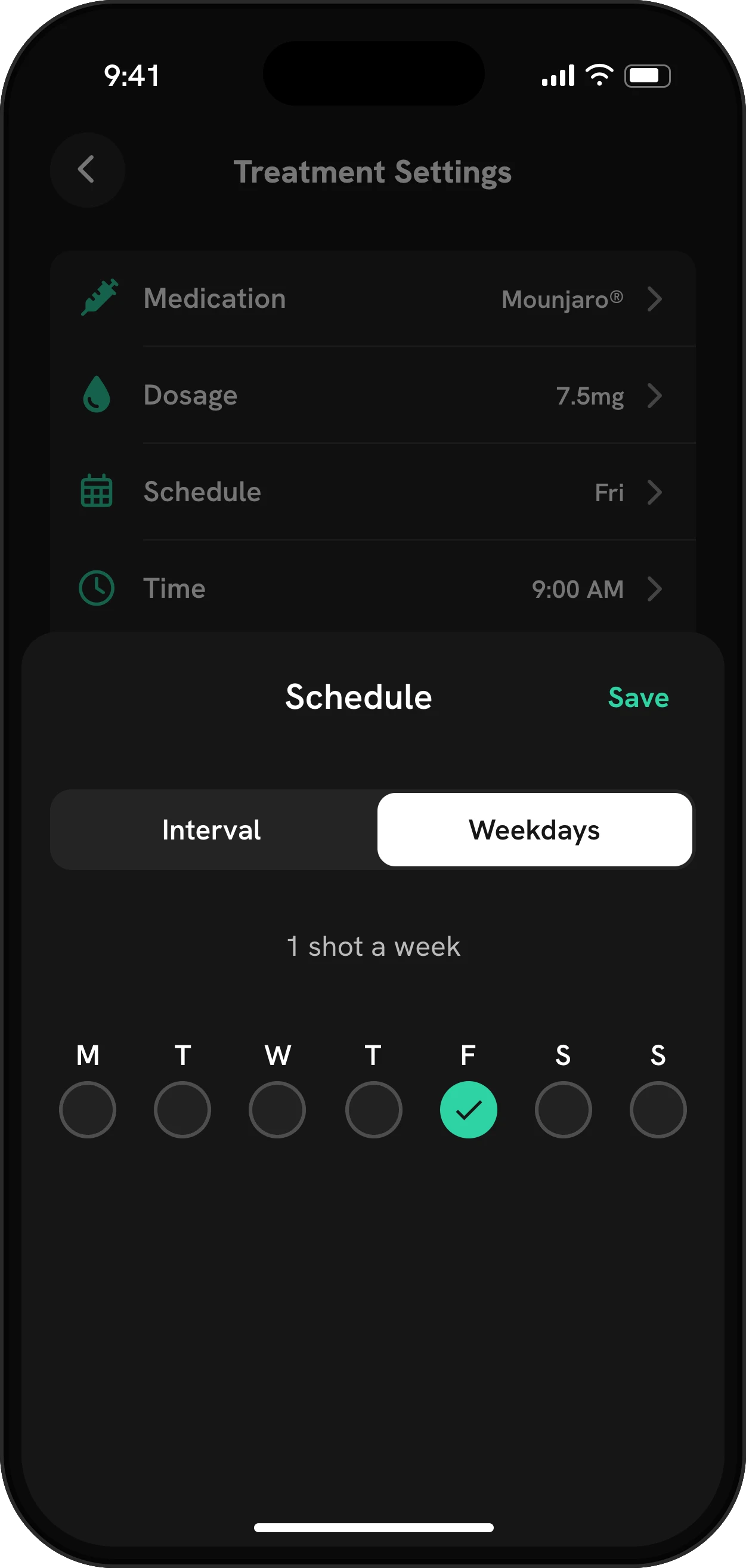
In Mingo, change the weekday in your schedule and your dose reminders move with it.
Checking whether your day works
After a few weeks, look back. Log cravings or food noise as a side effect with a severity, and Mingo charts it against your estimated level. If your hardest day is still hard, that’s useful to bring to your appointment. Our five-question food noise check is another way to put a number on it.
The shot day is one part of the GLP-1 shot tracker, alongside your dose history, injection sites and reminders.

